Showing posts with label Mason County 2016. Show all posts

Wednesday, December 21, 2016

Revis Hill Prairie Video


I did a few videos this year, and I thought this might be able to stand out on its own.  I did a video of the sights at Revis Hill Prairie in October, especially a certain little orchid...

Also, I know I'm saying Revis like it's spelled Reavis. I have since learned that this is incorrect.


(For full size click the link below)

https://youtu.be/0bSCdsNO96A

Saturday, November 26, 2016

Top Sixteen Adventures of 2016

(Next year's list is "Top Seventeen Adventures of 2017", obviously.  2038 will get rather tiresome, I suspect, provided I'm still writing this blog by then!)

God has blessed me so much this year, and I've been able to participate in and see so many amazing sights and wonders.  If you're new to this blog and want to catch up on the most relevant parts of this blog, read on.  If you are an old reader of this blog, read on to see what I've ranked as what.  If you went on one of these trips with me, thanks for putting up with all my nonsense and for going along with me, because that really made my days.  If you've never been on a trip with me, sign ups are in the comments section below:)

By the way, I do know that we have a month to go, but I doubt I'll see anything in December that will be put on this list. December is such a busy month that I'm not likely to be able to do anything during it.  If I do have a surprisingly amazing adventure, it will be on next year's list.


16.  Electroshocking- Honestly, getting to go out and do this was great.  I caught more fish in this one outing than I ever have in my entire life, and I got to do it as part of a wonderful class.


15.  Being detained as a terrorist -This is one of my favorite stories to tell people, as an introduction to my life.  It probably shouldn't be, but it was quite exciting, even if that title is basically the punchline of the story.  Additionally, I got to hang out with my brother, something which I'm growing to appreciate a little bit more each year.  He actually took the photo above.


14.  Exploring Carpenter Park with Dan and Jesse-  There were so many toads, a few lifer plants, and just great times with great friends.


13.  Twenty-Three Smallmouth Salamanders in Lick Creek Wildlife Area - What's better than a Smallmouth Salamander?  How about finding twenty-three of them in about an hour of searching?


12. The Great Northern Expedition- If you can't tell, I have some of my best trips with my dad.  He put up with a lot on this day, and we had a great time, especially late in the day at Nachusa.


11.  Exploring Lick Creek Wildlife Area with Dan and Jesse-  This was the first trip we did as a group, and the three hikes I went on with those two are among the best  I've been on.  All trips are better when taken with friends, especially friends who appreciate nature, but who can also drag you out of it for a random conversation about philosophical topics and general nonsense.  This is especially good when you're exploring someplace you've never been before.


10.  The Ides of March - First Common Loon and Western Chorus Frogs, two of the best new birds and frogs I've seen this year.  Overall, it was a wonderful day, and I enjoyed it quite a bit, so much so that I split it into two blogposts. Links are here and here.


9.  Michigan Canoe trip-  My shoes may never smell the same way ever again, I may have fallen out of the canoe twice, and my sunglasses have never reappeared since, but this was awesome.  Next time, though, I'm going to get a little more prepared!


8. Seeing 14-plus duck species in Center Park-  If Northern Harriers drew me into birding, this expedition capped it off!  I got to see just about half of all Illinois duck species at once!  Links for both sections are here and here.


7.   Going to Revis Hill Prairie and Scrub Oak- Sand Prairie with Dan-
It was a difficult hike, but a great trip to two of the wildest spots in Central Illinois, and even better because I brought a friend along for the struggle. Several new plants and many strange insects awaited us in these, the absolute wildest of Central Illinois natural areas.


6. Going to Southern Illinois with the Environmental Club-  This trip had orchids, salamanders, friends, and grand adventures.  Plus, I got to see a Logperch! (It's a fish). Unfortunately, we didn't find any of the scorpions, copperheads, or anything else scary or dangerous (other than the heights at Fults Hill Prairie).  Still, there's always next time!  Links for both sections are here and here.


5.  First winter trip to Nipper-  This single trip got me into birding big-time (to the point where I say birding instead of birdwatching).  A single Northern Harrier along the road ended up becoming a hobby which I have spent countless hours doing this year. I also met people I didn't know who read my blog, and that was back in January!  Honestly, sometimes I forget how many people read this blog, and who all that might be.  And, I got to do this all with my dad!


4.  Going up to Mason County for the first time-  That was a long, lonely trip, but there were so many new  birds and experiences I had that I will never forget.  I saw the rarest lifeform of the year there, the Tennessee Milkvetch, and I found a large number of nature preserves only an hour or so from my house, with tons of exciting plants and animals.  The wild sandlands of Illinois are the best.  Links for the three sections are here, there, and ere.


3.  Going up to Chautauqua and Emiquon with Jesse and Dan-  Trips are always best with friends, especially when we debate philosophical concepts while watching sandpipers on a levee in the middle of a mild thunderstorm.  Trust me, it's an invigorating experience, and one which brought me plenty of lifer shorebirds and great memories with friends, as well as an interesting experience in accidental trespassing which I hope no future employer sees as a reason to not hire me...
Links for both sections are here and there.


2.   Going to Indiana Dunes- Five Orchids in one day! I've seen seven this year, and as it's November I am unlikely to see any more.  Roughly a quarter to a third of the lifer plants this year were seen on this trip, including a plurality of the best ones.  And, as with several of my favorite trips, I got to go on this with Dad.  Links for all four sections are here, there, and also here, and everywhere.


1.  Surviving this year-  Thanks to God for my survival this year.  Considering this is a website open to the internet and the general public, I don't plan on sharing all that's happened to me over the course of this year.  I will say that a close family member suffered from a serious disease.  They are completely fine now, (again-  Thank you, God!)  but between that and the usual hassles that come with being a full-time student, it's been a rather... interesting... year.  At the same time, I've gained so many good friends... too many to list! (And besides that, half of them are all named Josh, Jesse, Dan, Logan, or Jake- It would get confusing:)  I've been so many wonderful places and seen so many wondrous creatures.  I really look forwards to next year!

P.S.  Some of the older posts have egregious errors.  Rather than redacting them, I've decided to leave them in, mostly because I'm lazy, but also because I think it's fascinating to see how much the tone has changed from month to month and year to year on this blog.  My apologies for any incorrect information.  Also, there may be photos taken by other people.  Other than ones taken from state websites, I will be removing those for copyright reasons, albeit slowly over the next month.

Friday, November 18, 2016

I Forgot This Completely!- Sand Prairie- Scrub Oak State Natural Area


Hey, remember when I went to Revis Hill Prairie?  I completely forgot to write up the first part of that day, when Dan and I visited Sand Prairie-Scrub Oak State Natural Area in June.  Granted, shortly thereafter I went to Indiana Dunes, etc. so my forgetting this trip isn't exactly surprising.  Also, this preserve has the most boring name of any preserve in the IDNR system.


Despite the drab name, drab location (the corner of two roads in the middle of southern Mason county) and drab initial appearance, this place has a bit of life to it.  Milkweed, for instance, was everywhere, especially Common Milkweed (Asclepias syriaca).


As  far as we could look from this one little corner of the preserve, it stretched out for miles.  This is a huge place, and it could easily take days to explore it all.  We opted for exploring one small corner instead, the northeast corner, where one of Illinois' largest milkweed patches can be found.


Since it was late June, prairie birds like this Dickcissel (Spiza americana) were still calling out and about.  Far louder were the Bobwhites calling from the treeline, though they quieted and fled as we approached, and thus we never saw any of those quail.


There are very few places where  Milkweed stretches out to the horizon.  For all this, there was a surprisingly small number of butterflies, probably because the flowers had just opened recently.


We did find this strange leafhopper, but it, like many other bugs, chose to be out of focus.


Some unknown member of the mint family and Common Milkweed made for a decent spectacle, even though despite the good rains we had had that spring, the grasses were already brown and dry.  Sand prairie holds little moisture, and subsequent drive-bys found the area browner and browner.


Among the dense dry vegetation, I found these Dodder (Cuscuta sp.) stems.  This parasite is fairly common in healthy prairies, it seems.  Another sign of healthy prairie is this:


This blurry butterfly is the state-threatened Regal Fritillary (Speyeria idalia), one of the rarest butterflies east of the Mississippi.  Illinois has the largest intact populations on this side of the Mississippi. Regal Fritillaries are a prairie butterfly seen only rarely outsides of healthy prairies. They are one of a handful of insects that receive state protection. Several other rare and protected insects also live here, including the Prairie Walkingstick, but we didn't see any of those, I believe.


A few more butterflies showed up, including this unidentified one.  However, none stayed in focus.


I went back to landscape photography instead, until I came across a new plant or two:


Above is Clasping Milkweed (Asclepias amplexicaulis), already out of flower even in June.  This is a sand-loving milkweed far more common here in Mason County than in most of Central Illinois.


The terrain opened up a bit as we went along, with small patches of the sandy soil showing through.


Far off in the distance, I could see small songbirds calling, so I cranked up my zoom:


We found Grasshopper Sparrows (Ammodramus savannarum), a shy, dry prairie denizen rarely seen outside of springtime, when they are busily calling.


Another resident of dry places was this Eastern Prickly Pear (Opuntia humifusa), a plant amazingly common in Mason County, and in bud here.  Ironically, only the day before I had seen several, just after a rain, in full amazing bloom.  Perhaps the rain triggered the bloom.


British Soldiers (Cladonia cristatella) lichens are fairly common here, growing where nothing else will.  Lichens grow in the most extreme environments, including here.


A couple of Six-lined Racerunner lizards vanished into the bush, living up to their name quite well.  As a result, I went back again to landscape photos of a place that has changed little since pioneer times.  The prairies here are enormous.  If you wanted to film a movie here, (other than the habitat disturbance that would invariably result) it would be a great backdrop for a Western.


While musing on this, we dropped back along one of the roads, where I found this Slender Dayflower (Commelina erecta), the native relative of a fairly common weed.  Unlike its Asiatic cousin, [A] Slender Dayflower grows in dry sandy areas and [B] I had never seen this native plant before.


We  made it back to the car, and driving down the road south a minute, we came to a spot with tons of wildflowers.  Stopping here, I found a fern, Ebony Spleenwort (Asplenium platyneuron).


There were a fair number of insects here, too, including this grasshopper.


A third species of Milkweed, this Butterfly Weed (Asclepias tuberosa) was the reason we had stopped, as its bright colors are well worth stopping to see.  This plant is yet another one far more common in the sandlands of Mason County than in most of the rest of Central Illinois.


After this, we did a tick check on the road.  While we hadn't picked up too much in the prairie, here on the side of the road we each had gotten half a dozen ticks on our clothes, including one Lone Star Tick, a dreadful animal that can cause permanent red meat allergies if it bites down on you for long enough.  I wish I was kidding, but I'm not.  Read here for more information.  Thankfully, the Lone Star Tick wasn't on me, it was on Dan.  Also thankfully, my friend Dan is a vegetarian.


We stopped at a small lot covered in flowers, where we took in the view.  We were halfway to Revis at this point, and it is here, among the Soapwort (Saponaria officinalis) above and Hoary Vervain (Verbena stricta) below, that I will end this brief forgotten journey in Mason County.  If you want to read the rest of the adventure, travel back in time (sort of) and click here.


Sunday, October 23, 2016

Ducks, Hawks, and ORCHIDS?- Mason County/Emiquon (Yet Again)


If  there's one natural area I love to visit on a semi-regular basis, that is Revis Hill Prairie in Mason County.  I always see something new, no matter when I go. (My regular readers know this, because they've been reading about it since the last days of June.)  I decided, one recent Saturday afternoon, to run up to Mason County and see what I could find.  It would turn out that I found quite a bit!


The populations of burrowing wasps had gone down, but I still found this colorful fellow among the sand and gravel of the path.  I have no clue what species it is, but it certainly is vibrant.


The hill prairies give way below to harvested crop fields, stretching out to the Sangamon River's floodplain forests beyond. The prairie itself, dry and crunching under my feet, cloaked the hill in tan grasses.  This particular section is just west of the big house on the north side of the road.


I don't know what dug this burrow (possibly Pocket Gophers), but I suspect that it'd be a good place to find snakes hiding.  I didn't see any, and I haven't seen any in the last two months, but nevertheless I still suspect this of being an excellent hiding spot for snakes.


Several different asters. including this Heath Aster (Symphyotrichum ericoides) bloomed among the grasses.  Asters have recently been moved taxonomically from genus Aster to the six-syllable lockjaw of Symphotrichium, at the behest of some taxonomists.  I prefer the simplicity of the name Aster, and while the taxonomists may have had good reasons, I wish they would have used a simpler word.


As  usual, however, the best part of Revis Hill Prairie is the views.  While it may not be the most easily accessible spot, Revis has spectacular scenery.  Even the road at its base has a good view of the lands to to the south.  It's somewhat a pity that it's all farm-fields.  If it was restored prairie, this would be even better than it is now.


By the way, I do reserve the rights to all images.


I went to the meadow on the far side of the big house on the north side (the main landmark here).  This is the one with the exposed loess (windblown dirt) cliff:


 After getting through the thorny brush at the base on a faint, barely-visible trail, I pulled my way up the hill, hand and foot.  Why, might you ask, had I come to this high, lonely hill?


For once, it's not a bird!  Here it is:


This is the Great Plains Ladies' Tresses Orchid (Spiranthes magnicamporum).  Most people associate orchids with the tropics, and the majority do grow in wet tropical rainforests, often in trees.  This species is a contrarian of the orchid family.  Growing in dry, short grasslands in temperate areas, the Great Plains Ladies' Tresses Orchid is one of Illinois's more common orchids, although that means it's still a rare find.  Look for them in dry, short areas or along paths in old relict prairies and fields.


One of the last plants to bloom, these can bloom well into November (and, based on the weather this year, these might). I found three of them after about ten minutes of searching, and I'm sure there were more hidden nearby.  They're only about six inches high, so finding them is a struggle.  However, for a plant lover like me, any orchid, especially in Illinois, is worth the work.


For comparison, here's the path I found them along.  I've read the opinion that orchids, like people, choose the most beautiful spots to reside, and that seems true in this case:


 These orchids, if you smell them, have a strong, pleasant fragrance.  However, please don't pick them.  Here at Revis, they are legally protected, but even elsewhere, any species of orchid is rare enough in Illinois that it should be protected.


While many have thought that I'm mostly a birdwatcher (and that seems true if you look at the past six months)  I can assure you that plants are my first interest.  I've just seen most of the common ones, and I haven't done that as much with birds before this year.


After several minutes, I looked back around, and appreciated the view once more, before making my way down the bank and back to my car.  There's no easy way up or down here.  It's all a scramble up and a controlled fall back down into the brush and then through the brush to my car.


Alright, now it's duck time.  I went on from here to Emiquon Preserve in Fulton County, a much less strenuous place for nature excursions, provided you don't accidentally trespass.


Thousands of ducks and coots congregated at the marsh on the southern end of Emiquon's Lake Thompson, with a few Great Egrets (Ardea alba) striding amongst them.


Well off, and distorted by the humidity, I spotted a few Northern Pintails (Anas acuta), noted for their brown heads, white necks, and identifiable pointed tails.  I had only ever seen one in the wild before.  Other birds identified in the foreground are Northern Shovelor (Anas clyptea) and American Coot (Fulica americana), both far more common this day than the Northern Pintails.


Intermixed with all of these were large flocks of Blue and Green -winged Teals (Anas discors) (Anas carolinensis), especially Green-winged Teal.


Behind all of these, where the marsh opened onto the lake, were thousands of American Coots.  I believe there were several thousand at a minimum on this lake on this single day!


Moving further up, I spotted some American White Pelicans (Pelecanus erythrorhynchos)  For only having seventy-odd nesting sites  in the world, these big birds do seem to get about during migration!


I then decided to hike the reopened pathway show on this map below:


I spotted a few Red-winged Blackbirds (Agelaius phoeniceus) in the trees on my way:


In the lake, a few Northern Shovelers lazily watched me, slowly drifting a bit further out into the water as I approached.


The Blue-winged Teal disdained my company and departed for other waters:


At the top bend in the trail, the lake opened up in front of me, and all I could see was coots!


On shore, a few hundred blackbirds called from the bushes.


The coots rose as one body as I and another walker approached.  He came to them faster and closer than I did, so they were spooked and took off, as did most birds after that.


Nearby, a number of Green-winged Teals and Northern Pintails foraged, far enough away that they didn't seem to be bothered by any walkers.


The other man's walking did disturb this Killdeer (Charadrius vociferus) and Calidris sp. sandpiper before I could get better photos.  I think this is a Least Sandpiper, but that is uncertain.


Thankfully, while unsuccessfully trying to locate the sandpipers, I found something watching me, which the other walker had not disturbed:

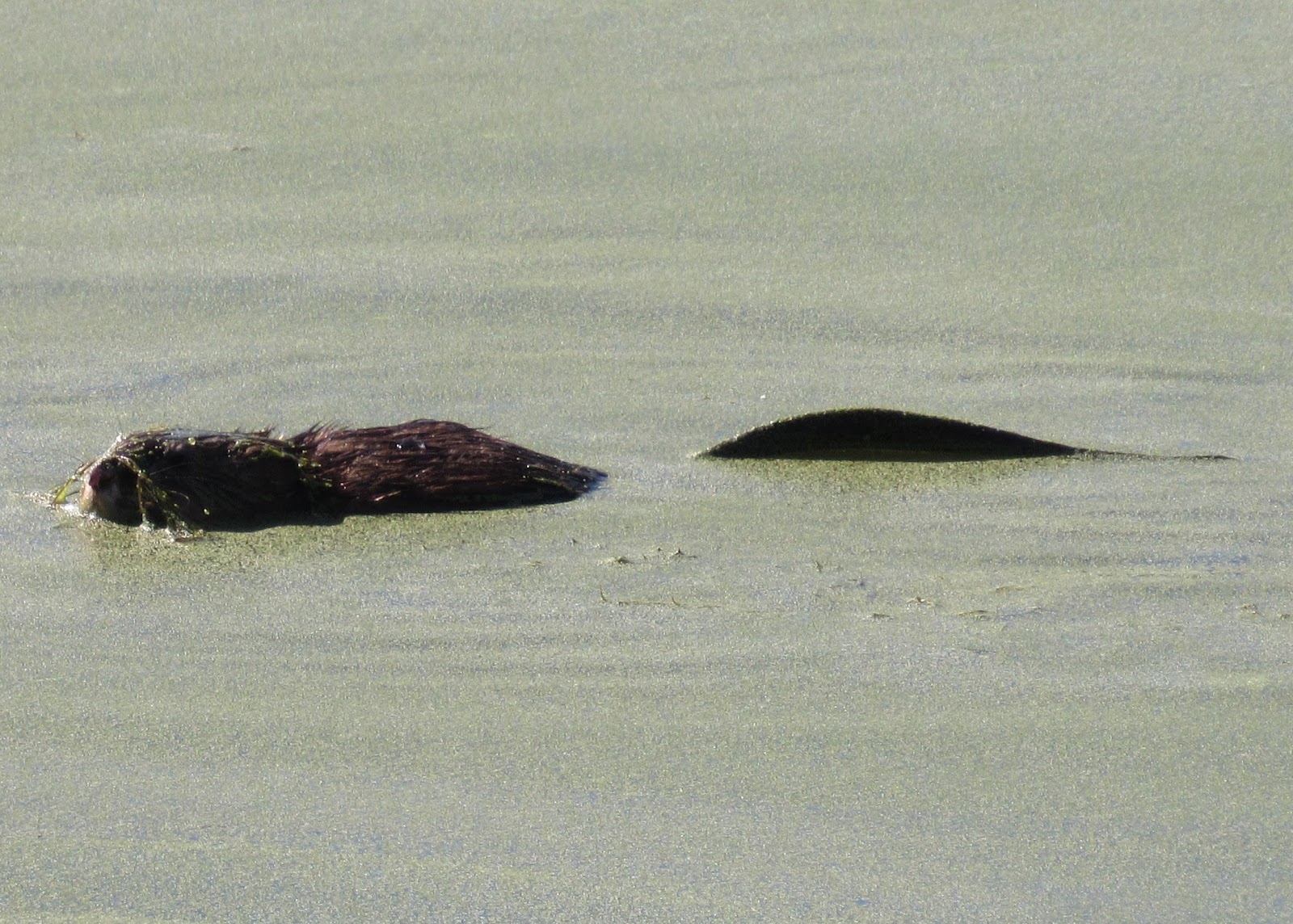
For some reason, I was about ten feet from these two Muskrats (Ondatra zibethicus) when they peeked above the water.  I have no idea why they were so close:


They vanished as quickly as they had come, but at least I had been the one to see them!


Thompson Lake, meanwhile, did not leave, and so I admired it for a bit.


A row of dead trees, used for nesting by some local birds, lingered out on the lake, relicts of a time before, when this natural area was farmland.  It was only converted into a wetland ten years ago, and with the numbers of rare or unusual birds etc. here, it wasn't a day too soon.

  I walked back by the coots again, who had clumped together:

Despite their apperance, coots are not actually ducks, but rails. Not like steel rails, but as in the group of birds known as rails for no reason I have discerned.  This is Illinois' most common rail, in fact:


Suddenly, the coots scattered as a dark shape flew overhead.  Osprey! (Pandion haliaetus)


The osprey circled around for a bit, but finding no fish, it left.  So did I.  I went on to Chautauqua, hoping for a few late shorebirds.  There were none, not even a killdeer.  The water levels had been raised, reducing habitat for shorebirds.  Furthermore, there were no large flocks of ducks on the lake, and no large flocks of pelicans like there had been previously!  It was all land birds for me.


I have no idea what this is, but it looked interesting, as it had a yellow belly.  It's probably a Phoebe.


A dark shape flew past me as I walked on the levee, and I realized that it was a Northern Harrier (Circus cyaneus), a fairly uncommon species of hawk in Central Illinois.  State-Endangered, Northern Harriers are usually prairie birds, but they move along the Illinois River wetlands during migration.


This was a juvenile, as its rusty-red/tan coloration indicated.  I tried to get a better picture, but there were too many willows and it moved too fast.  The white rump above is a clear sign of the bird's identity, as was its low flight style, just skimming over the tops of marshland bushes.


While looking around in those bushes, I stumbled upon a mysterious sparrow, which I believe is a Savannah Sparrow  (Passerculus sandwichensis) (named for Savannah, Georgia, where they were first found).  I've never seen one outside of the bird banding station before.


From disappointments at Chautauqua, I moved on to Sand Ridge State Forest.  It was too late for birds, and the sun was nearly setting as I arrived.  I popped out of the car, however, and found these puffball fungi growing on a nearby log.  A few minutes later, I called it a day, and went to leave.


Leaving was a rather complicated procedure, and I stumbled across the parking lot, where the setting sun's rays poured through the pine needles, illuminating the dust in the air:


This effect isn't a camera trick, I actually saw this with my eyes, and it was an amazing semi-ending to a mixed-bag of  a day.  The day wasn't finished yet, as I went down a road with only one lane and sandy soil for pavement as I attempted to leave.  I then took a wrong turn and ended up in Tazewell County before pulling off completely, setting up my GPS, and heading home.  Lesson learned- don't go trying new routes when your supper is on the table!