Showing posts with label Forgottonia. Show all posts

Wednesday, June 7, 2017

Finding Three Lifers in a Flooded Cornfield (Four Corners, Meredosia NWR)


The last day of May was one of the better days I've birded this year.  I was going to visit Emiquon and look for a vagrant White-faced Ibis and Western Kingbirds, but the Ibis had left and the Western Kingbirds will wait for now, since they're a breeding species. Furthermore, I couldn't find any birders to go along. So, after 17 Dunlin and two Red-necked Pharalopes were reported at Four Corners in Morgan County, I decided to go looking, as I'd never seen either species.  I started out ambling in the country, up towards Beardstown, a town to which surprisingly I've never been before.  Dickcissels (Spiza americana) (above) sang along as I went.

Evidently Beardstown has a marsh.  All I found in it was Red-winged Blackbirds (Agelaius phoeniceus) and Wood Ducks, as well as a calling Sora, not seen but heard.  A Sora is a type of rail, little birds with  tendencies to hide in marshes and make weird sounds.  Ordinarily, a Sora would be the best bird of the day, but not on this particular day...

Four Corners was the next place I stopped.  This place, south of Beardstown near Meredosia, is a series of large fluddles, or flooded fields, around a four-way intersection of two county roads.  At the time of my visit, the flooded zones were the size of small lakes, and they had been there for at least a month or two, allowing much life to grow in them.  This mixture of insects, worms, and algae was the perfect stopover for migrating shorebirds, including...


Dunlin!  These were the first lifers of the day.  Dunlin (Calidris alpina) are a fairly common shorebird, but one I'd continued to miss for some reason.  They are the long, thin-billed birds with gold backs and black bellies above.  Dunlin migrate from the edge of the Arctic Ocean, far above the Arctic Circle, all the way to the Florida Coast in the winter, and then back again.


Forster's Terns (Sterna forsteri) sat by, and a Common Tern flew off before I took this photo!  Both of those are State-endangered, because while they're very common migrants, they only rarely breed in Northeastern Illinois.


Can you spot the Red-necked Pharalope?  It's got a white belly and white cheek patch.


 I met up with Vaughn Suhling here, and we birded from about 4:45 to 7:15 PM.  These Blue-winged Teal (Anas discors) were only the tip of the iceberg when it came to birdwatching here.


About two dozen Black-necked Stilts (Himantopus mexicanus) roamed through the fields, often flying at other birds.  The Killdeer would chase off the Semipalmated Sandpipers, and the Black-necked Stilts would chase off the Killdeer.  I presume this aggression is a display of these birds defending their nests, as I've seen something similar at Emiquon.


One of my favorites were the thirty-two Black Terns (Chlidonias niger) flying overhead.  Black Terns are another Illinois State-endangered species, primarily because they nest in freshwater marshes in far Northestern Illinois- much like Forster's Terns and Common Terns.
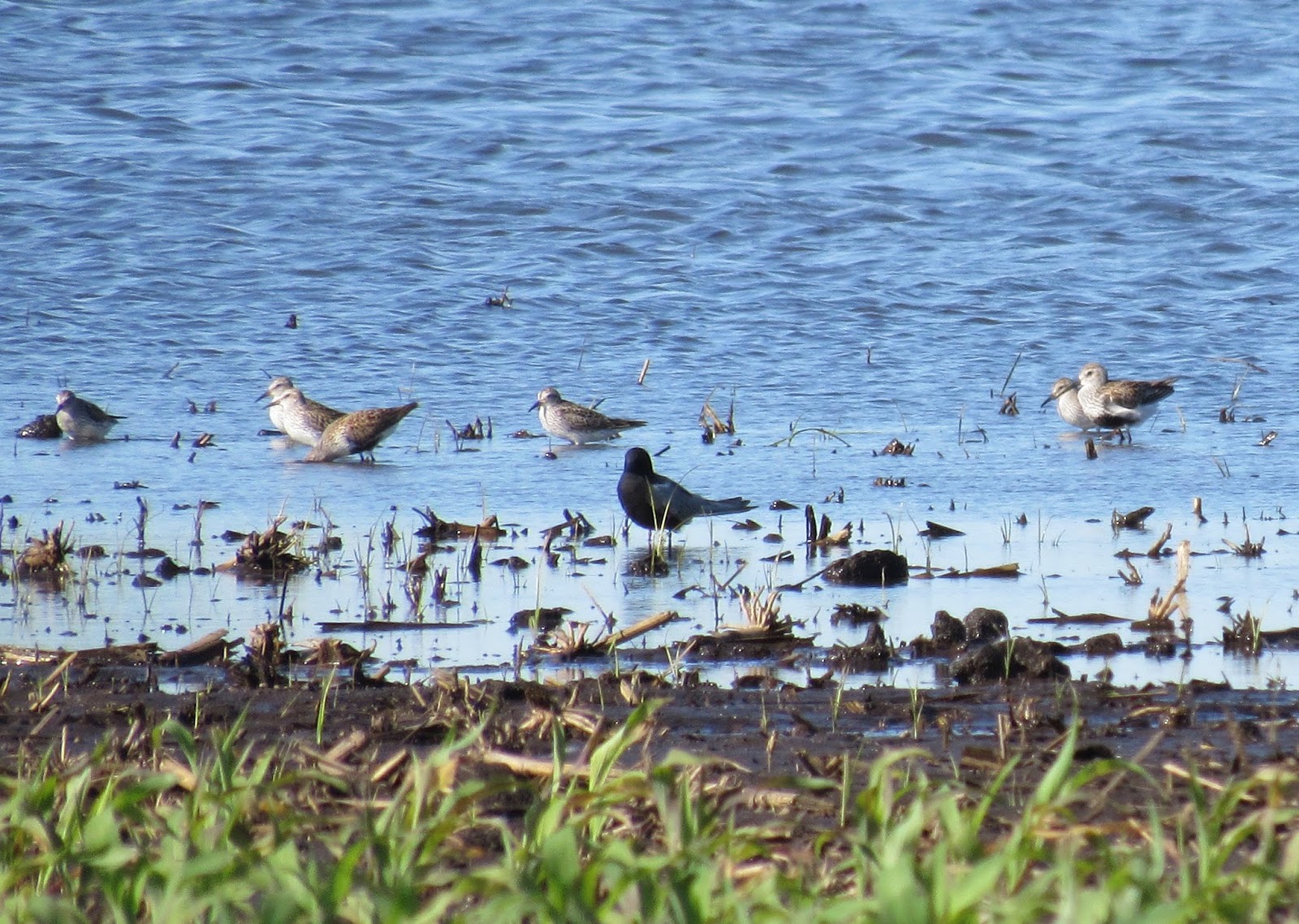

A few White-rumped Sandpipers (Calidris fuscicollis) hid among the terns on shore.  These are distingushed by having longer wings, slightly larger size, and white rumps when in flight.


Dunlin and White-rumped Sandpipers weren't the only species present. The majority were Semipalmated Sandpipers (Calidris pusilla), the small, pale, plain ones in the photo above.


 A few Stilt Sandpipers (Calidris himantopus) also hung about, including this one cleaning its feathers. They were a nice side bonus to the day.

The highlights, however, were the Phalaropes.  Phalaropes are among the oddest birds in the world.  The Red-necked Phalarope (Phalaropus lobatus)below in the center (Killdeer [Charadrius vociferus] on the left, Semipalmated Sandpiper on the right) is a female, and the females are more colorful than the males.  This is common among humans, but generally not among birds. Furthermore, Phalaropes are in the group called shorebirds, but the Red and the Red-necked Phalarope both winter out on the deep sea, eating plankton and swimming on the surface of the water, far out of sight of shore.  Odd for a SHOREbird!


 Perhaps most fascinating about this group of shorebirds is how they feed- they spin in a circle to produce a current and stir up their food.  At any rate, this was my first Red-necked Phalarope, and these aren't easy to find in Illinois during the spring, so I was quite happy!


A second one can be seen on the left side of this photo.  I watched them spin for a bit, among the many Semipalmated Sandpipers, before moving on.


Other odd birds included State-threatened Wilson's Phalaropes (Phalaropus tricolor) (right, above) and  a pair of late Northern Shovelers (Anas clypeata).  Duckwise, I saw 5 Blue-winged Teal,  the 2 late Northern Shovelers, and 2 (breeding) Hooded Mergansers, which with Mallards and Wood Ducks makes 5 species- not bad for the end of May! The photos of these birds, so far away, were obscured due to the haze of humidity from water evaporating out of these ponds.


We were briefly interrupted by the arrival of a speeder getting pulled over, and this inspired us to go looking for Common Gallinules where they breed nearby.  We found one of these state-endangered birds, among a flooded marsh/prairie with breeding Pied-billed Grebes and American Coots calling, when a Black-crowned Night Heron (Nycticorax nycticorax) showed up.  This State-endangered species is rare away from Northeastern Illinois and Emiquon, to my understanding.  I also saw a Green Heron, a Great Egret, and Great Blue Herons here.


Calling Dickcissels  were everywhere, as, deeper in the grasses, were Northern Bobwhites and Ring-necked Pheasants.  A few Indigo Buntings also sang, though I didn't get any good photos.


We then went over to the nearby Meredosia National Wildlife Refuge, looking through prairies with the bluffs above the Illinois River in the background.


A few American Goldfinches (Spinus tristis) hopped about in a field where the uncommon if uncomely Henslow's Sparrows had been seen, though we heard and saw nothing more exciting than a Grasshopper Sparrow, another little brown bird non-birders don't care about, here.


Next, we went looking for a Blue Grosbeak at another spot, just north of this.


This spot had my first Illinois Orchard Oriole (Icterus spurius), though I did recently see a few of these for the first time in Missouri, in this post here.


Last migrants, the Cedar Waxwings (Bombycilla cedrorum) are flying north, and I've seen a few hundred in the last few weeks or so, mostly at times and places it's inconvenient to record them.


Little Common Yellowthroats (Geothlypis trichas) love grassy areas throughout the state, and they are one of the few warblers I can easily find in Illinois.  After finding a few more birds, but not our target Blue Grosbeak, we turned around, only to spot something...


My second-ever in Illinois Blue Grosbeak (Passerina caerulea), a female, looked over at me from its perch and posed perfectly for the camera.  This is one of several bird species far more common at Meredosia National Wildlife Refuge than most other spots in Illinois.


Another bird in that same category is the Yellow-breasted Chat (Icteria virens), and here's one below.  This unique "thrasher-warbler" (it's a warbler with the song and behavior of a thrasher/mockingbird) is one of the more common "rarities" in Illinois.  It seems to me that birds in Illinois sometimes have their rarity determined based on how many times they are seen in Chicago. Chats seem fairly easy to find in sandy, brushy areas downstate.


Just as we began to leave again, a state-threatened species, the Black-billed Cuckoo, a third lifer for me, flew across our path and into the bushes.  We stopped leaving once more, and began looking for it.  Black-billed Cuckoos are a nemesis of mine I'm glad to have conquered, albeit with a lack of a photo.

Though we didn't refind it, I did see a Bell's Vireo (Vireo bellii) and took its photo.  These rarely-seen birds were calling all over, but I hate to report them if I don't see at least one.  This is usually about as much as you see of a Bell's Vireo, and to be fair, it isn't the most exciting bird in Illinois.  The fact that I found my first one only a week before is far more exciting to me, however.  Bell's Vireos are a little gray Western bird that are locally abundant in Illinois.  Some spots have many, most have none.  They like shrubs on the edge of prairies in western Illinois.


 I drove back home along the scenic bluffside roads an extremely happy man. Three lifers is a very good day, and with all the other birds on top, today was probably my best birding day of this spring. And I wasn't even expecting to go to Meredosia as of that morning!

 Bird of the day, among so many good birds, would have to be the Black-billed Cuckoo, followed by the show-stealing Black-crowned Night Heron and the Red-necked Pharalope. However, over half of the birds I saw today would be the highlights of any other average day. Heck, seven of these birds are state-listed as threatened or endangered. (To be fair, the Black, Common, and Forster's Terns and the Wilson's Pharalope are kind of cheating on that, since they're fairly common migrants.) Seeing the state-listed Black-billed Cuckoo, Common Gallinule, and Black-crowned Night Heron made my day just as much as the lifer shorebirds. Thanks to Vaughn for showing me around!


(P. S. I had one last stop at Centennial Park, just a second or two late for the setting sun, but not too late to capture the Foxglove Beardtongue spectacle at the park's prairie restoration)


Ebird Checklists

Four Corners (I have 51 species- this may be my longest checklist ever!)

http://ebird.org/ebird/view/checklist/S37301701

Meredosia National Wildlife Refuge

http://ebird.org/ebird/view/checklist/S37301834

Saturday, December 10, 2016

The Eagles are Coming! (Pike County Eagle-watching) Vertebrate Zoology Journal #Bonus#


On Saturday, December 3, I ventured into Pike County, Illinois as part of the final field trip for Vertebrate Zoology, looking for Bald Eagles (Haliaeetus leucocephalus).  Of course, that began with me running late out of my house to meet up with my classmates.  On my way to meet them, I spotted a Great Horned Owl, which turned out to be one of the best birds of the day. thought sadly not in a photographable location.


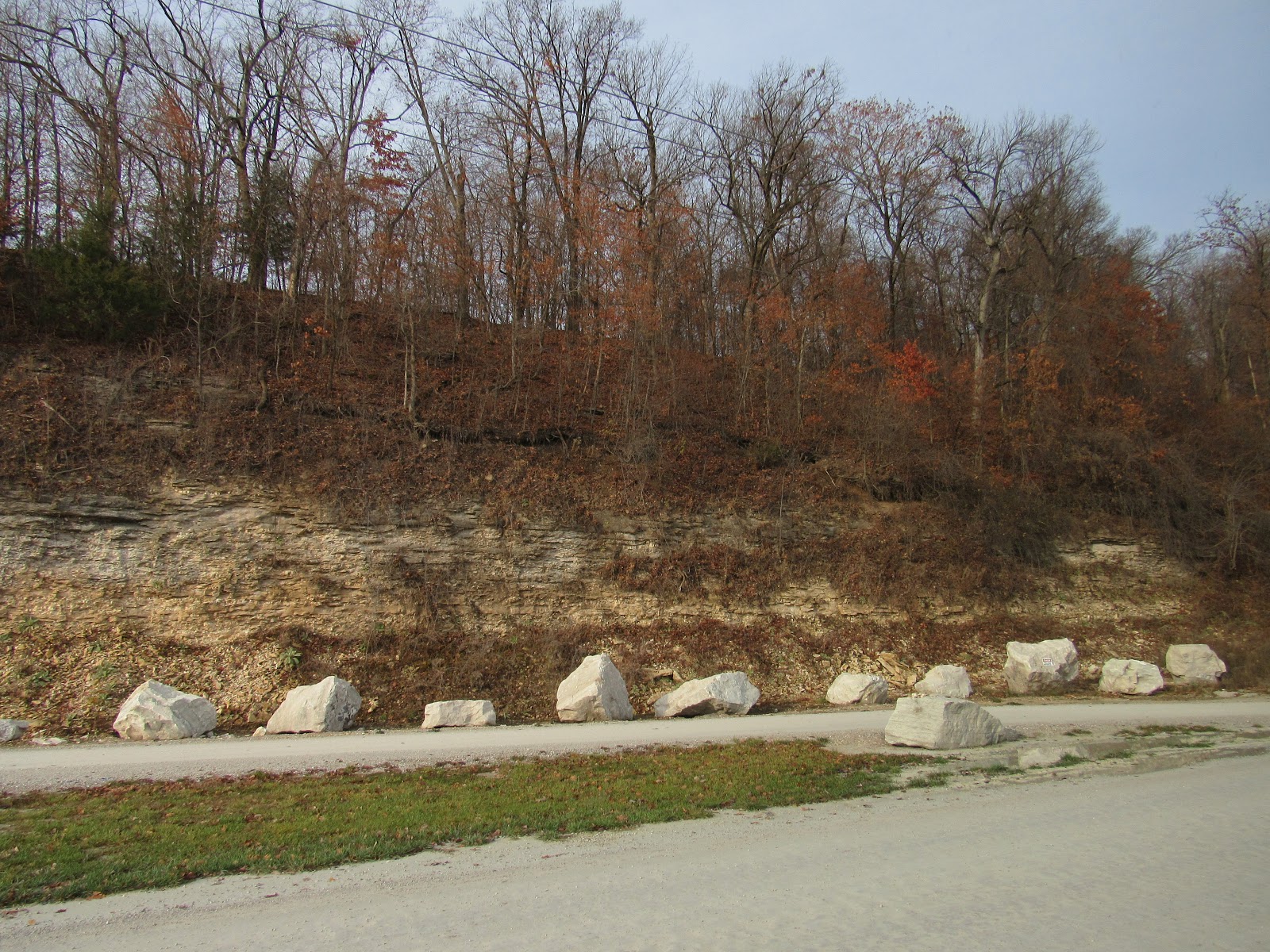
We  met up with a couple of other people and ventured on to Pike County (above).  Pike County is one of Illinois' oldest counties, famous for its deer hunting (supposedly, but more on that later).  In 1821, Pike County covered all of the counties north and west of the Illinois and Kankakee Rivers, including the Chicago area and what is now Calhoun County.  Bits of land were whittled away until only modern-day Pike County was left.


 This is easily one of the most attractive counties I've ever visited in Illinois, with a diverse mix of  rolling hills, rocky streams and robust woodlands.  Our first stop  in Pike County itself was the quarry/floodplain near the bridge at Florence. (We had seen some eagles and hawks just across the river in Scott County, in the floodplains west of Winchester.)


Here, a small, muddy lake and some brush around the edge provided us with a few birds, including these Song Sparrows (Melospiza melodia):


We also found several hundred circular rosettes of this plant growing in the mud.  Any ideas?


From there, we drove along the river.  This section of Illinois was badly affected by the flood of '93, and every house along the river built since that time is up on stilts.  I didn't get photos of that, since we had a lot of ground to cover.  The scenery was picturesque, too, at least for Illinois. I'd imagine even better earlier in the fall, when the leaves are still mostly on the trees.


Yes, we do brake for woodpeckers.  This Red-bellied Woodpecker (Melanerpes carolinus) is eating small pieces of gravel, which end up in its gizzard and help with digestion.  All birds, to my knowledge, do this, although it's uncommon to see them do it.


We saw several Belted Kingfishers (Megaceryle alcyon) on our journey, and I believe all were males:


Eventually, we pulled off to look at a Bald Eagle nest, which I realized was occupied after looking at my photos.  There are two on the nest in the photo below, which is heavily cropped:


While stopped, I took a brief hike up to look at the bluff behind us:


While doing so, I found some Cedar Waxwings (Bombycilla cedrorum), and their associated berries:


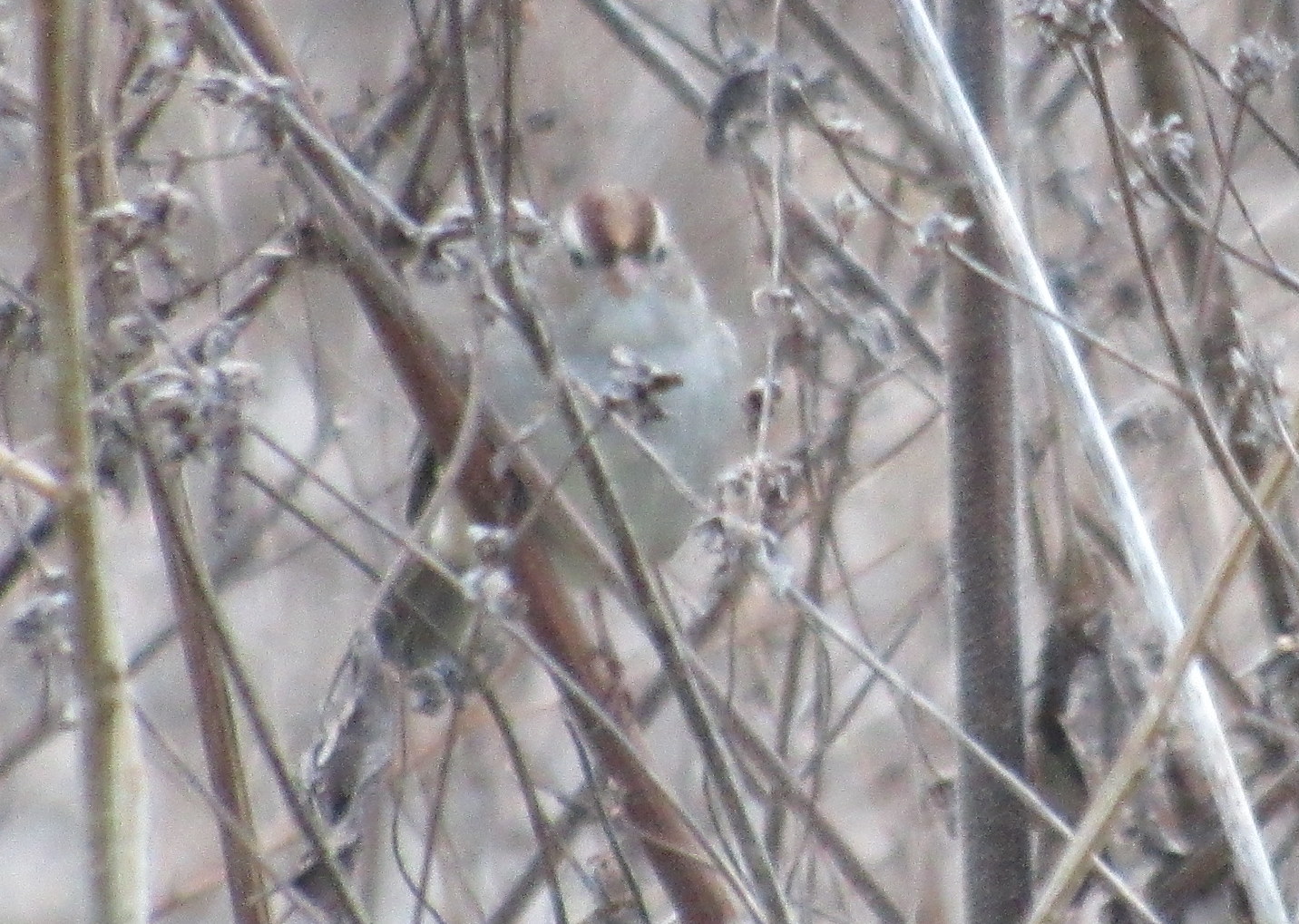
We then drove on further down the river, encountering several mores species along the creeks, including American Tree Sparrows (Spizelloides arborea):


One of the local creeks was being used as a birdbath by all kinds of sparrows, as well as jays and cardinals.  We lingered for a bit here, before moving on.


Several miles down the road, we came to a spring.  I've never drank water straight out of the ground before, but it was quite fine water, for as much as a "city boy" like myself would know about it.


While there, I was sitting in the car eating chips, when deep in the woods across the road, I spotted a Pileated Woodpecker.  As my mouth was full of chips, I could only mumble incoherantly.  "El Presidente", who was sitting next to me, told me that he couldn't understand me.  With my non-greasy hand, I flipped through my field guide, which is quite difficult to do with one hand, looking for the woodpecker section.  In the meantime, the bird flew away.  I eventually showed everyone the guide's picture of the Pileated,  and explained. too late for them to see it.  The moral of the story is don't eat too many chips at once!  Just after this, we also found a turkey pelvis, and that was all. I have no idea how it ended up there, as intact and clean as it was.  Here, the man who found it has it in hand:


We then went along and stopped at another spring, this one a bit further back in the woods:


Here, we found some amphipods.   The amphipods (and an isopod) are hidden on this leaf, towards the back.  We were dared to eat them, as a sort of challenge.  Since they lived in a spring that people regularly drink from, we did.  They have no flavor and very little texture whatsoever.


Having massacred the amphipods, we then posed for a photo above the spring:


After this, we went back on the road, going inland at Bee Creek and upland into the farmfields.


One of the fifty-odd Red-tailed Hawks (Buteo jamaicensis) we saw:


While driving around, we saw one Ring-necked Pheasant (Phasianus colchicus), but it got away before I could take a picture, to my chagrin.  Imagine my surprise when a second pheasant appeared, in better view!  This is the best photo I've ever taken of a Pheasant:


Further on yet, we spotted two American Crows (Corvus brachyrhynchos) and a Red-tailed Hawk in a showdown.  The hawk eventually left, leaving the crows behind as victors.


We saw more eagles, including three in one small creek valley.  The majority of our wildlife seen was not photographed, and is thus listed in the Ebird checklists attached at bottom.  I had a Woodpecker Suite (all seven typical woodpecker species in Illinois), and we saw far more eagles than photographed.  Most of the day's photographs, due to the lighting, are actively terrible:


Some of our group (possibly including myself) were dying to get out and stretch our legs.  So we did. likely on someone's private property.  Still, they forgot to post No Trespassing signs, unlike everyone else. Pike County is (supposedly) big deer country, and thus No Trespassing signs are everywhere. We spotted what appeared to be a bomb shelter, which turned out to be an old root cellar instead, and investigated an old barn in the distance, in the most badly timed photo I've done all year:


One of our party found a dead raccoon skeleton in the barn.  Several others climbed up into the barn's upper layer.  I would like to say that I did not do so for moral reasons, but I did not do so because I did not trust the flooring of the barn not to give way, and by the time I did, it was time to leave:


Several exciting, and mostly unphotographed miles later, we ended up in Pittsfield, where we had an excellent lunch at McDonalds.  I would like to go out of my way to praise the Pittsfield McDonalds.  It is rare that I get my order correct at any McDonalds, especially if I order a hamburger (notably, not a cheeseburger.)  The Pittsfield McDonalds correctly made my order of hamburgers and fries, and thus sets an example for all the ones in Sangamon County that never have.  I understand if some of my readers don't care for McDonalds, but in many small towns it's the only option.  (In Pittsfield, this is not the case, but it was one of the few options, and we all didn't mind it, so we went there.)


Anyway, this is not a restaurant review service, but a nature blog, and that means back to Bald Eagles.  After lunch (at around 2:30 PM) we went to Lake Pittsfield.  Here, we saw five Bald Eagles:


All but one were immatures, patterned in shades of brown, black, and white, instead of the familiar white head and tail on black body.  The size, shape, and bill of these birds is unmistakable, however:


They sat out on an old oak tree at the edge of a cliff above the lake:


Fifth Orchid of the day was, if anything, a Meadowlark in  an airport field.  All in all, we saw around 30 Bald Eagles in one day.  We also saw 467 cows, give or take a cow, a new personal record.  Pike County, however, is known for deer and deer hunting.  I saw three wild deer and three dead, skinned ones in someone's front yard.  I believe the authorities have confused cows for deer, or perhaps the hunters have killed most of the deer. Either way, Pike County 's deer population seems a bit overrated.  I shall have to come back and see Pike County again, to decide this.

Ebird Checklists:

Area before lunch:

http://ebird.org/ebird/view/checklist/S32845943

Lake Pittsfield:

http://ebird.org/ebird/view/checklist/S32845741