Showing posts with label Carpenter Park. Show all posts

Saturday, November 26, 2016

Top Sixteen Adventures of 2016

(Next year's list is "Top Seventeen Adventures of 2017", obviously.  2038 will get rather tiresome, I suspect, provided I'm still writing this blog by then!)

God has blessed me so much this year, and I've been able to participate in and see so many amazing sights and wonders.  If you're new to this blog and want to catch up on the most relevant parts of this blog, read on.  If you are an old reader of this blog, read on to see what I've ranked as what.  If you went on one of these trips with me, thanks for putting up with all my nonsense and for going along with me, because that really made my days.  If you've never been on a trip with me, sign ups are in the comments section below:)

By the way, I do know that we have a month to go, but I doubt I'll see anything in December that will be put on this list. December is such a busy month that I'm not likely to be able to do anything during it.  If I do have a surprisingly amazing adventure, it will be on next year's list.


16.  Electroshocking- Honestly, getting to go out and do this was great.  I caught more fish in this one outing than I ever have in my entire life, and I got to do it as part of a wonderful class.


15.  Being detained as a terrorist -This is one of my favorite stories to tell people, as an introduction to my life.  It probably shouldn't be, but it was quite exciting, even if that title is basically the punchline of the story.  Additionally, I got to hang out with my brother, something which I'm growing to appreciate a little bit more each year.  He actually took the photo above.


14.  Exploring Carpenter Park with Dan and Jesse-  There were so many toads, a few lifer plants, and just great times with great friends.


13.  Twenty-Three Smallmouth Salamanders in Lick Creek Wildlife Area - What's better than a Smallmouth Salamander?  How about finding twenty-three of them in about an hour of searching?


12. The Great Northern Expedition- If you can't tell, I have some of my best trips with my dad.  He put up with a lot on this day, and we had a great time, especially late in the day at Nachusa.


11.  Exploring Lick Creek Wildlife Area with Dan and Jesse-  This was the first trip we did as a group, and the three hikes I went on with those two are among the best  I've been on.  All trips are better when taken with friends, especially friends who appreciate nature, but who can also drag you out of it for a random conversation about philosophical topics and general nonsense.  This is especially good when you're exploring someplace you've never been before.


10.  The Ides of March - First Common Loon and Western Chorus Frogs, two of the best new birds and frogs I've seen this year.  Overall, it was a wonderful day, and I enjoyed it quite a bit, so much so that I split it into two blogposts. Links are here and here.


9.  Michigan Canoe trip-  My shoes may never smell the same way ever again, I may have fallen out of the canoe twice, and my sunglasses have never reappeared since, but this was awesome.  Next time, though, I'm going to get a little more prepared!


8. Seeing 14-plus duck species in Center Park-  If Northern Harriers drew me into birding, this expedition capped it off!  I got to see just about half of all Illinois duck species at once!  Links for both sections are here and here.


7.   Going to Revis Hill Prairie and Scrub Oak- Sand Prairie with Dan-
It was a difficult hike, but a great trip to two of the wildest spots in Central Illinois, and even better because I brought a friend along for the struggle. Several new plants and many strange insects awaited us in these, the absolute wildest of Central Illinois natural areas.


6. Going to Southern Illinois with the Environmental Club-  This trip had orchids, salamanders, friends, and grand adventures.  Plus, I got to see a Logperch! (It's a fish). Unfortunately, we didn't find any of the scorpions, copperheads, or anything else scary or dangerous (other than the heights at Fults Hill Prairie).  Still, there's always next time!  Links for both sections are here and here.


5.  First winter trip to Nipper-  This single trip got me into birding big-time (to the point where I say birding instead of birdwatching).  A single Northern Harrier along the road ended up becoming a hobby which I have spent countless hours doing this year. I also met people I didn't know who read my blog, and that was back in January!  Honestly, sometimes I forget how many people read this blog, and who all that might be.  And, I got to do this all with my dad!


4.  Going up to Mason County for the first time-  That was a long, lonely trip, but there were so many new  birds and experiences I had that I will never forget.  I saw the rarest lifeform of the year there, the Tennessee Milkvetch, and I found a large number of nature preserves only an hour or so from my house, with tons of exciting plants and animals.  The wild sandlands of Illinois are the best.  Links for the three sections are here, there, and ere.


3.  Going up to Chautauqua and Emiquon with Jesse and Dan-  Trips are always best with friends, especially when we debate philosophical concepts while watching sandpipers on a levee in the middle of a mild thunderstorm.  Trust me, it's an invigorating experience, and one which brought me plenty of lifer shorebirds and great memories with friends, as well as an interesting experience in accidental trespassing which I hope no future employer sees as a reason to not hire me...
Links for both sections are here and there.


2.   Going to Indiana Dunes- Five Orchids in one day! I've seen seven this year, and as it's November I am unlikely to see any more.  Roughly a quarter to a third of the lifer plants this year were seen on this trip, including a plurality of the best ones.  And, as with several of my favorite trips, I got to go on this with Dad.  Links for all four sections are here, there, and also here, and everywhere.


1.  Surviving this year-  Thanks to God for my survival this year.  Considering this is a website open to the internet and the general public, I don't plan on sharing all that's happened to me over the course of this year.  I will say that a close family member suffered from a serious disease.  They are completely fine now, (again-  Thank you, God!)  but between that and the usual hassles that come with being a full-time student, it's been a rather... interesting... year.  At the same time, I've gained so many good friends... too many to list! (And besides that, half of them are all named Josh, Jesse, Dan, Logan, or Jake- It would get confusing:)  I've been so many wonderful places and seen so many wondrous creatures.  I really look forwards to next year!

P.S.  Some of the older posts have egregious errors.  Rather than redacting them, I've decided to leave them in, mostly because I'm lazy, but also because I think it's fascinating to see how much the tone has changed from month to month and year to year on this blog.  My apologies for any incorrect information.  Also, there may be photos taken by other people.  Other than ones taken from state websites, I will be removing those for copyright reasons, albeit slowly over the next month.

Tuesday, September 20, 2016

Vertebrate Zoology Field Trip Journal #4: Carpenter Park-100th Post!


This is the hundredth post on my blog.  Wow.  I wasn't sure at points whether I was going to continue with this website.  It's not always easy for me to have these posts out, and certainly not in time.  Often, there are days, like the one described below, where I just scrap an entire blogpost because the pictures don't work out or there just wasn't much to write about.  My last blogpost, however, I posted to an email group of birdwatchers, and it got me several kind emails in reply, full of advice and ideas.  If you're one of those people, thanks for reading this blog and emailing me!  

Carpenter Park State Nature Preserve

Friday, September 9, 3:45 to 5:00 PM

Temperature: 80 degrees Fahrenheit

Weather:  Mostly cloudy, with intermittent brief rain, winds negligible.


I'll be honest, getting to Carpenter Park was terrible.  As I drove down there on the highway, a septic treatment truck, with a loaded septic tank on back,  switched lanes so that it was in front of me.  It then began to leak, at sixty-five miles an hour.  There were some words said as the contents of the tank intermittently splattered against the windshield, hood, and front grille of my car.  Thankfully, it turned off a few miles later, though not before leaving a few semi-permanent stains in the front of my car.  Running late, I raced to meet up with the main field trip.  I caught up to them, finally, with my tale of woe, and a car desperately in need of a wash.  The trip was nominally taken in search of snakes, but none were to be found.   We missed out on seeing any warblers here as well.  We could hear a Pileated Woodpecker calling, but it remained out of view, sadly.

Initially, however, all we could seem to find were Eastern Wood-Pewees (Contopus virens).  We did spot a Swainson's Thrush or two, and we could hear Blue Jays and a Black-capped Chickadee calling.  However, these are, with the exception of the Swainson's, all among the most common Illinois birds.  No other vertebrates could be seen at this place, which was usually teeming with life.  Only one form of life was widespread and everywhere; that was the mosquito.


Out in the prairie section, the Gray Catbirds mocked us from the edge, while American Goldfinches (Spinus tristus), about eight of them, bounced around the weeds on the path ahead of us.


With the general lack of vertebrates, I was soon distracted by plants, and this colorful False Foxglove (Agalinis spp.) was a good distraction.  These prairie flowers, while not state-listed, aren't exactly a common find for me.  Partially parasitic, False Foxgloves steal water and nutrients from the roots of other plants, which makes these botanical semi-vampires quite bizarre and fascinating to me.


Also, this time of year, the butterflies are on the move, and we found this tiny yellow one, resting on the leaves of a Cassia plant.  It was around the size of my thumbnail.


Back in the woods, we found several more Eastern Wood-pewees and a Red-bellied Woodpecker.  Far more exciting than these common birds was the Gray Treefrog  (Hyla spp.) we also found.  My computer, for no explicable reason, wants to have this picture vertically oriented:


I also spotted an unusual fungus or two, something quite easy to do at Carpenter Park:


Finally, we made it out to the banks of the river, where Boneset and Hibiscus grew.  Still, there wasn't even a heron visible!  We contented ourselves with an American Robin and a Chimney Swift or two flying overhead, and dipped back into the forest.


On the way, our professor stopped for a photo inside this tree.  The mosquitoes and mud made this section a bit unbearable, so we moved on quickly, heading for the bluff.


With the lower water levels, the rocks at the base of the bluff were exposed:


A Northern Cricket Frog (Acris crepitans) hid among the pebbles and debris on the banks of the Sangamon River, defying us to find it when it weren't moving.  These frogs, the size of crickets, are among North America's smallest vertebrates and our most plentiful frogs.  Can you see it?


The birds were also more visible.  We spotted several more Chimney Swifts catching bugs above the treetops, as well as a pair of Mourning Doves and a Downy Woodpecker.  Of course, this paled in comparison to what we found when we got atop the bluff.  An adult Bald Eagle flew right past us as we climbed up the bluff, going east along the river, so suddenly that we failed to get pictures.  After a few minutes, we spotted a second, juvenile Bald Eagle flying near a group of eight Turkey Vultures to our southeast.  This was the highlight of the day.


We made our way back to the parking lot during a brief rainshower.  I waited around with a couple of our party, trying to see what birds were in the trees around the parking lot.  We turned up several more Eastern Wood-pewees and a couple of White-breasted Nuthatches (Sitta carolinensis), including one hiding in the photo below.  It's a short list, but at least we had a Bald Eagle and a Gray Treefrog.  I would not recommend returning to Carpenter Park anytime soon, however, unless you are especially resistant to mosquitoes.  I'll certainly be back... after frost.


Ebird Checklist:

http://ebird.org/ebird/view/checklist/S31503123

Monday, June 6, 2016

Pawpaws, Whirlpools, and Pileated Woodpeckers


I've decided to start posting once a week, occasionally twice a week when needed.  This gives me a bit more free time, and as the newness of the blog has worn off as of late, I don't feel as tied down to the blog, or to having to blog everything that I visit.  By no means am I stopping.  Recently, I just got too caught up in watching statistics, and I've stepped back from that.  The whole point of this blog is to document the wild plants and animals of the Land of Lincoln, as well as anywhere else I go.  That is this blog's Prime Directive.  (I've been watching Star Trek, if you couldn't tell.) With only a year or so until I have to change the name of the blog, I've decided to take my time and enjoy it.  Speaking of enjoying life, I took a second trip to Carpenter Park recently.  The picture above is of a drying creekbed in that park.


As it stopped raining only minutes before we landed at the park, the humidity was extreme, and the lighting was poor.  Carpenter Park is the only DNR Nature Preserve in Sangamon County, and it deserves the title.  This mushroom was growing on a stump just outside the car.


Large sections of the old, unlogged forest had stands of Pawpaw (Asimina triloba).  This is a Southern plant, with the vast majority of related species in Florida.  Another name is Prairie Banana, as this plant has fruits in late summer with vague resemblance to the taste and texture of banana.
One extremely nice feature of Pawpaw trees is that their large, shading leaves keep shrubs from growing near them.  As a result, people can walk more freely around in a Pawpaw grove.


After leaving one such grove. I found this small caterpillar on my clothing.


 This swamp was soon discovered, upland, away from the river valley.  It doesn't seem to matter where I hike, I invariably find a swamp at least once.


Back on the trail, I spotted this Blue butterfly (Polyommatus spp.).  Blue is the name of the group of butterflies, who often happen to be blue.  Carpenter Park is a great spot for insects, though large spiders seem to be rare, thankfully enough for me.  I've seen at least three new insects (to me) every trip I've made to this park.


Almost as diverse as the insects, the fungi growing on all the downed logs made for a spectacle.  This coral fungus was one of several fungi we encountered on the hike, but it was the most interesting.  I've always been fascinated by these unusually branched fungi, so different from typical mushrooms.


The floodplain itself was awash in Butterweed (Packera glabella), a sea of yellow over the mud.


Just before going down into the floodplain,  I spotted this Gray Treefrog (Hyla versicolor or Hyla chrysoscelis).  Two species of Gray Treefrog live in Illinois, and both look almost identical.  It takes a DNA test to figure out which is which.  I mean it.  There is some slight difference in the calls these species make, but even experts have a hard time identifying the frog from calls alone.  Part of the problem is that these treefrogs can change color. Light gray is usually a sign of stress for these frogs, so I'm hoping this particular individual is doing better than it was at the time of the picture.


Here's the Sangamon River, in all its glory.  The second largest river in what I define as Central Illinois, the Sangamon is too large to be bridged easily and too small for most motorboats.  As a result, it retains a very wild feeling.


Here is one of about twenty toads (Bufo spp.) we encountered throughout the hike.  As it was just after a rain, the amphibians were remarkably active.  I found four within three feet of this spot alone.

This enormous and colorful dragonfly also posed for a picture nearby.  I'm going to try and photograph more dragonflies in future.  Also,  I don't know what species this is.  (Thanks to Tom Arbour of The Ohio Nature Blog, this is a Rapids Clubtail [Gomphus quadricolor], a species noted for being found in late spring/early summer along medium to large rivers.  This is a species only found in high-quality rivers, usually near small rapids.  As a result,  Rapids Clubtail are an uncommon insect here in Central Illinois.  I'm glad to have seen it.)  (This is actually more likely to be a Midland Clubtail [Gomphus fraternus], again thanks to the above source.  Honestly, at this point, I'm just going to call it an insect.)


Unusually for me, I only had one bird photograph for this post, but it's one I've wanted for awhile.  The largest woodpecker in Illinois, Pileated Woodpeckers (Dryocopus pileatus) are very people-shy, preferring large tracks of woods with old trees and dead limbs.  I spotted two Pileated Woodpeckers, which flew hundreds of feet away.  I'm frankly impressed with how well this picture turned out, considering the lighting and distance.


One of my favorite sedges, Gray's Sedge (Carex grayi), was also present in the floodplain, which began to narrow as the river edged closer.  Soon, we came to a stream:


 I'm 99% sure this is the tallest waterfall in Sangamon County.  There's a cascade below it as well, but that's hard to photograph.  (It's about two feet tall.)


Above the waterfall, the creek flows through a canyon, one of the few in this region.


Nearby, a tree which fell into the Sangamon has had its stump converted into a throne.


I had never seen Smooth Wild Petunias (Ruellia strepens) before, although I grow a close relative, the Hairy Wild Petunia, in my garden.  Funnily enough, I misidentified this plant as a weedy Morning Glory (Ipomaea spp.) when one of my friends pointed it out, before doing a double-take.


This damselfly (like a dragonfly, but smaller, thinner, and with folded wings) was one of the most attractive native insects I have ever seen.  I understand if you don't like bugs, but to me this insect is downright elegant.  The specific name of this species is Ebony Jewelwing (Calopteryx maculata).


The sun finally came out as I climbed on the rocky ledge alongside the river.


This exposed rock, below the nearby bluffs, is part of what makes Carpenter Park such a unique habitat.  Here, you have a steep slope, rock outcrops, and a large river, all unusual in this area.


Even on the rocks, just above the river, toads were out and about...


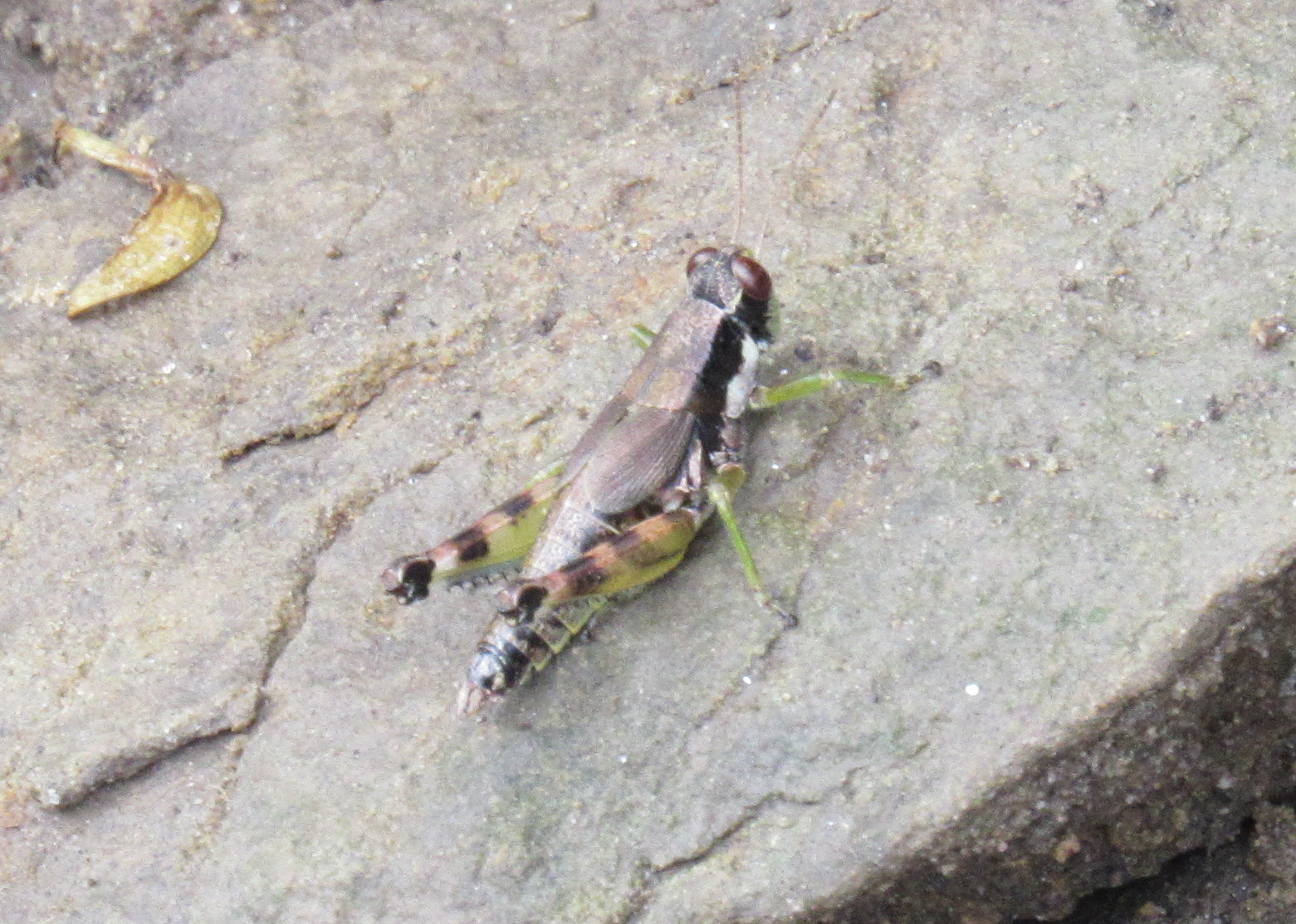
... as were a few unusual and brightly-colored grasshoppers.


I may have forgotten to mention the large amount of snails out and about.  We saw at least as many snails as we did toads.


Continuing along the bluff line, we found some very hardworking sycamores (Platanus occidentalis).


Proceeding still further, with one hand gripping the wet cliff edge, we then found this pile of rocks. Everything looked as if it was just a small rapids.  Then I noticed something:


...a whirlpool had formed in one corner of the rocks.  While small, it was still quite noisy.


Here, you can see the same rapids and whirlpool from upstream.  (Caution: Snakes Below)


This young Northern Watersnake  (Nerodia sipedon) was sunning itself at the base of the bluff.  After a few photos with the passive snake, we climbed up a creekbed at the base of the bluff and worked our way to the top of the formation.


One American Columbine (Aquilegia canadensis) hung on at the edge of the cliff.


I have to say, this photo makes the ledge look a whole lot scarier than it actually is.  Still, while quite worthy of a visit, Carpenter Park isn't exactly for little kids or pets.


On top of the bluff, we found a Garter Snake (Thamnophis spp.) sunning itself.  This species primarily eats fish and toads, two creatures found in abundance nearby.


On the way back, this Sulfur Shelf (Laetiporus spp.), concealed under a log, caught our attention.  Leaving the bluff is difficult, as there are a lot of unofficial trails in its vicinity.  We made our way to a nearby road and walked up from there, spotting the unidentified butterfly below while doing so.  I have to say, it's rare for me to have a post where the insects outnumber the birds in pictures. I had a great time with the friends I took on this trip.  Overall, I enjoy Carpenter Park more and more every visit, and I always discover something I've never seen before every trip,  If you live in the area, I highly recommend a visit.