Showing posts with label Rare Plants. Show all posts

Friday, May 12, 2017

More Strange (and Rare!) Springtime Flowers, and Dust Devils!


If this looks at all familiar, it's because this was  my second visit to Revis Hill Prairie Nature Preserve within a three-week period.  During that time, however, entirely new and different flowers bloomed.


Here is one of the many Wood Betony (Pedicularis canadensis) plants I found, a sign of an old prairie.  Scientific names are back, because plants have confusing common names.  This, for instance, is  also known as Lousewort, yet I've never gotten a louse from it.


I found the great yellow flowers of Hoary Puccoon (Lithospermum canescens), which used to be used as a dye by Native Americans (hence puccoon, from the word poughkone- meaning dye, in the Powhatan dialect of the Algonquin language).  (Yes, I googled that- I'm not that smart!)


Here was the view from the top of Revis, with thousands of Wood Betony plants blooming on the hillside.  Now, add in about six bumblebees whirling about, checking me out, and you have a complete picture of this prairie.


Blue-eyed Grasses (Sisyrinchium sp.) bloomed profusely all over the hillside, and I spotted several hundred on my way back down the hill. I then drove on down to another hill prairie, to go looking for a small plant of considerable rarity in Illinois:


I found it.  This, the Ozark Milkvetch (Astragalus distortus), is an Illinois state-threatened species, and it's quite a beautiful little flower.  Several dozen bloomed along a thin hill prairie ridge, bordered by trees.  I had to be careful where I walked!


Ozark Milkvetch, as its name implies, is generally found to the southwest of Illinois, where it becomes more regularly found in the Ozarks and even more common in Texas. The sandlands of Mason County bring something from the west yet again!


Fringed Puccoon (Lithospermum incisum), a paler, more ruffled relative of Hoary Puccoon, bloomed along the roadside by the hundreds.  My only other time finding this plant was finding three small specimens hiding low in a hill prairie somewhat north of here, Manito Prairie.  I'd assumed it was a bit rarer, but this proved me wrong.  I also heard my first White-eyed Vireos and Lark Sparrows calling as I walked down the road, among many other birds:


Lark Sparrows (Chondestes grammacus) are yet another western species far more common in Mason County.  They love the sandy prairies, and migrate back here each year.  This is my first Lark Sparrow of the year, but hopefully it's not my last!


Another first was  in dust devils, those miniature tornadoes that one occasionally sees out in barren fields (or, on one memorable occasion, in a parking lot slamming my parent's car door shut).  At one point, about six made their way across the field.  They did not film well, so I took a few pictures and watched the spectacle move on.  I'd imagine the combination of a warm day and unusual air currents off the hills moving into the valley helped to form these dust devils.


I then drove off to go looking for an orchid.  I didn't find it, so I stopped and looked about at Chautauqua National Wildlife Refuge.  I heard calling Red-headed Woodpeckers (Melanerpes erythrocephalus).  It never ceases to amuse me how people get so excited about Red-headed Woodpeckers (including me).  They're not that rare in my area, but they are a bird, like Eastern Bluebirds and Indigo Buntings, that automatically require a photo when seen.


The Red-headed Woodpeckers here were at war.  A dead tree on the shores of Mud Lake  had several holes in it, and over these the Red-headed Woodpeckers were fighting near-constantly while I watched.  This bird and its apparent mate drove off the other three or four Red-headed Woodpeckers, claiming victory at last.


In total, I saw seven Red-headed Woodpeckers.  The shoreline of Mud Lake is one of the best places in the world to see Red-headed Woodpeckers.  Between the oak and nut trees along the banks of the lake, the grasshoppers in nearby roadsides and cornfields, and the large fly population on the lake, they have tons of food.  Red-headed Woodpeckers often catch flies for food, and cache live grasshoppers in tight tree crevices.  They are fairly un-woodpecker-like in this respect.


Then I went "into the desert on a horse with no name"- minus the horse, and minus most of the desert, but this is still H.A. Gleason State Nature Preserve, the driest spot in Illinois.


Field Sparrows (Spizella pusilla) called from all corners of the preserve, with their song that has been unjustly compared to the bouncing of a ping-pong ball.  It sounds, to my ears, like a metal detector, where the beeps come closer and closer together when metal is found.  "Fe-fe-fefefefeeeee" is a good approximation of it.  I saw a couple in the bushes, but I'm sure more were hiding nearby.


Also hiding nearby was one of the rarest plants in Illinois, the Silvery Bladderpod (Lesquerella ludoviciana), and I had finally found it in flower!  It was far better a sight than the name "Bladderpod" would imply!  (It's called Bladderpod because it has seedpods that swell up like balloons in a few month's time.)


Here, for scale, is my hand.  Now, though this wasn't the last place I stopped that day, this is the last plant of the day.  I decided to split these posts down the Illinois River, so that all my Emiquon adventures will be in another post.  It should also be noted that no flowers seen in this blog are probably in flower now, because it's been a few weeks, unless you're reading this in future mid-April.


Ebird Checklists

Revis Hill Prairie:
http://ebird.org/ebird/view/checklist/S36222914

Chautauqua NWR
http://ebird.org/ebird/view/checklist/S36222914
http://ebird.org/ebird/view/checklist/S36222899

H.A. Gleason State Nature Preserve
http://ebird.org/ebird/view/checklist/S36222587

Tuesday, April 25, 2017

BULLSNAKE! And Emiquon, Too!

Right, time to finish up that Mason/Fulton County trip I did a few weeks ago.  You can read about the part where we visited Revis Hill Prairie here.  We stopped to eat lunch afterwards, at Chautauqua National Wildlife Refuge.  This gave us a good idea exactly how flooded the river was, as  the lake was considerably higher than the last time I was there.


A few Ruddy Ducks (Oxyura jamaicensis) slept in the middle of the lake as we sat eating our lunch.


A couple of Northern Shovelers (Anas clyptea) flew by, too, showing off all their colors.


Several Red-eared Sliders (Trachemys scripta) sat in the muddy water.  This lake, I've been told, used to be much fuller of fish and more scenic before the government put a levee across the middle.  That and the introduction of Asian carp to these waters seems to have worsened the water quality.   Still, even in a reduced state it's an appreciable place for nature.


Several American White Pelicans (Pelecanus erthrorhynchos) sat out on sandbars, and one flew right over our heads.  The majority of people with me weren't birdwatchers, but pelicans are a bird everyone can appreciate, given their size and bill.

The pelican landed just behind us in a small bay, where it posed for photos.  After this, we went over to Sand Ridge State Forest and into the desert of H.A. Gleason State Nature Preserve.


Two of the four of us had never been to H.A. Gleason, so we trekked over the sands.


The breeze had kicked up, and we walked through the dry grasses as they blew in the wind, north towards a tall dune named the Devil's Neck.  I call this grass patch the "Devil's Prairie" as I always end up with ticks when crossing it.


Once on the Devil's Neck, we found a few small members of the Mustard family, inlcluding this Draba reptans, but one a bit rarer than the rest:


The famous Silvery Bladderpod (Lesquerella ludoviciana) while in bud, was not in flower (at the time, though on a second visit later...)


I love the giant sandbox that is this part of Mason County.

Now, I'm not going to say exactly where this tree is, but it is in the vicinity of our previous locations.  The reason for this is simple- snakes like this are often taken from the wild.  As a result, I will say that this is in Mason County, but no more than that.


I had walked ahead of the group, looking on the ground for snakes.  Someone called out "Snake!" and I immediately ran back to see it.  We had discussed the possibility that there might be some Racers in the vicinity, but as soon as I saw it, I happily screamed. "Bullsnake!"  (Pituophis catenifer sayi).


Bullsnakes are the largest snake species in Illinois, and while this wasn't a big one, it was about three and a half to four feet long.  They are most often seen in Illinois on the "Kankakee Sands", south of Chicago along the state's northeastern border with Indiana.  The Mason County population is similar, but far less photographed by herpers. This snake resides in the sand-prairie regions of Illinois, and avoids the black-soil former prairie areas throughout most of Illinois.


This was a beautifully-patterned snake. Unfortunately, I don't have a clear photo, and they get the name Bullsnake for their aggressive-if-handled temperament.  I let the snake climb higher in the tree, and both it and I were happier for it.


In the same area, we found some Corydalis flavula, a favorite of mine that I don't see near home.

A member or two of our group had never seen a wild Bald Eagle before, so I decided to show them a nest I'd found.  As we approached, the Bald Eagle flew off of the nest.  It wasn't a great look, but they did finally see a wild Bald Eagle!


We then went off to Emiquon, and realized quickly that while the levee-protected Thompson Lake wasn't very high, the surrounding area's floodwaters were far higher than usual!


We started watching fish in the shallows, including this Shortnose Gar (Lepisosteus platostomus) below.  Obviously, I've tweaked the photo so that you can see the gar.  I had never seen a gar in the wild before, and it was quite fun to watch as it cruised along the water's surface.


Far off in the distance, we spotted an Osprey (Pandion haliaetus)  flying past.  It dove for a fish just after this photo was taken.  Ospreys may be State-endangered, but here they're an easy bird to see.


At the Emiquon Visitor's Center, several Savannah Sparrows (Passerculus sandwichensis) (named for Savannah, Georgia) hopped about in the grass on the edge of the wetland.

We saw several other interesting birds, some or all of which will be mentioned in the future.  After a brief drive-about, we took a photo of the lake and left for home, stopping at Dairy Queen on the way.  It was a fine end to a long day of exploring.  Little did I know I'd be back the next weekend...


Thursday, April 13, 2017

Going to Mason County for... Flowers?


I've been quite busy lately.  School is ramping up in the tail half of the semester, just as the flowers and birds come back in full.  I wish finals came in March so that we could have spring to enjoy unencumbered by exams and grades.  That being said, I got to go to Revis Hill Prairie and a few other sites in Mason County, spending a full day doing so.  It's not something I can do often, but it sure is fun to do when possible!


Our first find of the day turned out to be one of our best, as we found the State-endangered Prairie False Dandelion (Nothocalais cuspidata), a plant far more common on the Great Plains.  In Illinois, this plant is in the as far southeast of its range, and Revis is one of its most southerly outposts here.


As usual, the views from the top of the hill prairies were great, even if the majority of the landscape remained in somber winter hues.


Several different forms of Cleft Phlox (Phlox bifida), all varying in petal "cleftness" (like the one at top), bloomed throughout the hill prairie.  This was the most common spring flower present.


It's always fun introducing people to Revis Hill Prairie, and I've gotten to do it a couple times now.


Even I, however, keep finding new life here.  For instance, I was not aware of Carolina Anemones (Anemone caroliniana) as a plant species until now.  They have to be the most attractive plant species I've seen this year, though that's currently a short list.


The flower is so tiny and delicate, and yet so durable as to survive here.  It is well made!


Our party worked our way downhill, and we found some bird hiding in a clump of bushes.  It eventually went up a bit and revealed itself to be an Eastern Towhee (Pipilo erythrophthalmus)!  This is a bird I don't feel that I see enough.  Then again, this is about as good a view as most people ever get of an Eastern Towhee- they're remarkably shy birds!


Then I found a plant I've been after for years- the Violet Wood Sorrel  (Oxalis violacea), in full bloom, at the base of the slope.  This is a "common" plant in Illinois, but it's common in areas where I don't live.  Dozens grew on the loose loess slopes. (Say that three times fast!)


We left from Revis after a bit more hiking, and on into further adventures.  However, since I am busy currently, I don't have time to write those all up now.  I leave you with one last look at Revis. I've waxed lyrical at many times about the views at Revis Hill Prairie, but they are the best I know of within an hour's drive of my residence.  What more can I say?

Wednesday, March 15, 2017

Taking My Parents Up Fults Hill Prairie


I recently came back from a brief trip to Southern Illinois, where I had planned to visit Giant City State Park with my family. It was raining there, and it didn't seem as if it was going to stop raining, so instead I decided to show my parents Fults Hill Prairie State Nature Preserve instead.  Fults Hill Prairie is located on the bluffs overlooking the Mississippi River in southwestern Illinois.  It's one of the finest places in Illinois I've ever visited, albeit one of the most rugged trails in Illinois, too.


The first great find of the day was this Putty-Root Orchid (Aplectrum hyemale), the first orchid species I've found this year.  I know they're much more common in Southern Illinois, but I still enjoy finding them.  This big evergreen leaf is a dead giveaway.


Above it on the path was the first violet species of the year, which between its size and light flower color almost looks like a new species for me.  I have no idea what that might be, however.


These woods are considerably steep and rocky, and my parents weren't thrilled about the difficulty of the trail.  It's rated "Extreme" for Illinois, though anyone out West would probably laugh at that rating.  Still, they wouldn't give this an "Easy" rating, either.


Some emerging ferns along the trail were out in the exposed, rocky areas, which I did not expect.  Also, I think this might be a new species for me.


The hill prairies here are dry and full of rocks, mirroring Missouri glades in the Ozarks further west.  In the summer, scorpions can be found here.  This stretch of bluffs here in southwestern Illinois is the only place in Illinois where you can find scorpions, and the rest of us are happy about that!


I flipped a few rocks meanwhile, and found this interesting fellow arthropod:

ARTHROPOD ALERT


I'm fairly certain the Cosmetid Harvestman (Vorones sp.) is a localized resident of hill prairies and glades.  I've only found them in such sites.  Apparently they are kept in captivity by some people, which doesn't surprise me, as they are unusual and docile.  Collecting any animals for captivity is banned at Fults Hill Prairie, however, as it is an official Illinois Nature Preserve.


I pushed my parents to come to the top, and eventually my dad went with me, while Mom stayed behind in the lower prairie, just a hundred or so feet away.  The view that rewarded Dad and I is, in my limited experience, the best in Illinois.


You can walk all the way to the edge of the cliff, though with the strong westerly winds at this time of year, I stayed well back.  This is one of the most amazing but also most dangerous preserves in Illinois, simply for the height of these bluffs. Eastern Red Cedar (Juniperus virginiana) grow along the edge.  Without regular burning and removal, they would come up and overgrow the entire prairie.


To the southeast is Kidd Lake Marsh, another Illinois Nature Preserve, and one I have yet to explore.  You can see it in both pictures here, above and especially below.


Both north and south of Fults Hill Prairie, other, undeveloped hill prairie preserves provide the only toehold of many Missouri species in Illinois, including the aforementioned scorpions.  Still, they are not alone here by any means, as some specialized Midwestern endemics live here too:


This is Cleft Phlox (Phlox bifida), a colorful plant of dry prairies and glades in the Midwest.  Thanks to the warmer winter and the warmth of the rocks on the edge of the bluff, it is up and blooming a bit early this year.  These photos were taken before the most recent snowfall hit Illinois.


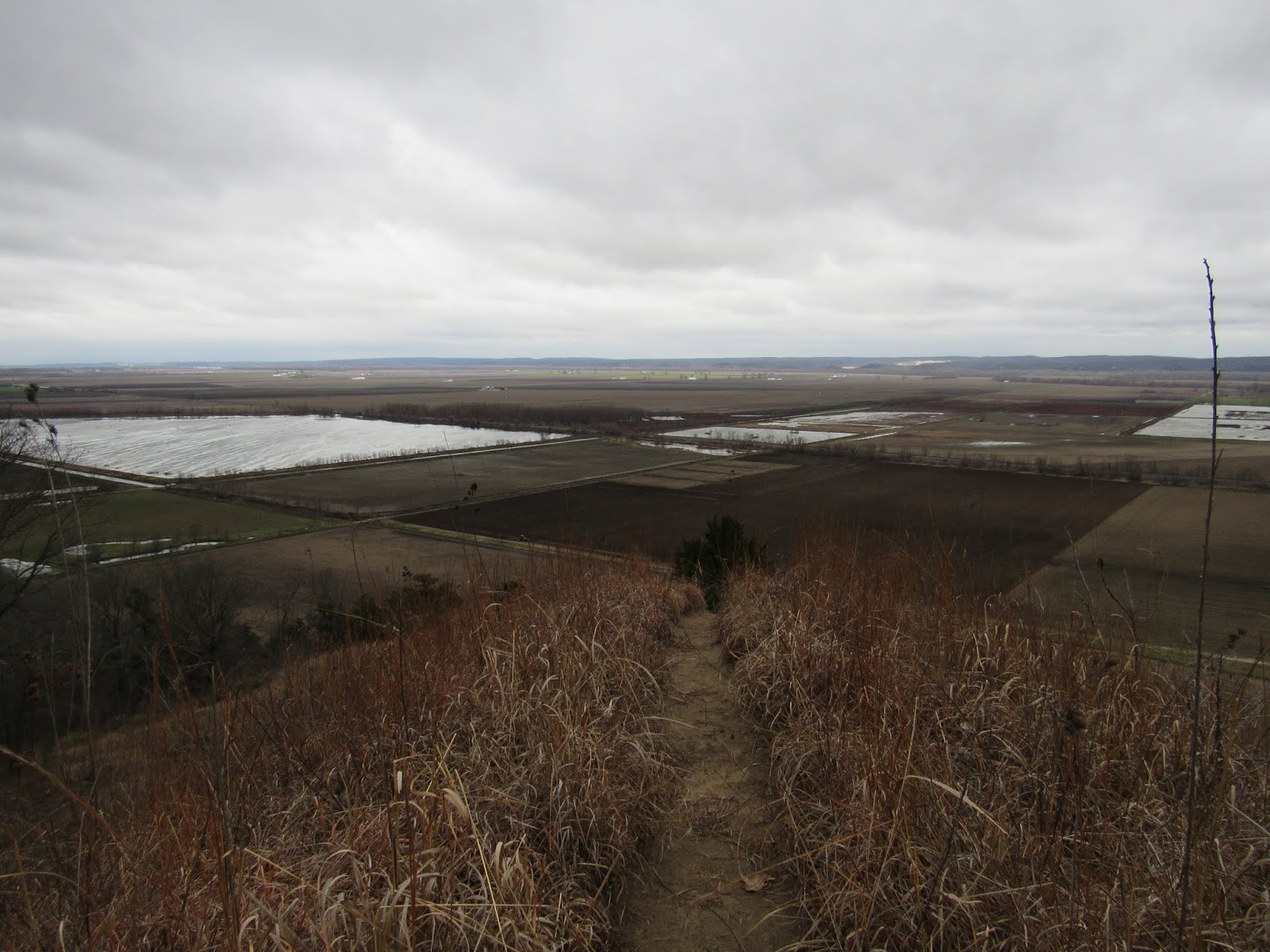
While it may look like a path to the end of the world, and it is the fastest and worst way back down to the parking lot if you keep going over the edge,  this trail actually leads to the cliff overlook seen earlier.  Look at that view! This is the only photo I have that even comes close to replicating it.


I believe this is Spicebush (Lindera benzoin) in flower. I have seen it in fruit up here, and it grows plentifully throughout the woods.  Despite its name, Fults Hill Prairie is mostly wooded.

We rejoined up with my mother and walked back down the short, steep trail that we had hiked up.


Notably, did anyone notice what was missing?  Bird photos! I finally have made a blogpost without a single bird photo, something I rarely do!  There are birds here, as it's one of the few places you can be at eye level with a Turkey Vulture, but I didn't notice them for the scenery.  We went on home, tired but happy for all that we had seen.  Someday, we will return and climb all the way to the top together.