Showing posts with label Lick Creek Wildlife Area. Show all posts

Wednesday, May 3, 2017

The Great Salamander Race -150 Posts!


I've been about as busy as I've ever been in my life.  Thus, I fled to nature on multiple occasions.  I've visited the LLCC Bird Banding Station at multiple occasions, and spotted the resident Tree Swallows taking over the bluebird boxes as usual.


I decided, in a two-hour gap between classes, to dart over to Lick Creek Wildlife Area and find a salamander.  This proved to be a trek.  I saw several blooming White Trout Lilies, among the huge masses of their leaves.


Spring Beauties were just opening at the time (this post is quite delayed!).


Hundreds of Blue-winged Teal flew in and out of the marshlands, hiding almost perfectly in the flooded pockets of water.


Here, you can see two Blue-winged Teal with two Mallards in front.  The Mallards are much less afraid of people- and almost twice the size! of the teal.


A few Swamp Sparrows watched me as I flipped logs for salamanders.


Success!  A nicely marked Smallmouth Salamander is my first smallmouth of the year.  I'm hoping for a few more salamanders this year, but I'll settle for what I can.


I even got a habitat shot of the salamander.  It acted like one of those kids where if it can't see you, you can't see it.  I then put it back under its log and proceeded to nearly step on a nearby Garter Snake, sunning itself in the marsh.


Just after class, I decided to drive around the lake a bit.  Only a few of the Double-crested Cormorants still linger on Lake Springfield, but there were hundreds back when this photo was taken. They turn the lake islands white with their guano (yes, that's poop).


Anyway, I'm going to try something new with this post- no scientific names.  They really slow me down when I go to write them, and as I've got a lot of posts coming up, I'll omit the scientific names unless I have to use them.  It was a fun idea, but it's becoming useless anymore.


Saturday, March 25, 2017

The First Snake of the Year


It's been rather busy lately, with some insane birding experiences.  Before all that, however, four men set out into the woods and swamps of Lick Creek Wildlife Area after some salamanders:


I know there's only three in this photo, but someone had to be behind the camera, and that somebody was me.  We all carried sticks.  Most of them broke.  My stick didn't, but mine is also a titanium field hook that I was using to flip logs in an unsuccessful hunt for salamanders.


We did find these puffball fungi on a log, and poked them with the aforementioned sticks to release clouds of spores.  It's juvenile, but it's also impressive how many spores these fungi puff out!


Peeling back the bark of a rotting tree allowed us to see all the old spiderwebs hidden beneath. The marsh that this tree was in, pictured at top, was full of calling frogs.  It's the first time my ears have hurt from the loudness of calling frogs.  Ironically, we didn't catch or even see a single frog.


Meanwhile, strange larvae hid under the logs on the ground, though sadly unaccompanied by salamanders. I have no idea to what beetle these grubs belong.  I think they're Dendroides sp.


At one point, a member of our party found this little Dekay's Brown Snake (Storeria dekayi).  My first snake species of the year, the Dekay's did not want to be photographed!


It calmed down a bit, enough to flick out its tongue.  We eventually released this harmless little snake back into the leaf litter, and it vanished out of sight beneath a log.


The "Burned Lands", as I'm calling the burned over section of marsh (fuller details here on how I discovered this), have begun to recover, the tussocks of marsh grasses making for unique scenery.


While skirting the edge of the marsh, we came across the first blooming False Rue Anemones (Enemion biternatum) of the year, and as you can see in comparison to my finger, they're tiny!


As we crossed over the old Route 66 bridge back to our cars, we found a couple of Blue-winged Teal (Anas discors) nosing about in the shallows.

We all parted ways, and as I arrived at my house, a huge bird flew overhead.  The epitome of the Fifth Orchid (if you don't know what that means, see here), and a new yard bird for me, this immature Bald Eagle (Haliaeetus leucocephalus) soared in one circle over my house before flying away.   While I may not have seen a whole lot then, that changed in the next few days.  Stay tuned...


Sunday, February 12, 2017

Well, My Marsh Burned To The Ground... (Lick Creek Wildlife Area)


For those of you who don't know this, I love Lick Creek Wildlife Area.  No matter when I go, I always find something interesting, and it seems that few people know about it.  That certainly isn't true, but at the same time, it's large enough and unused enough to make it enjoyable.  I spotted a Mink in the section of the marsh above, and then I smelled smoke.  Another few dozen steps showed me why:


MY MARSH IS BURNED!  I don't even know why or who did this.  Clearly, based on the fact that a few limited fires were still burning, it happened recently.  Some sections almost looked like they were a controlled burn, but others looked uncontrolled, and the fact that fires are still present seems to indicate an uncontrolled or badly-controlled burn.


Overhead, a mournful-sounding Greater White-fronted Goose (Anser albifrons) passed by back and forth.  It was the only one I saw of the day, which I feel is concerning for this goose.  This bird isn't supposed to be alone, at least in my opinion.  I don't like how it kept flying back and forth, too.


Through a gap in the trees, I saw even more ducks and geese, as well as one Mute Swan:


Thus, I crossed over a tree as per usual and, while I was halfway across, heard a Killdeer.  I went over to the nearby mudflat, and I heard nothing and saw nothing but scenery.

A little further down, I came across some Buffleheads (Bucephala albeola), my favorite diving ducks.  I love the look that Bufflehead in the back is giving me:


I then spotted my first Green-winged Teals (Anas carolinensis) of the year:


I also had my first Duck-riding Gull, too!  I might have made that last bit up, but the optical illusion with the Mallard (Anas platyrhynchos) in front and the Ring-billed Gull (Larus delawarensis) on a sunken log behind is still very amusing to me.  Also, as per usual, the American Wigeon in this photo ( the one duck just to the lower left of the illusion, that doesn't have green except for near its eye) went unnoticed until I went through my photos later.  American Wigeons (Anas americana) are invisible to me in the wild.  I only see them later in photos.


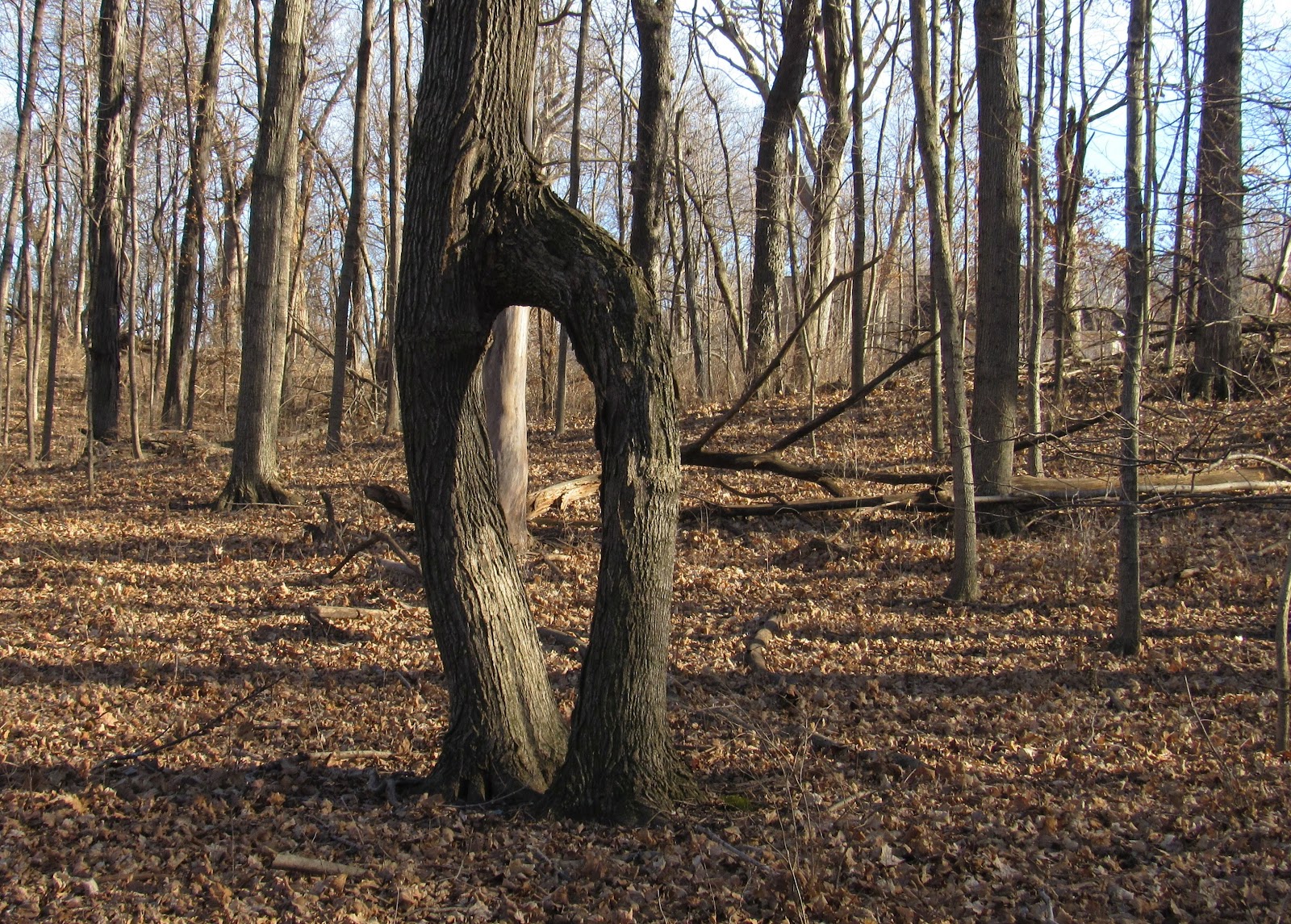
I then found this tree, which is not an optical illusion.  The top of the tree looked quite fun, but the trunk had done this strange loop.  I can't tell whether two trees have grown together or whether this one tree has split in two.  Regardless, it's unusual.


At this point, I went back to the burned-over area, where I found a tree still quite on fire!  I remained on the opposite side of a wide creek from the fire, just in case.


This fire eventually burned itself off when the branch broke.  The fall snuffed the flames out.


After seeing this, I spooked something large and round-faced into flying and landing in a nearby tree.  It was a Barred Owl! (Strix varia)  I took several photos, but it was so windy that all the trees in this photo were moving at once, including the one containing the owl.


I never got a "great" photo, but any photo of an owl makes me happy.  Another man showed up on the other side of the creek, and took photos of the owl, too.  It eventually flew off to another tree, harassed by a few small birds, and probably a little skittish around the two of us, unfortunately.


The other man turned out to be a former neighbor of mine, whom I had not seen in years and whom I had no idea was interested in nature photography.  We talked for a bit, spotting a few birds here and there. I tried to turn up a salamander, but I think it was just a bit too cold and dry for much activity here.  I did see plenty of new growth everywhere, so I know spring is coming!

Overall it was an odd mix of a day.  I spent the initial part of the visit putting out a few boards for future snake and amphibian searches. I'll have to see how the marsh does this spring after the burn...


Ebird Checklist:

http://ebird.org/ebird/view/checklist/S34336774

Wednesday, January 4, 2017

The Last Herps of 2016- Lick Creek Wildlife Area


One of my good friends was back in town, and Boxing Day (December 26), being in the 50s Fahrenheit, I figured it was worthwhile to look for salamanders.  I told my friend that we probably wouldn't find any, but I figured it would be a good excuse to test out my field hook.  The very first log flipped turned up a Smallmouth Salamander (Ambystoma texanum):


Many strange and different fungi also grew on the logs.


We also found hibernating invertebrates under the logs, including all these snails:


Overhead, a few hundred ducks and geese had flown, and then I heard a few odd-sounding geese, my first Snow Geese (Chen caerulescens) of the season:


After the two hundred-odd Snow Geese flew over, my friend Dan and I wandered into the marsh, while more and more ducks and geese flew overhead.


In the center of the marsh was a pond, and we walked out into it in our rubber boots.  Under the first six inches of water, silt, and duckweed was a slick layer of ice, which we occasionally cracked. When the ice cracked, we sank almost to our knees! It was the strangest sensation, walking on the ice on the bottom of a pond!  The ice rose in the center, as you can see below, to the right:


This marsh is quite beautiful, and little-visited because, well, not enough people know about it.  However, I somewhat appreciate the fact that Lick Creek is so little-known.  The fishing area usually has several people, but once on a trail (or even better, off one) there's little else but nature.


Overhead, surprising me, were three Turkey Vultures (Cathartes aura), some of the eight or so we saw that day.  Turkey Vultures have stayed further and further north in the winter.  Some say it's clearly global climate change.  Others say it's that with the abundance of roadkill, Turkey Vultures no longer need to migrate.  Either way, they're still far rarer in the winter than in the summer.


So too are Smallmouth Salamanders. There's one spot for them, near the edge of the marsh, that's almost certain to turn them up.  Even with the frost under the logs, we found five, and this is the last of those five.  I also think it shows how I need to improve my salamander photographing.  The moist skin and constant movement tends to make the salamander a blurry, oddly lit photography subject.


Looking out into the marsh, four small birds appeared to stand out a bit.  I had forgotten that Eastern Bluebirds (Sialia sialis) don't migrate far!  They are much brighter in person than in the photo below:


We then crossed a creek, difficult to do in rubber boots on ice and slippery logs.  The adjacent marsh, behind Piper Glen neighborhood, had a wonderful view of the creek.  As we had arrived here earlier, several hundred Canada Geese had departed from the ice on this section of the creek, in a thunder of flying wings.  While we wandered around, we also found our first owl, a Great Horned Owl that vanished into some nearby trees before I could get a photo.


Walking into the woods on the other side of the marsh, we came to a clear, beautiful stream draining Piper Glen neighborhood, and hopping about its banks was a Cricket Frog (Acris crepitans).  Considering it was 45 degrees Fahrenheit outside in late December, this seemed a bit odd.


Further investigations in the area nearby turned up some Witches' Butter fungi (Tremella mesenterica), which grows on branches high up and can be found on the ground when said branches break.  While supposedly not very flavorful, Witches' Butter is edible, too!


Looking north about this time, I spotted a juvenile-plumaged Bald Eagle (Haliaeetus leucocephalus), the first one I've ever seen anywhere near this part of the lake.


Walking further along the shoreline, we found even more, including these ants feeding on the sap from a freshly beaver-gnawed log!  Might I remind you, the date of this is December 26!


Then, we found the geese and ducks that had been flying overhead.  There were so many that it was impossible to get a photo of the complete group.  Furthermore, I somewhat... forgot to, in my excitement.   I did get a few Canada Geese (Branta canadensis) landing:


Out on the water, in the middle of the groups, I was looking for non-Mallard ducks, and I was not disappointed!  Three Northern Pintails (Anas acuta) are present below in the foreground.


Below, I spotted the Black Ducks, and then the Cackling Geese, among a flock of many mixed subspecies of Canada Geese and Mallards.  I'll let you guess where they are, before telling you:


Give up?  The Black Ducks (Anas rubripes) are in the front row of ducks about a third of the way in the center at left, and the Cackling Goose (Branta hutchinsii) (the most obvious one) is  a quarter of the way in center right, facing away, right behind the tail of one of the larger geese.


Above are my very first pictures of two American Wigeon (Anas americana), swimming in the center and right of the photo, as well as one Gadwall (Anas strepera), the duck with the "black butt" standing on the ice in the back left.


After watching the ducks for a bit, I returned to the trees, here beautiful with their bent branches against the sky.  We walked over to a marsh near the bike trail.  Another owl, this time a Barred Owl, took off, again before I could get a photo.  We then stumbled across a creek, with ice too thin to cross, too wide to jump, and no visible logs to cross.  As a result, we were detoured an hour or so trying to cross the creek.


We did find an area with a small pool, where the ice had begun to split, and we spent some time cracking the ice, moving it about  like tectonic plates, and generally having a good time.  After finally crossing the creek, we found a mysterious purple log, below:


Once we had crossed the creek, we found ourselves under the power lines, and we walked to the bike trail through the prairie- like clearing underneath the power lines.


Some colorful orange fungus grew on a nearby tree, right next to a few boards.


Under the boards, we found a log.  Under the log, we found a Chorus Frog (Pseudacris triseriata),  with which I took a quick, blurry photo and then replaced its cover.


Along the edges of the trail, we found several birds, including this Swamp Sparrow (Melospiza georgiana)  American Tree Sparrow (Spizella arborea).


Back in the woods on the other side of the trail, we found this handlike fungus:


We also found this small, smooth orange one, likely the same as before.  During this time, we spooked a third owl, a second Great Horned Owl, though as usual I failed to get any pictures. At this point, we were a bit tired, absentmindedly flipping logs on our way back.


One of those random flips eventually proved good, when we turned up this Bullfrog (Lithobates catesbeianus), the very last herp of the entire year.


After making it back to the road, my friend had a few burrs to clean off. I took the time to look for the last few salamanders (there were none) and scare a mouse from among the rocks.  On my way back, I spotted this lovely last flower of the year, a Dandelion (Taraxacum officinale), in full bloom alongside the edge of the road.  It might not be rare, it might not be native, but it's a flower on December 26, and it was the best Fifth Orchid I could ask for on such an amazing day.


Ebird Checklist:

http://ebird.org/ebird/view/checklist/S33219347