On Saturday, December 3, I ventured into Pike County, Illinois as part of the final field trip for Vertebrate Zoology, looking for Bald Eagles (Haliaeetus leucocephalus). Of course, that began with me running late out of my house to meet up with my classmates. On my way to meet them, I spotted a Great Horned Owl, which turned out to be one of the best birds of the day. thought sadly not in a photographable location.

We met up with a couple of other people and ventured on to Pike County (above). Pike County is one of Illinois' oldest counties, famous for its deer hunting (supposedly, but more on that later). In 1821, Pike County covered all of the counties north and west of the Illinois and Kankakee Rivers, including the Chicago area and what is now Calhoun County. Bits of land were whittled away until only modern-day Pike County was left.
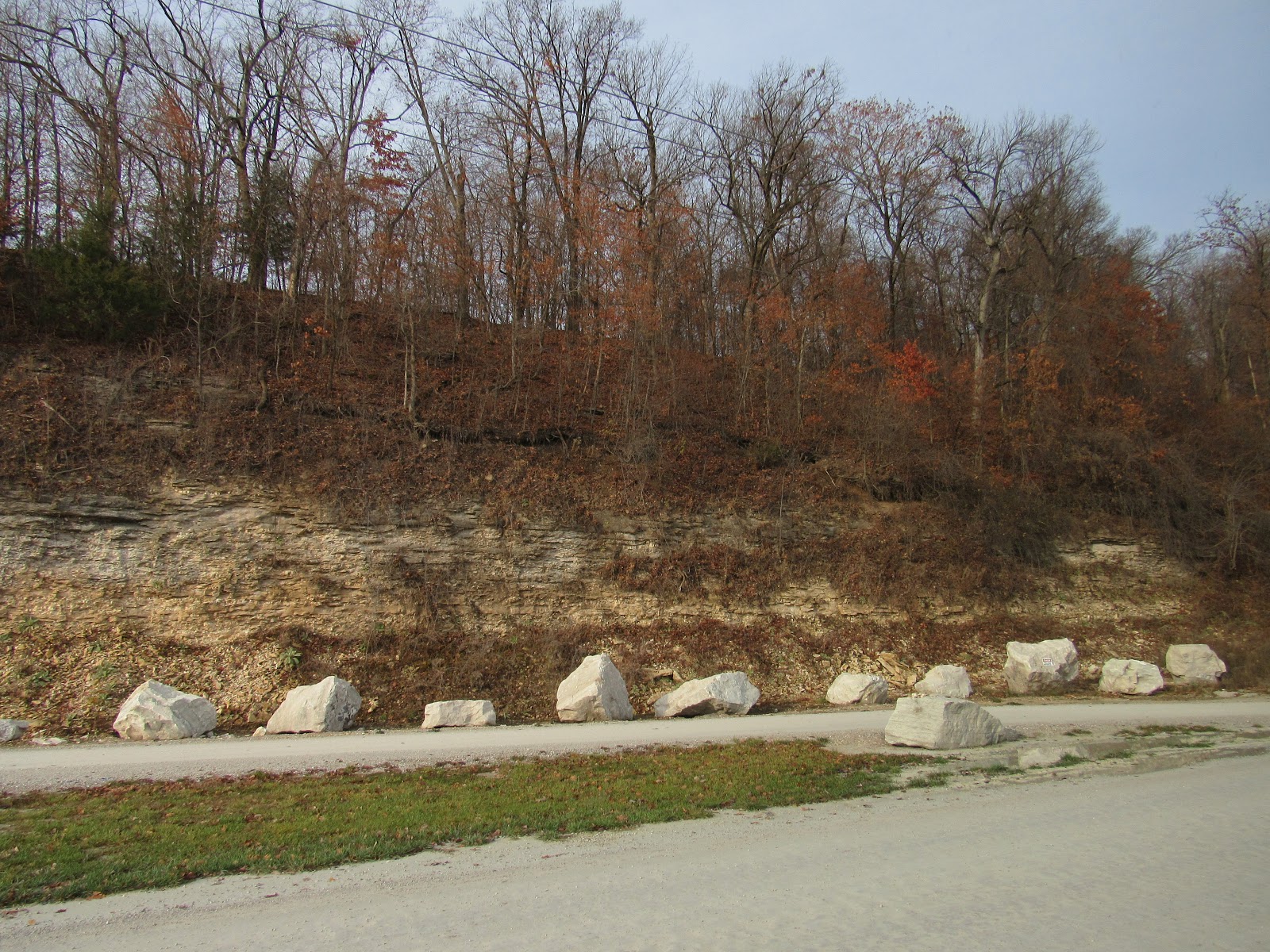
This is easily one of the most attractive counties I've ever visited in Illinois, with a diverse mix of rolling hills, rocky streams and robust woodlands. Our first stop in Pike County itself was the quarry/floodplain near the bridge at Florence. (We had seen some eagles and hawks just across the river in Scott County, in the floodplains west of Winchester.)

Here, a small, muddy lake and some brush around the edge provided us with a few birds, including these Song Sparrows (Melospiza melodia):


We also found several hundred circular rosettes of this plant growing in the mud. Any ideas?

From there, we drove along the river. This section of Illinois was badly affected by the flood of '93, and every house along the river built since that time is up on stilts. I didn't get photos of that, since we had a lot of ground to cover. The scenery was picturesque, too, at least for Illinois. I'd imagine even better earlier in the fall, when the leaves are still mostly on the trees.


We saw several Belted Kingfishers (Megaceryle alcyon) on our journey, and I believe all were males:


While stopped, I took a brief hike up to look at the bluff behind us:

While doing so, I found some Cedar Waxwings (Bombycilla cedrorum), and their associated berries:

We then drove on further down the river, encountering several mores species along the creeks, including American Tree Sparrows (Spizelloides arborea):
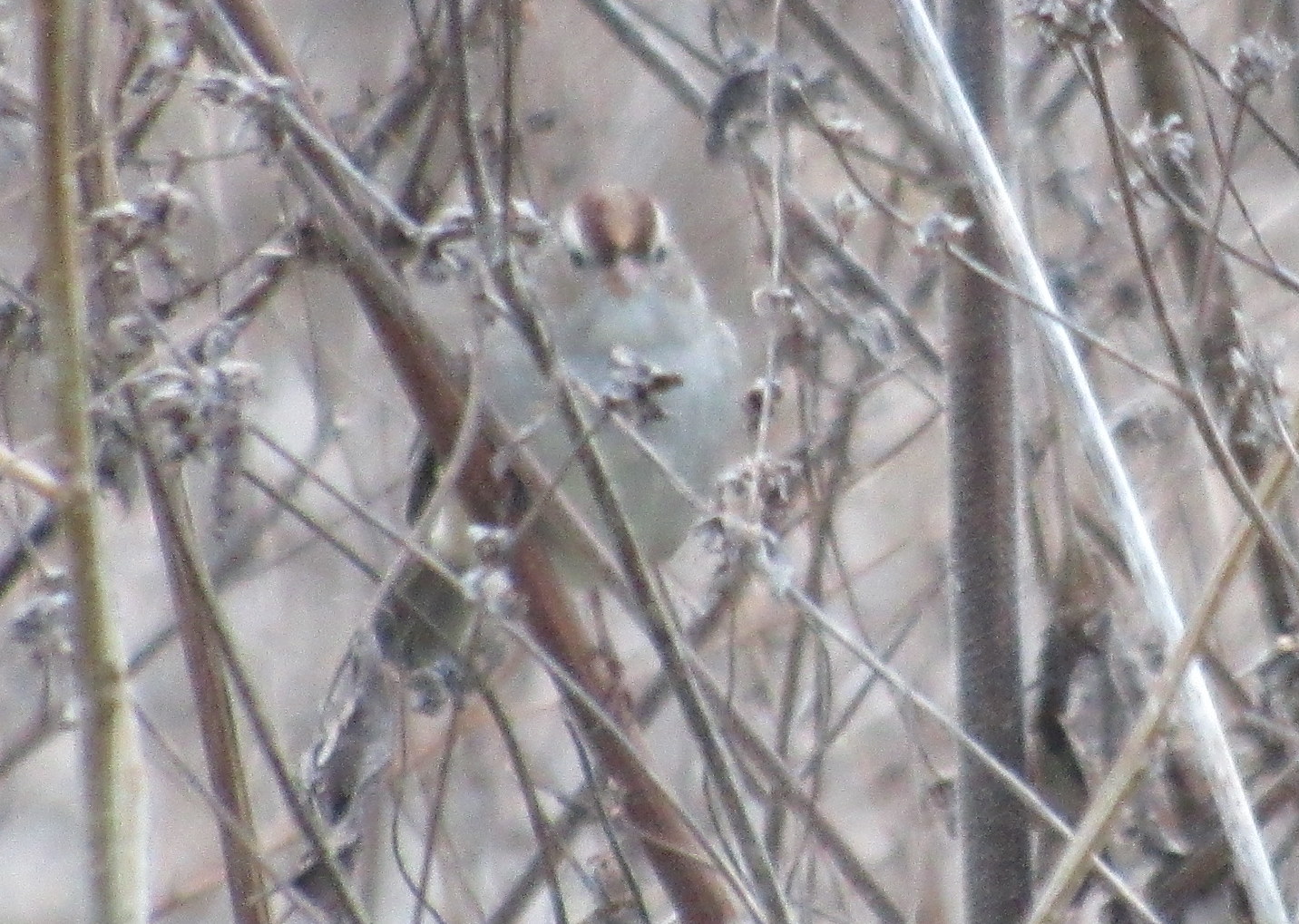
One of the local creeks was being used as a birdbath by all kinds of sparrows, as well as jays and cardinals. We lingered for a bit here, before moving on.

Several miles down the road, we came to a spring. I've never drank water straight out of the ground before, but it was quite fine water, for as much as a "city boy" like myself would know about it.

While there, I was sitting in the car eating chips, when deep in the woods across the road, I spotted a Pileated Woodpecker. As my mouth was full of chips, I could only mumble incoherantly. "El Presidente", who was sitting next to me, told me that he couldn't understand me. With my non-greasy hand, I flipped through my field guide, which is quite difficult to do with one hand, looking for the woodpecker section. In the meantime, the bird flew away. I eventually showed everyone the guide's picture of the Pileated, and explained. too late for them to see it. The moral of the story is don't eat too many chips at once! Just after this, we also found a turkey pelvis, and that was all. I have no idea how it ended up there, as intact and clean as it was. Here, the man who found it has it in hand:

We then went along and stopped at another spring, this one a bit further back in the woods:

Here, we found some amphipods. The amphipods (and an isopod) are hidden on this leaf, towards the back. We were dared to eat them, as a sort of challenge. Since they lived in a spring that people regularly drink from, we did. They have no flavor and very little texture whatsoever.

Having massacred the amphipods, we then posed for a photo above the spring:

After this, we went back on the road, going inland at Bee Creek and upland into the farmfields.

One of the fifty-odd Red-tailed Hawks (Buteo jamaicensis) we saw:

While driving around, we saw one Ring-necked Pheasant (Phasianus colchicus), but it got away before I could take a picture, to my chagrin. Imagine my surprise when a second pheasant appeared, in better view! This is the best photo I've ever taken of a Pheasant:

Further on yet, we spotted two American Crows (Corvus brachyrhynchos) and a Red-tailed Hawk in a showdown. The hawk eventually left, leaving the crows behind as victors.


Some of our group (possibly including myself) were dying to get out and stretch our legs. So we did. likely on someone's private property. Still, they forgot to post No Trespassing signs, unlike everyone else. Pike County is (supposedly) big deer country, and thus No Trespassing signs are everywhere. We spotted what appeared to be a bomb shelter, which turned out to be an old root cellar instead, and investigated an old barn in the distance, in the most badly timed photo I've done all year:

One of our party found a dead raccoon skeleton in the barn. Several others climbed up into the barn's upper layer. I would like to say that I did not do so for moral reasons, but I did not do so because I did not trust the flooring of the barn not to give way, and by the time I did, it was time to leave:

Several exciting, and mostly unphotographed miles later, we ended up in Pittsfield, where we had an excellent lunch at McDonalds. I would like to go out of my way to praise the Pittsfield McDonalds. It is rare that I get my order correct at any McDonalds, especially if I order a hamburger (notably, not a cheeseburger.) The Pittsfield McDonalds correctly made my order of hamburgers and fries, and thus sets an example for all the ones in Sangamon County that never have. I understand if some of my readers don't care for McDonalds, but in many small towns it's the only option. (In Pittsfield, this is not the case, but it was one of the few options, and we all didn't mind it, so we went there.)

Anyway, this is not a restaurant review service, but a nature blog, and that means back to Bald Eagles. After lunch (at around 2:30 PM) we went to Lake Pittsfield. Here, we saw five Bald Eagles:

All but one were immatures, patterned in shades of brown, black, and white, instead of the familiar white head and tail on black body. The size, shape, and bill of these birds is unmistakable, however:

They sat out on an old oak tree at the edge of a cliff above the lake:

Ebird Checklists:
Area before lunch:
http://ebird.org/ebird/view/checklist/S32845943
Lake Pittsfield:
http://ebird.org/ebird/view/checklist/S32845741