Showing posts with label Statistic. Show all posts

Saturday, December 31, 2016

Favorite Pictures of 2016 + Lifers of 2016!


Happy New  Year!


Swamp at Beaver Dam State Park


Water Willow (Justicia americana) at Lake Springfield

Mallard (Anas platyrhynchos) takes off at Center Park, Lake Springfield


Pere Marquette State Park


Sunbeams in Sand Ridge State Forest

Cedar Waxwing (Bombycilla cedrorum) in Michigan

Rapids of Sangamon River at Carpenter Park

Graham's Crayfish Snake (Regina grahmii) at Lake Springfield

Muskrat (Ondatra zibethicus) at Emiquon Preserve

 Least Sandpiper (Calidris minutilla) at Lake Springfield


Total Lifer Birds of 2016- 108 lifer birds


9 Birds of Prey: Northern Harrier, Rough-legged Hawk, Red-shouldered Hawk, Sharp-shinned Hawk, Barred Owl, Short-eared Owl, Merlin, Peregrine Falcon, Screech Owl

25 Waterfowl: Greater White-fronted Goose, Ross' Goose, American Black Duck, Gadwall, Northern Shoveler, Northern Pintail, Green-winged Teal, Blue-winged Teal, American Wigeon, Canvasback, Redhead, Ring-necked Duck, Greater Scaup, Lesser Scaup, White-winged Scoter, Surf Scoter, Bufflehead, Common Goldeneye, Hooded Merganser, Common Merganser, Common Loon, Pied-billed Grebe, Horned Grebe, Red-necked Grebe

2 Herons: Little Blue Heron, Black-crowned Night Heron

17 Sandpipers: American Golden-Plover, Semipalmated Plover, American Avocet, Black-necked Stilt, Spotted Sandpiper, Solitary Sandpiper, Greater Yellowlegs, Lesser Yellowlegs, Semipalmated Sandpiper, Least Sandpiper, White-rumped Sandpiper, Pectoral Sandpiper, Short-billed Dowitcher, American Woodcock, Stilt Sandpiper, Wilson's Pharalope, Marbled Godwit

8 Gulls and Terns: Bonaparte's Gull, Franklin's Gull, Sabine's Gull, Lesser Black-backed Gull, Caspian Tern, Common Tern, Forster's Tern, Black Tern,

47 Songbirds: Eurasian Collared-Dove, Common Nighthawk, Whippoorwill, Red-headed Woodpecker, Yellow-bellied Sapsucker, Hairy Woodpecker, Eastern Wood-Pewee, Willow Flycatcher, Warbling Vireo, Red-eyed Vireo, Yellow-throated Vireo, Blue-headed Vireo, Northern Rough-winged Swallow, Cliff Swallow, Sedge Wren, Winter Wren, Hermit Thrush, Wood Thrush, Yellow Warbler, Cape May Warbler, Pine Warbler, Northern Waterthrush, Orange-crowned Warbler, Common Yellowthroat, Hooded Warbler, Wilson's Warbler, Black-throated Green Warbler, Yellow-breasted Chat, Carolina Chickadee, American Tree Sparrow, Field Sparrow, Lark Sparrow, Savannah Sparrow, Henslow's Sparrow, Lincoln's Sparrow, Fox Sparrow, White-crowned Sparrow, Blue Grosbeak, Dickcissel, Bobolink, Summer Tanager, Eurasian Tree Sparrow. Purple Finch

OTHER ANIMALS AND PLANTS

 9 Lifer Reptiles: Spiny Softshell, Smooth Softshell, Common Map Turtle, Eastern Box Turtle, Six-lined Racerunner, Blue Racer, Chicago Garter Snake, Prairie Kingsnake, Graham's Crayfish Snake

5 Lifer Amphibians: Fowler's Toad, Western Chorus Frog, Spring Peeper, Smallmouth Salamander, Spotted Salamander

3 Lifer Mammals: Beaver, River Otter, White-footed Mouse

9 Lifer Fish:  Logperch. White Sucker, Redear Sunfish, Orangespotted Sunfish, Green Sunfish, White Crappie, White Bass, Yellow Bass, Yellow Bullhead.

Total Lifer Animals: 134!

70 Selected Lifer Plants (Orchids in bold, non-natives struck through):  White Cedar, Wood Betony, Green Dragon, Cream Violet, Hoary Puccoon, Fringed Puccoon, Pale Beardtongue, Small-flowered Skullcap, Tennessee Milk Vetch. Prairie Ragwort, Western Wallflower, Ebony Spleenwort, Goat's Rue, Field Horsetail, Marsh Fern, False Indigo-Bush, Purple Rocket, Gray's Sedge, Smooth Ruellia,  Silvery Bladderpod,  Prairie Sunflower,  Short Green Milkweed, Thimbleweed, Leadplant, Pale-spike Lobelia, Western Marbleseed, Hoary Vervain, Royal Fern. Round-leaved Sundew, Grass Pink, Yellow-fringed Orchid, Pink Ladyslipper, Spoonleaf Sundew, Rose Pogonia,  Bog Yellow-eyed Grass, Horned Bladderwort, Swamp Rose, Lowbush Blueberry, Kalm's St. John's Wort, Wild Lupine, New Jersey Tea, Hairy Puccoon, Prairie Phlox, Tall Thimbleweed, Skunk Cabbage, Michigan Lily, Eurasian Helleborine, Safflower, Allegheny Monkey Flower, Spotted Beebalm, Hemp, Halbard-leaved Rose Mallow,  Clammy Weed, Boxelder, Virgin's Bower, Eelgrass, Water Forget-me-Not, Swamp Rose Mallow, Hog Peanut, Rough Blazing Star, Field Goldenrod, Bronze Fern, Great Plains Lady's Tresses, Bradley's Spleenwort, Shortleaf Pine, Cliff Onion, Cutleaf Grape Fern, Rose Verbena, Giant Cane, American Mistletoe

27 Protected Species seen (State or Federal Threatened or Endangered):  Northern Harrier, Short-eared Owl, Osprey, Little Blue Heron, Black-crowned Night Heron,  Forster's Tern, Common Tern, Black Tern, Smooth Softshell, White Cedar, Tennessee Milk Vetch (also State-endangered), Silvery Bladderpod, Regal Fritillary,  Grass Pink, Yellow-fringed Orchid, Rose Poginia, Pink Ladyslipper, Leatherleaf, Round-leaved Sundew, Spoonleaf Sundew, Tamarack,  Buckbean, Eastern Hemlock, Kalm's St. John's Wort, Smooth Softshell, Bradley' Spleenwort, Shortleaf Pine,

26 New Nature Preserves visited- Carpenter Park, Manito Prairie. Sand Ridge, Henry Allan Gleason. Chautauqua NWR, Emiquon, Emiquon NWR, Matanzas Prairie, Scrub Oak-Sand Prairie, Revis Hill Prairie, German Cemetery Prairie, Pinhook Bog. Cowles Bog,  Loda Cemetary Prairie,  White Pines Forest, Castle Rock, Nachusa, Rogue River, Calamus Lake, Spitler Woods, Bois de Sangamon, Piney Creek Ravine, Fults Hill Prairie, Horseshoe Lake, Cypress Creek NWR


Y'know, some people have really hated 2016, but for all the reasons above, I've kinda enjoyed it.

Friday, December 23, 2016

Top Ten Lifer (Vertebrate) Animals and Top Ten Lifer Plants of 2016

Top 10 Lifer (Vertebrate) Animals of 2016

Honorary Mentions-  River Otter, Sabine's Gull, Cape May Warbler, Peregrine Falcon, Smallmouth Salamander


10.  Spotted Salamander (Ambystoma maculatum)-  The best find of a spectacular day, under a log atop a dry bluff (an unusual spot for salamanders).  While it's by no means the rarest possible animal that can be found at Fults Hill, it's one I've never seen, it's colorful, and it was in an unusual location, although I'm beginning to not believe in the concept of usual and unusual locations anymore.


9.  Little Blue Heron (Egretta caerula)-  I don't know how, but I somehow knew that I would find this bird when I went to the Beachhouse one day.  It's an interesting example of something not really explainable, and an example of what I said before about not believing in usual locations.  This is a Southern bird that migrates north in late summer, which is atypical and very interesting to me.


8. Blue Racer (Coluber constrictor foxii)-   I have to say this is the best snake species of the year.  I've always wanted to see one, and now I've seen two, under my very first flipped piece of tin ever!  Plus, it's yet another example of the awesome wilds of Mason County producing something amazing.


7.  Northern Harrier (Circus cyaneus)-  This is the bird that got me into birding.  Well, it ties for that with the Ruddy Duck, but as I've seen Ruddy Ducks in previous years I'm going to go with this one.  It's one of my favorite moments I've ever spent with my dad, chasing this hawk down in a car in rural Sangamon County before managing to get the photo above.


6.  Beaver (Castor canadensis)-  This animal is not one I see often, and as I am fond of the book "The Lion, the Witch, and the Wardrobe", in which a pair of beavers play a crucial role, I am fond of beavers by extension, and one made my day back in April, and again in October.


5.  Eastern Box Turtle (Terrapene carolina) -  The highlight of a day in Macon County, Eastern Box Turtles are among my favorite Illinois animals, and seeing this particular one under a metal canister was quite a surprise.  I was even more surprised to find a second one a month or so later at Lincoln Memorial Gardens.

4.  Common Gallinule [no photo]-  This bird appears to be parts of several birds mismatched together, with its oversized feet, chunky body, and small head.  That's fine by me, considering I saw two of them back in March in Sangamon County.  Both the time and place are incorrect for these birds to be here, and yet there they were.  This is also my greatest missed photo opportunity of 2016, and as a result, the sighting remains unconfirmed, according to Ebird.  However,  I do know what I saw.


3.  Least Sandpiper (Calidris minutilla)-  Moving from none to best on the photography scale,  I got, well, probably too close to this little bird when I found one on Marine Point this spring, but it seemed to tolerate this.  Between this and #1, I've now got a strong interest in sandpipers.


2.  Common Loon  (Gavia immer)- These are my favorite birds (when I have to actually pick a favorite, as many people ask me for one).  The only reason they're not higher on the list is that I saw them where I expected to see them, on Lake Springfield.  I did not expect:


1. American Woodcock (Scolopax minor) -  Maybe not my favorite bird, but as far as quirky little creatures go, it rises to the top.  Between its adorable "dancing" and awkward appearance, the Timberdoodle makes #1 on this list. Besides, none of the rest showed up at my house. Now I just want to find its cousin, the irritatingly unseen Wilson's Snipe!


Plants-  Notably, about half of these were at Indiana Dunes, and the majority of the rest were from Mason County expeditions.

Honorable Mentions:  (Both Indiana-native species of) Sundews, Safflower, Silvery Bladderpod, Yellow-fringed Orchid,  Grape Ferns (both Bronze and Cutleaf varieties)


10.  Hoary Puccoon (Lithospermum canescens) - This may seem like an odd choice to include when I've seen far rarer plants, but the fact remains that this is the first plant I recognized in Mason County, and it's one I've always wanted to see before then.  It's a beautiful reminder of the odd flora of Mason County's sandlands, and as such I can't wait to look for it again next spring!


9.  Shortleaf Pine (Pinus echinata)-  This was easily the best tree I've seen this year, on a day full of exciting discoveries.  The Eastern Hemlock doesn't make it here simply because I found them last November.  This also wins best gymnosperm (out of two contenders for that title, I might add.)


8.  Royal Fern (Osmunda spectabilis)- I had to include a fern.  This is easily the largest fern I saw, and one of the few I've managed to identify this year.  Fern identification is an arcane, esoteric, nearly-mystical art form.  I have no idea how many of the small ferns are identified correctly.


7. Goats' Rue (Tephrosia virginiana)- I've spent a long time looking for this plant over the last few years, and it's always nice to knock one of these nemesis plants off my list.


6.  Michigan Lily (Lilium michiganense)-  The first, and so far only, wild true lily I've ever found, this is one of the most beautiful native plants I have ever seen.  I found a couple of these within three days of each other, and I haven't ever repeated that. Hopefully, next year I'll get Turk's Caps!


5. Tennessee Milkvetch (Astragalus tennesseensis)- Easily the rarest plant (or, to be honest, the rarest ANYTHING)  I've seen all year, this only gets fifth because it isn't an orchid.  Nevertheless, this was still an awesome plant to find! It amazes me that it grows only a few hundred feet from a person's house.  It feels like a plant you should only see hundreds of acres into the middle of nowhere.


4.  Eurasian Helleborine (Epipactis helleborine)-  This orchid species originated the term "Fifth Orchid" on this blog, as in a surprise discovery at the very end of the trip.  Since I haven't found a birding, botanizing, or herping term to match its meaning, I keep saying it.  This is also the only nonnative of either plants or animals in my top ten lists.


3. Great Plains Ladies' Tresses (Spiranthes magnicamporum)-  This is the closest native flowering orchid I've found to me, as well as the only orchid I've found in Central Illinois (though by no means is it the only one around here).  I've always wanted to see one, and they are quite tiny, I have learned.


2.  Moccasin Flower (Cypripedium acaule)-  This is a Ladyslipper Orchid, finally! I  don't include it as #1 simply for lack of flowers.  However, seeing a Ladyslipper Orchid has been a goal of mine since at least fifth grade.  I got very close in 2015, so actually finding quite a few in 2016 (albeit out of flower in Indiana where I knew they grew) made my day, almost as much as:


1.  Grass Pink Orchid  (Calopogon tuberosus)-  It was easy to see, it was easy to photograph, and it's an orchid and looks like one.   Grass Pink Orchids have been eagerly sought out by me since I first saw their picture, and like the best plants and animals on this list, it was a complete surprise to see it.

 If you haven't noticed, I use the (just-invented) Spanish Inquisition Rule in assessing how much I like something. If I didn't expect it, then it's even better.  I give this its name from the Monty Python skit about the Spanish Inquisition, where the characters are constantly saying  "Nobody expects the Spanish Inquisition!".   This Spanish Inquisition Rule, like the concept of the Fifth Orchid, will now pass into the lexicon of this blog (all of which can be found on the uppermost right, above the ad.)

Since this is the last post I'll be putting out till after the 25th, Merry Christmas!

Tuesday, September 20, 2016

Vertebrate Zoology Field Trip Journal #4: Carpenter Park-100th Post!


This is the hundredth post on my blog.  Wow.  I wasn't sure at points whether I was going to continue with this website.  It's not always easy for me to have these posts out, and certainly not in time.  Often, there are days, like the one described below, where I just scrap an entire blogpost because the pictures don't work out or there just wasn't much to write about.  My last blogpost, however, I posted to an email group of birdwatchers, and it got me several kind emails in reply, full of advice and ideas.  If you're one of those people, thanks for reading this blog and emailing me!  

Carpenter Park State Nature Preserve

Friday, September 9, 3:45 to 5:00 PM

Temperature: 80 degrees Fahrenheit

Weather:  Mostly cloudy, with intermittent brief rain, winds negligible.


I'll be honest, getting to Carpenter Park was terrible.  As I drove down there on the highway, a septic treatment truck, with a loaded septic tank on back,  switched lanes so that it was in front of me.  It then began to leak, at sixty-five miles an hour.  There were some words said as the contents of the tank intermittently splattered against the windshield, hood, and front grille of my car.  Thankfully, it turned off a few miles later, though not before leaving a few semi-permanent stains in the front of my car.  Running late, I raced to meet up with the main field trip.  I caught up to them, finally, with my tale of woe, and a car desperately in need of a wash.  The trip was nominally taken in search of snakes, but none were to be found.   We missed out on seeing any warblers here as well.  We could hear a Pileated Woodpecker calling, but it remained out of view, sadly.


Initially, however, all we could seem to find were Eastern Wood-Pewees (Contopus virens).  We did spot a Swainson's Thrush or two, and we could hear Blue Jays and a Black-capped Chickadee calling.  However, these are, with the exception of the Swainson's, all among the most common Illinois birds.  No other vertebrates could be seen at this place, which was usually teeming with life.  Only one form of life was widespread and everywhere; that was the mosquito.


Out in the prairie section, the Gray Catbirds mocked us from the edge, while American Goldfinches (Spinus tristus), about eight of them, bounced around the weeds on the path ahead of us.


With the general lack of vertebrates, I was soon distracted by plants, and this colorful False Foxglove (Agalinis spp.) was a good distraction.  These prairie flowers, while not state-listed, aren't exactly a common find for me.  Partially parasitic, False Foxgloves steal water and nutrients from the roots of other plants, which makes these botanical semi-vampires quite bizarre and fascinating to me.


Also, this time of year, the butterflies are on the move, and we found this tiny yellow one, resting on the leaves of a Cassia plant.  It was around the size of my thumbnail.


Back in the woods, we found several more Eastern Wood-pewees and a Red-bellied Woodpecker.  Far more exciting than these common birds was the Gray Treefrog  (Hyla spp.) we also found.  My computer, for no explicable reason, wants to have this picture vertically oriented:


I also spotted an unusual fungus or two, something quite easy to do at Carpenter Park:


Finally, we made it out to the banks of the river, where Boneset and Hibiscus grew.  Still, there wasn't even a heron visible!  We contented ourselves with an American Robin and a Chimney Swift or two flying overhead, and dipped back into the forest.


On the way, our professor stopped for a photo inside this tree.  The mosquitoes and mud made this section a bit unbearable, so we moved on quickly, heading for the bluff.


With the lower water levels, the rocks at the base of the bluff were exposed:


A Northern Cricket Frog (Acris crepitans) hid among the pebbles and debris on the banks of the Sangamon River, defying us to find it when it weren't moving.  These frogs, the size of crickets, are among North America's smallest vertebrates and our most plentiful frogs.  Can you see it?


The birds were also more visible.  We spotted several more Chimney Swifts catching bugs above the treetops, as well as a pair of Mourning Doves and a Downy Woodpecker.  Of course, this paled in comparison to what we found when we got atop the bluff.  An adult Bald Eagle flew right past us as we climbed up the bluff, going east along the river, so suddenly that we failed to get pictures.  After a few minutes, we spotted a second, juvenile Bald Eagle flying near a group of eight Turkey Vultures to our southeast.  This was the highlight of the day.


We made our way back to the parking lot during a brief rainshower.  I waited around with a couple of our party, trying to see what birds were in the trees around the parking lot.  We turned up several more Eastern Wood-pewees and a couple of White-breasted Nuthatches (Sitta carolinensis), including one hiding in the photo below.  It's a short list, but at least we had a Bald Eagle and a Gray Treefrog.  I would not recommend returning to Carpenter Park anytime soon, however, unless you are especially resistant to mosquitoes.  I'll certainly be back... after frost.


Ebird Checklist:

http://ebird.org/ebird/view/checklist/S31503123

Friday, August 26, 2016

Matthiessen State Park- 1 Year Anniversary!

It has been about a year since I published my first blogpost on this blog.  Man, that's hard to believe.  I recently figured out that I've seen 76 birds, 8 reptiles, 4 amphibians  3 mammals, and 70-odd flowers  new to me, and I visited 20 nature preserves new to me, since I first started working on this blog on August 29 of last year. I've written 93 published blogposts in that time, mostly about Central Illinois.  When I first started writing this blog I wasn't sure how much I could write about Central Illinois, as at first glance it appears to be a Lincoln-obsessed cornfield.  It's ironic that in this particular blogpost, I'm revisiting the first place that convinced me Illinois was more than corn and soybeans. Matthiessen is one of the first state parks I visited when I was younger, and its beauty, rockiness, and large number of plant species made me far more interested in Illinois than ever before.

The day after finding that Little Blue Heron at Lake Springfield Beach, a friend and I took a road trip to Matthiessen, which is in northern Illinois, just across from Starved Rock State Park.  I liked it a bit better in the past than Starved Rock, however, mostly due to its lack of crowds.  That preference was tested a bit on this trip.


In  order to explore an area neither of us had ever been to, we pulled off along the Vermilion River section of the park.  This is also known as the river bluffs section,  On the route in, I discovered the Hog Peanut (Amphicarpaea bracteata) above, a native plant new to me, although fairly common here in Illinois.   As I've begun hiking a LOT more this year, it has become apparent that I really haven't seen many of our native plants or animals.  As you read above, I've done a bit to rectify that, but not enough.  Of course, there never will be enough.  If there's one thing I love about exploring nature, it's that there are endless discoveries just waiting to be made.

Indeed, we made a discovery as we hiked down into the valley: a spot with open bluffs and some boulder fields below.  Large cliffs are rare in Illinois outside of the Mississippi River Valley, and on a smaller river like the Vermilion, large cliffs are even rarer.  Also, this section of the Vermilion River, between Lowell and Oglesby, is one of the few places in all of Illinois to have whitewater rapids.


We  came to the edge of the water, as had a few bathers and fishermen, to see the rapids.  Large gravel beaches opposite looked inviting, but there was no way we were crossing the river.  One curious fact about the Vermilion River is that there are two of them, both flowing in opposite directions, but with headwaters in the same general area, a former upland marsh near Roberts, Illinois.  This one flows into the Illinois River, and the other flows into the Wabash River.  Both contain a number of high-quality nature preserves and are among Illinois' most scenic rivers.  The Middle Fork of the other Vermilion River is Illinois' only National Wild and Scenic River.  With a bit of sediment removal, this river could probably qualify for the same.


This section of Illinois is also among the most geologically diverse.  I found crinoid fossils, granite, limestone, sandstone (the cliffs in the area are mostly sandstone) and fool's gold (iron pyrites):


Among all these rocks, I was surprised at the lack of snakes or frogs.  That's not to say there was nothing interesting, as I've never seen this unusual species of grasshopper before:


Picking our way along the edge of the river, we made it to the base of the bluffs.


Along the way, we found Monkey Flower (Mimulus ringens), the more northern of the two common Monkey Flowers in Illinois.  I only found my first earlier this summer at White Pines Forest.


A degraded prairie awaited us at the base of the bluff, with several Goldenrods, among other flowers.


At  the very bottom, we found wet clay.  This part of Illinois is one of the few to contain claypits.


The cliffs themselves were up to fifty feet high, and the steepness of the boulder field at their base made them inaccessible.  We stood at the base of the cliffs for a few minutes, before the heat and time drove us back to the treeline.  After that, we had lunch in our car.


While driving to the more well-used Dells section of Matthiessen State Park, we saw that the parking lot was almost filled, and dozens of people were milling about the entrance.  This did not bode well.  We abandoned our plans of visiting Starved Rock, which is usually far busier at the best of times, and contented ourselves with dodging the crowds at Matthiessen's "dells".


After walking quite a ways past several screaming children, barking dogs, and noisy families, I found a Eurybia aster on top of the bluffs, with several small, brightly-colored bees or wasps on it:


Also on top of the bluffs was a state-threatened tree, the Northern White Cedar (Thuja occidentalis):


This tree is a northern plant brought this far south likely by glaciers.  Several dozen of these trees grow on the rim of the "dells", actually one large canyon containing a stream flowing south into the  Vermilion River- the north-flowing one. You can see why two Vermilion Rivers is confusing.


As  we walked into the canyon, we found this large millipede (Narceus spp.), about four inches long. This millipede is among the largest invertebrate animals in our area.  Also, yes, it is pooping.


All over the walls of the canyon, various liverworts (above), mosses and ferns grew.  The permanent shade of the canyon was also about ten degrees cooler than on the bluffs above.  This microclimate makes for excellent summer hiking, and there were large numbers of people around to prove that.  I had to time my shots in order to avoid getting people in the picture:


This area is supposed to be an excellent place for salamanders, and I suspect that it is.  However, I have never seen one.  Then again, I haven't stopped to flip many rocks, which is the best way to find salamanders.  As we were on a bit of a time crunch, we kept moving.


I did stop to photograph any unusual plants we found, including this fern I haven't identified.


We  continued up the creek, where the creek became underlain with sandstone.  Eventually, we reached the top of the canyon, at Lake Falls.


The upper part of Lake Falls is actually a dam, so this waterfall is at least partially artificial.  Above the waterfall is a lake and a privately-owned golf course.


On  the way back, I photographed this natural arch.  A friend of mine squeezed through it, and it's certainly a tight fit.  Don't try this at home, or here.


Further downriver, a fence bars access to the top of Cascade Falls, the dividing point between the generally rock-bottomed, narrower Upper Dells and the soil-bottomed, wider Lower Dells.  That bridge above is where I got the picture earlier overlooking the Lower Dells.


Several mineral springs in the Lower Dells result in streams with scarlet waters.  It almost seems as if the ground is bleeding in several places.  Also, there's a TON of mud.


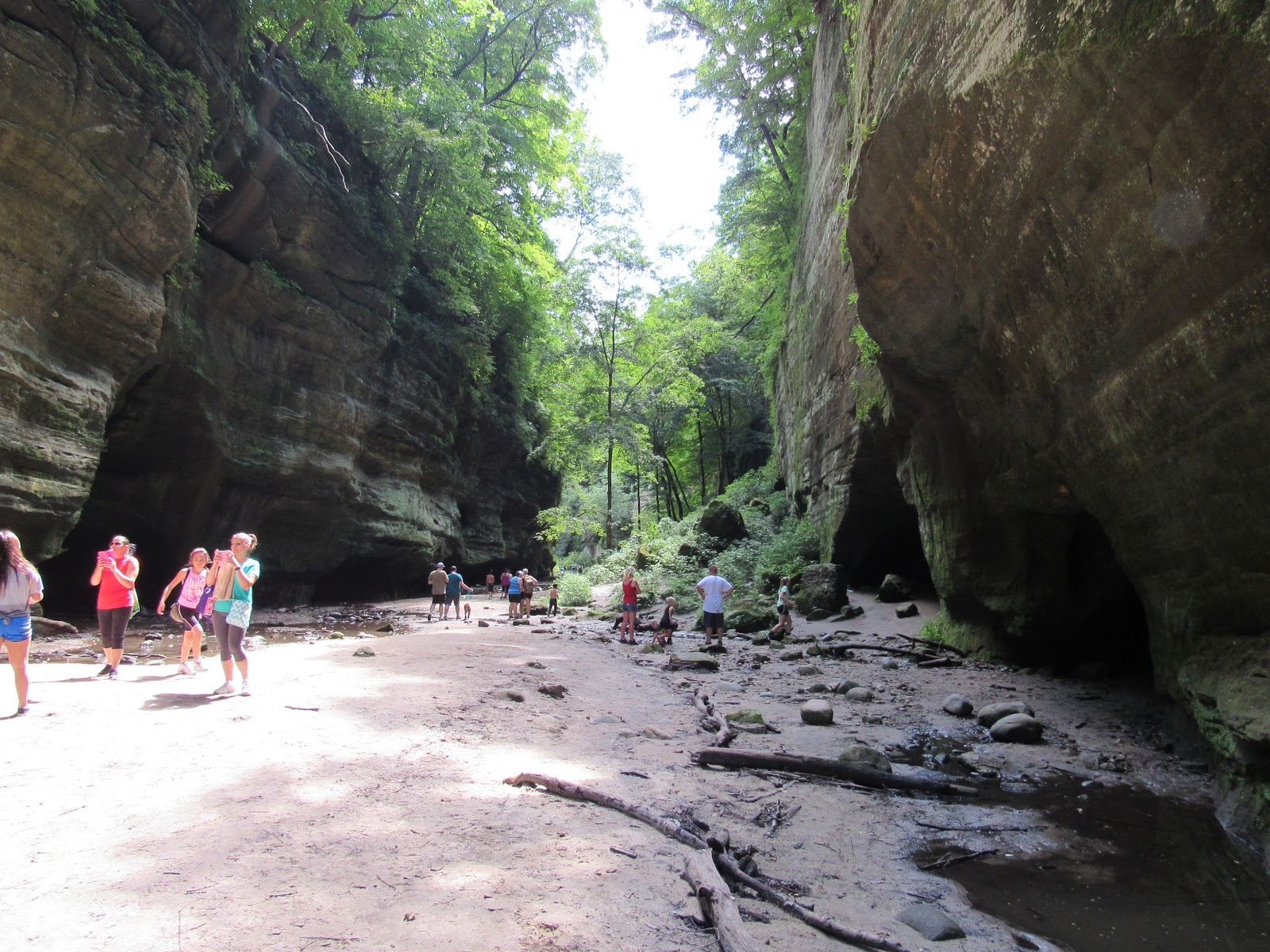
The surrounding cliffs, some fifty or more feet high and whitened with lichens, funneled the crowd as we walked towards the waterfall.  I took this picture during a rare crowd-free moment. Here's what happens when I don't wait for those fleeting crowd-free moments:


There were at least a hundred people, probably two hundred, in this small, narrow canyon, splashing about in the water, complaining loudly about the mud or just bumbling about.  My friend and I didn't exactly diminish the numbers, so I can't complain too much.


The area is understandably lovely, but it needs a little more protection.  The first fine weekend towards the end of the summer in any natural area near Chicago does mean crowds.  However, when I see people glued to their cell phones while letting their dogs or kids run free, many chiseled names in the rock that were put there since I last visited, upwards of fifty discarded water bottles (in the upper dells alone). and about a hundred people illegally swimming in every possible body of water, it makes me a bit depressed at the large crowd.


Also, at least twenty wet, muddy pairs of socks were thrown down at various points and left there. This really took me over the edge.  JUST, WHY!  THERE'S GARBAGE CANS FOR THIS! It's a good thing I never saw anyone throw off a water bottle or pair of socks. I mean that it's a good thing for them.  Environmentalist rage is one of the purest forms of anger, and as this place was one of the parks that helped to spark my love of botany and Illinois nature, seeing it degraded infuriates me.


Thankfully, there were still many ferns to love. My friend and I decided to venture downstream to get away from the people.  By the way, neither I or the DNR recommend going south of the last staircase.


At  the base of the cliffs, several swamp and wet prairie wildflowers bloomed.  A couple of rarer plants are supposed to be found here, but I observed none of these.


The mineral-rich scarlet waters from the largest mineral spring, Devils Paintbox, run into a nearby creek.  The Lower Dells has several of these, most in varying shades of orange-scarlet.


My  guess is that iron is the contaminant making the waters so red, but I really have no idea.  I am fairly sure that the name Vermilion River comes from the reddish hues of these springs near its banks.


Either way, this part of the gorge has several differing fern species, none of which I identified.


As we walked along the canyon, we saw the end approaching.  It was at this point that the mud made it virtually impassible. Several times, I nearly fell into the creek or the mud, it was so slick.  Eventually, I managed to pass by and we scrambled out onto the rocks alongside the river.


The river at this point was beautiful.  Slanted rocks on our side gave way to gentle rapids and a large gravel island near the far bank.  Of course, a picture does it better justice.  A few bathers swam upstream of us, but for the most part, the area was crowd-free.  There's probably a rule against straying from the trail, and knowing the muddy conditions, I wouldn't walk that way again.  Still, it was a fine day, and I'm always glad to have gone hiking.  Despite the crowds and trash, Matthiessen is still one of my favorite state parks in Illinois.  It's places like this that inspire me to keep working on this blog, a year from when I started it.


Hopefully, I'll still be doing this a year from now.  I'd love to work on this blog my whole life.  Of course, when I move out of central Illinois, it'll need a bit of a title change.  Although, Abraham Lincoln lived on Earth, so I could qualify that Earth is the wild Land of Lincoln in the big picture.  I do like inoffensively anachronistic titles.  We'll have to see.  Either way, it's been a fun year of blogging so far, and I will likely keep on blogging for awhile yet.

By the way, it's really, really hard to photograph your shadow, even when it looks almost like Indiana Jones with the hat you're wearing.  Happy trails.