Showing posts with label Hemlock Research. Show all posts

Monday, July 4, 2016

How To Make A Quaking Bog


This weekend, I found orchids!  But we'll get to that...

I visited  Pinhook Bog in Michigan City, Indiana, near the southern edge of Lake Michigan.  The southern coast of Lake Michigan, between Sleeping Bear Dunes and the Door Peninsula, is one of the most biodiverse spots on the North American continent, culminating at Indiana Dunes National Lakeshore.  The National Park Service runs Pinhook Bog.  You can walk around the moraines above the bog, or on certain Saturdays from 12-3, you can visit the gated-off bog itself.   We arrived a bit early, so we hiked around for a bit above the bog.


I'm hoping someone knows what species of butterfly this is.  All I know is that it sat still long enough for one good photo, before fluttering away.


There are ravines here, in loose soils of the Valpraiso Moraine, and filled with old trees, though there were holes in the canopy where Emerald Ash Borers had killed off ash trees around the forest.  Emerald Ash Borers are making their way down to Central Illinois, and will be here within five years, according to all predictions.  I hate those bugs.  But I digress from lighter topics.


On the forest floor, this toad (Bufo sp.) hopped along, blending in with the forest floor perfectly.


We soon came to a bridge over a pond connected to the bog.  A true quaking bog like Pinhook Bog has no natural outlet, so any water that flows in remains in the bog's basin.  As a result, the water is full of tannins and other natural chemicals that make it a brown-black in color.


The only place I've ever seen with similarly colored waters was a swamp in Florida.


Upland, we found boulders every so often, considered to have been left behind by glaciers in the moraine,  A moraine, by the way, is a great ridge of land that a glacier leaves behind when it reaches its furthest extent.  To put it simply, think of a bulldozer.  As it goes along, it scrapes the land along in front of it, pushing soil and rock.  When it stops, it leaves a pile of whatever it scraped off in front.  A glacier is essentially God's bulldozer, and a moraine is the mound of dirt left behind.


Dense growths of Ostrich Ferns (Matteuccia struthiopteris) could be seen in wet places.  It isn't only soil and rock that were scraped south by glaciers, but soil and seeds, too.  This species of fern reaches its furthest south around the same area as the  the southern limits of the most recent glaciation, according to geologists.


Oh!  This is an Eastern Hemlock (Tsuga canadensis), growing near one of the wooded ravines.  They aren't recorded from northern Indiana.  These might have been planted, but I doubt it.  I suspect that there are far more Eastern Hemlocks in the Chicago/Gary vicinity that previously believed, considering this is my second time finding an "unrecorded" population.  Make no mistake, there are trees of several ages here.  It definitely looks like a natural or naturalized population.


In the woods nearby, this Cedar Waxwing (Bombycilla cedrorum) flitted about, always in motion. These birds love berries, and ripening blueberries and raspberries in the area attract them like flies.


At a nearby creek, we could see a large number of rocks which had eroded out of the moraine.


 Throughout the duration of  the trip, Gray Catbirds (Dumetella carolinensis) sang, hissed, and meowed all alongside us, in the bushes.  I finally found this one in a dead ash tree.

As it was now time for the bog to open, we exited the trail and went back to the parking lot.  A couple of rangers showed us in on the unlocked path.  Along the edge of the bog, the strange Lizard's Tail (Saururus cernuus) bloomed, an interesting species of wetland plant.


The rangers then opened the second gate, and we hiked into the outer ring of the bog.  About this time, my dad and I heard a Sandhill Crane call from someplace deep in the bog.  We never saw the bird, sadly.


A quaking bog is arranged in layers, starting with the outer belt around the edge.  The outer layer of a quaking bog seems to be the most variable.  This one was filled with ferns, which was fine by me.  I can't identify most ferns, but I really like them anyway.


Underneath all of the plants is a thick mat of Sphagnum Moss. also known as peat moss.  Underneath this moss layer, there is a large body of water.  It is this mass of peat moss that holds up all the plants  in the quaking bog.  By the way, it's called a quaking bog because the entire bog shakes when one part is moved.  For instance, if you jump up and down on the boardwalk, the entire bog around you will quiver, because the two are attached.


This is a cross-section of Pinhook Bog.  According to geologists, quaking bogs form when a large blog of ice breaks off of a glacier, leaving behind a depression that fills with water, known as a kettle-hole lake.  For a true bog to form, there must be no outlet of water, either through a stream or underground.  Eventually, this lake fills with sphagnum peat moss from the sides inward.  As the mat thickens, herbaceous plants and then shrubs and trees grow on the mat.  The peat moss mat thickens and dead peat sinks to the bottom, slowly filling in the bog.  Eventually, the entire bog fills in with peat, and the area is covered over by regular forest.  This process is known as bog succession.


The Water Arum (Calla palustris), is a far northern species found in only one county in Illinois and three in Indiana.  This plant is much more common up in Canada, where there's thousands of bogs.
Plants like this are incredibly rare


Above are Royal Ferns (Osmunda spectribilis), once ground up for use as orchid potting soil.  That seems like a promising sign...


Oh!  What's this hiding underneath?  It's my very first Ladyslipper Orchid, the Pink Lady's Slipper (Cypripedium acaule).  Unfortunately, it's out of flower by about a month.  This is very rare plant here in the Midwest, but out in the Northeast, it's supposed to be fairly common.


A few seconds later, I found this orchid (plant in the center), though again, it had no flowers.  My personal guess is that it's an Orange/Yellow Fringed Orchid (Platanthera ciliaris), which bloom in late July and are even more rare in Illinois than the last orchid.

Growing on the bog near us were full-sized trees, though none very tall.  As the bog's soils are only a few feet deep, the trees could easily tip over in strong winds.  The  needle-leafed tree is the Tamarack (Larix laricina), another Canadian plant growing far south of its normal range.

I've decided to cut this post into two parts.  Read on in part two for carnivorous (insect-eating) plants and orchids actually in flower.

TO BE CONTINUED...

Sunday, April 17, 2016

Top Ten Best Moments of First Quarter of 2016


Winter is over here in Central Illinois.  I figured it was time to do a recap of the best (nature) moments of that season, as that is the first season in which I sincerely dedicated a good portion of time to this blog.  (I'm just going to run it through March, and since we're still getting frost warnings and have juncos,  I believe that qualifies.  Until the juncos go north, it's still winter.) I'm also writing this post as a sort of index of what's worth reading on my blog from January-March 2016.  This article is thirty-three posts condensed into one. with links to the top fifteen or so posts.  I know a lot of you are busy, so this is kind of a "catch-up" article.


Honorable Mention: Being Published In  "The Lamp" Newspaper

Well, seeing my work in print is a fun experience.  I actually haven't released my second article out on this blog, partially due to the fact that it is about Eastern Hemlocks.  It will be released out here soon.  Also, the picture above which went with the article and  which I have actually set as my phone background, was taken by my brother.  He did not receive credit, so I am giving it to him here.


10. Discovering Marina Point

This is one of the three best birdwatching areas around Lake Springfield, along with Lincoln Memorial Gardens and Center Park.  I knew about the other two, but I had no idea of Marina Point until recently.  As you can see, the ducks and gulls are enjoying it immensely.


9. New Deer/Turkey Record

59 deer and 27 turkeys is a huge number of wild animals to find along one road.  Yet, all the way back in January, that's exactly what I did at Chatham Wildlife Sanctuary.  A recent visit had three deer and no turkeys, and the animals seem far more common in the winter.  Still, it's worth a visit.


8. Finding Common Gallinules  At Lick Creek

(The picture above is from an old trip to Florida) Well,  I mean, it's not every day you do something like find a State-Threatened  Endangered Bird.  (Well,  I just looked it up, and it's even rarer than I thought, in this state.)  So far this year,  I've seen four State-Endangered birds (Short-eared Owl, Common Gallinule, Northern Harrier, and Osprey), as well as two which have since been removed from State-Threatened listing (Pied-billed Grebe and Brown Creeper) and were incorrectly said to be State-Threatened on earlier posts.  Sorry about that.  Here's the checklist I am using.


7. Common Loons In Breeding Plumage

( Look how much the photo quality improves over the years)  Common Loons may not be rare, but this is my favorite Illinois bird...


6. An American Woodcock In My Sideyard

...Although Timberdoodles are a close second.  Finding this bird was such a surprise to see in my suburban neighborhood.  I even got a video, which is posted on Youtube and linked here.  Whether called Woodcock, Brush Snipe, or Timberdoodle, this bird is basically the Illinois version of the New Zealand Kiwi, and is not nearly well known enough.  These birds dance for worms, literally.


5.Rediscovering Eastern Hemlocks in Illinois

I know I keep harping on this, but this is one of my favorite moments, and was easily the best thing I did all of last year.  The rediscovery this year at Starved Rock State Park, confirming that this IS a native population, was an excellent day, which I stretched over three posts.  (For those who don't know what I'm talking about, go here.)


4. Seeing Short-Eared Owls/Northern Harriers

These two State-Endangered birds are what got me into birding.  On top of that, meeting someone  I didn't know who reads my blog was even better.  See here for more details.


3. Fourteen Duck Species in One Park

Yeah, this was the second luckiest I got this year in terms of birds, and it came just when I started out birding.  If Short-eared Owls got me into birding, this is what got me hooked.  Despite birding for hours on hours afterwards,  I actually haven't repeated my successes of that day.  It is now a record to beat.  To recap-  I saw Ruddy Ducks, Common Goldeneyes, White-winged Scoters, Greater Scaups, Lesser Scaups, Redheads, Canvasbacks, Ring-necked Ducks, Mallards, Hooded Mergansers, Buffleheads, and Common Mergansers.  Here and here are the two articles, for more information.


2. Being Detained as a Terrorist

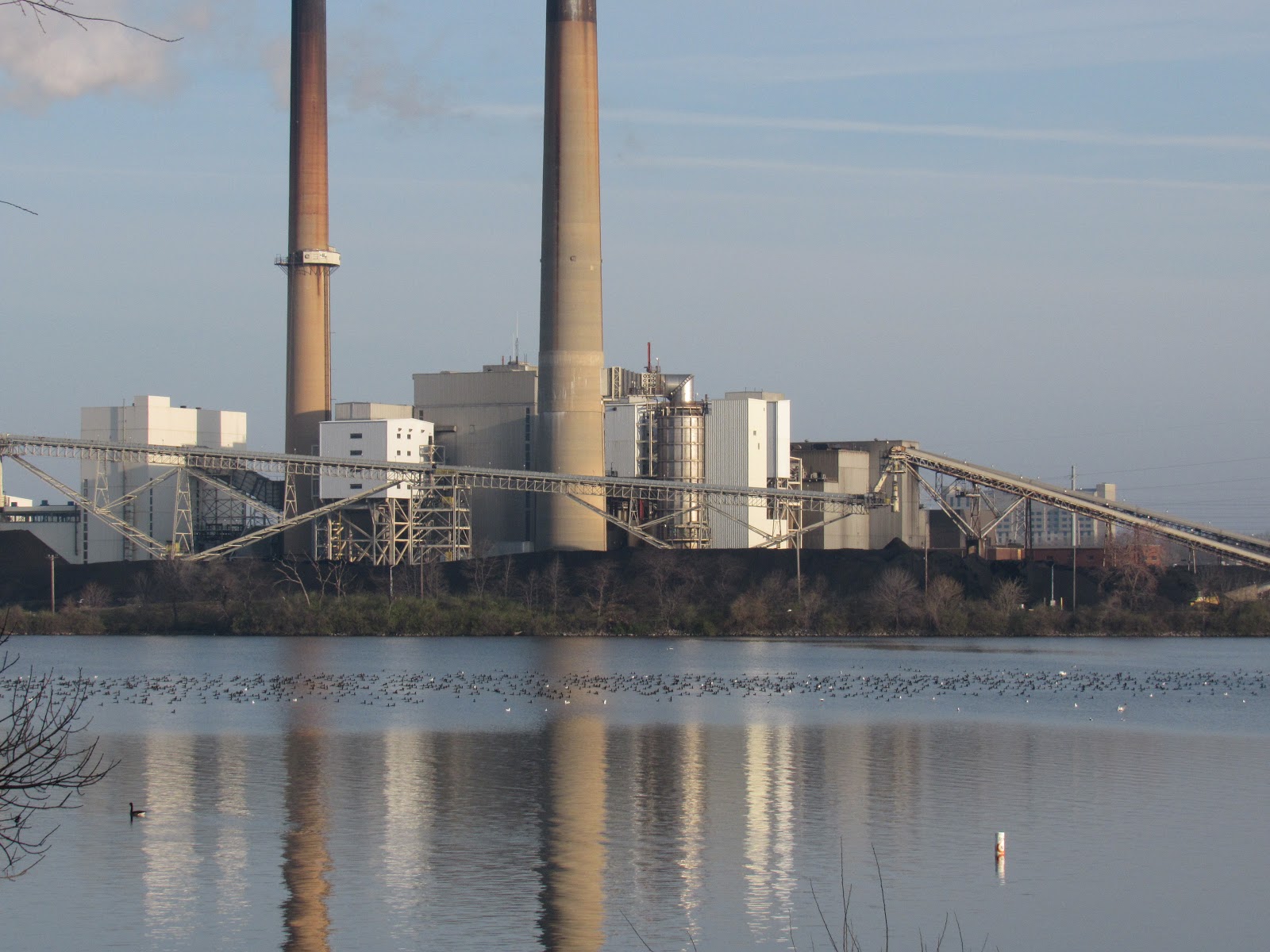
The expression people have when I say this is good enough, but the complete story is even better.  For the anecdote alone, as well as the fact that a government institution in Illinois is actually acting competantly, I give this my  #2.  To recap:  I was taking pictures of gulls in the direction of the power plant with a fancy camera.  Two Conservation Police officers saw me and asked me to step over.  They wanted to examine my pictures.  What I didn't know, as I showed them the pictures, was that my brother had taken a picture of Mom making a silly face.  As a result, the officers and I had a good laugh.  We went our separate ways.  Since the officers had called me over, it was technically detainment, and so I get to use that phrase.  Later, on a separate trip, I snapped the above picture deliberately, as a joke,( and also for the cormorant flotilla in front of it, but this was a different trip.)


1.The Ides of March

This insanely lucky day was so great that I  had to write two blogposts about it.  Seriously.  That day goes down in the annals of this blog.  It will be on the list for top ten of this year, easily.  And to think...  If I had gone ahead after lunch and skipped my chemistry lab, it probably wouldn't have happened as it did.  I had in fact, considered going off and skipping lab, as my usual lab partner was sick that day.  Instead,  I went after lab, first to Lincoln Memorial Gardens and second to Nipper Wildlife Sanctuary as a field trip.  Both were great experiences.  I was also very lucky to get decent pictures, as the upload glitched, resulting in a near-catastrophe and considerable hair-pulling.  That was the day I saw my first loon, my first chorus frogs, my first fairy shrimp... It was a huge day.  The colorful Eastern Garter Snake (Thamnophis sirtalis) below was a bonus.


I  recently learned that I am going to visit the Smokies this year, so I can't wait. Expect that in a couple months' time.  And to think...  I'm not even in my twenties yet. I've gotten two flexible part-time jobs,  my schooling is going pretty well, and I have a LOT of great friends, many I made or drew closer to this year.  It's a wonderful life, and I know I don't deserve all this.  Thank you,  God.  You've done way, way more for me than I could even begin to do back, and as that is how it should be, I am so thankful for all that I have.  Also, thanks to all my friends, especially the ones who put up with the Russian folk music between hikes, and to the many nature bloggers online who inspired me to write my own blog.  It's fascinating to me how in the middle of this busy week, I still feel thankful.  I suppose it's the birthday cheer, because I turned nineteen the day I wrote this.  I'm really not trying to brag, it's just that I don't understand why good things keep happening to me, and I  feel so thankful for it right now.  Anyway, expect the Smokies in a few weeks' time.


Sunday, March 13, 2016

A Very Ice Place To Visit (Ottawa/Kaskaskia Canyons): The Great Starved Rock Expedition of March 2016


The recent snowfall suited the canyon well, as we walked into the last hike of the day.  I promised that we found something here that not even the IDNR resident at the park knew about, and this is true.  Guess what, it's an Eastern Hemlock  (Tsuga canadensis):


A single, twenty-foot tall hemlock tree grew in  Kaskaskia Canyon.  This is the only wild Eastern Hemlock  I have seen outside St. Louis Canyon.


However, Kaskaskia Canyon is most famous for a massive shelter bluff, seen above.  It's hard to appreciate exactly how big this bluff is, but it is probably 40-50 feet tall and about 100 feet wide.  The dark stain on the back of this bluff was made by Native American campfires.  Facing southeast, this bluff provides the ideal location for a residence, as it is near a stream, out of the wind, and large enough for a few families to live under it.  There is a history of human habitation here that stretches back thousands of years.


A few small icicles clung to the edge of the rock.  This area was full of icicles, some of the largest I have ever seen.


Most of the canyon was bare of ice, however, but the rocky canyon walls, free of foliage, were easily seen.


The few green plants, such as the hemlock, stood out boldly in contrast to the rest of the canyon.


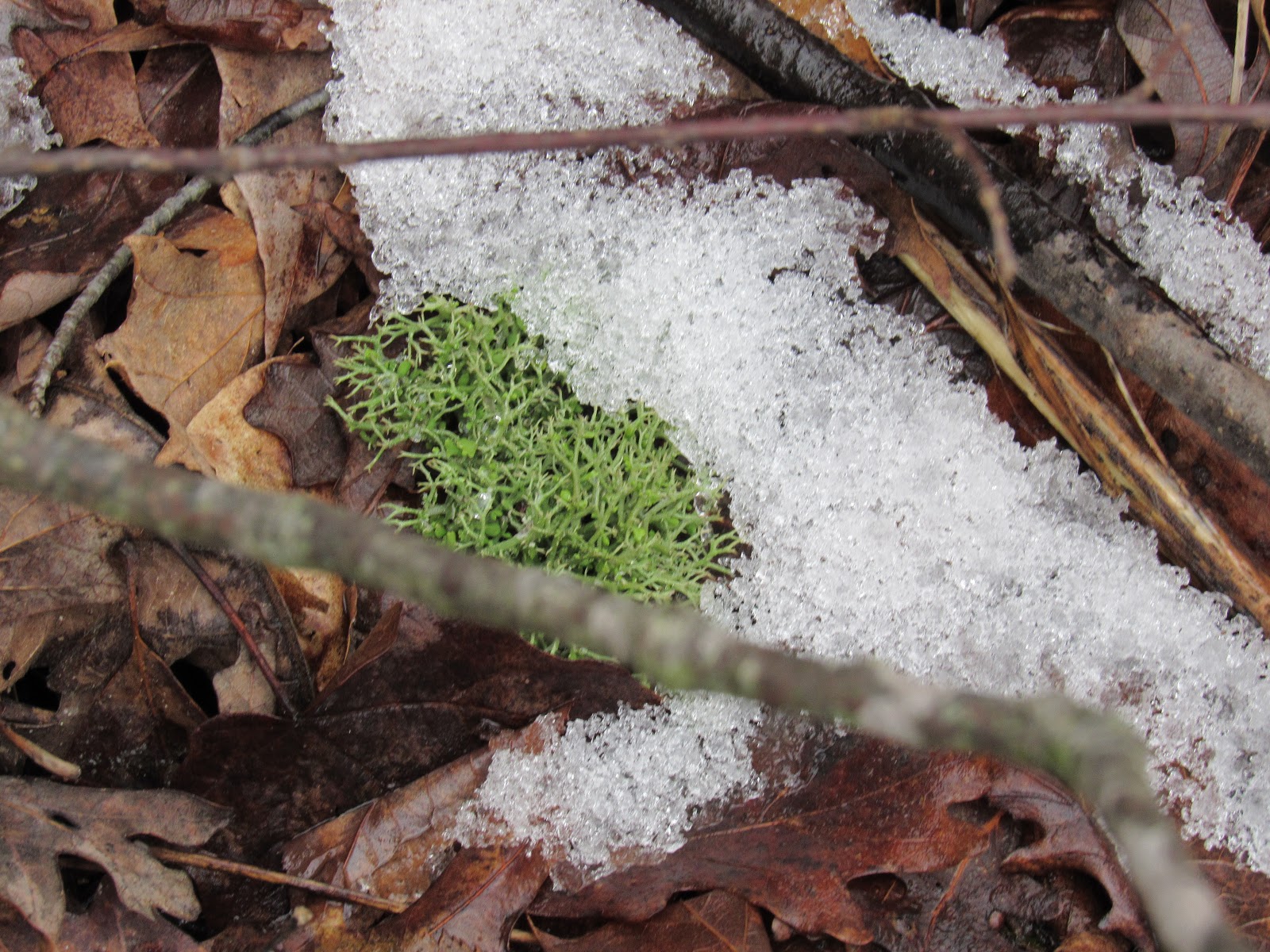
On the ground nearby, a few tufts of foliose lichen had fallen from the canyon walls.  Foliose lichens are one of several signs of a high-quality natural area, especially in this state.


The rocks nearby were really quite uniquely shaped.  This shelter bluff reminded me of a bridge, waiting to be fully carved out of the rock.


On average, the bluffs were 40-50 feet high, occasionally higher.


Here, the dripline, where the stone overhangs prevent moisture from reaching further inwards, are very clearly seen.  Almost no plants grow nearer to the cliff than the dripline, as the dry, sandy, permanently shaded region at the base of the cliff is nearly impossible to grow in.


Does this not remind you of a tongue sticking out?


Here, one gets a sense of scale.  This place was huge.


Here's the waterfall at the back of Kaskaskia Canyon.  It's one of the shorter waterfalls.


Ice has formed on the downed trees, right next to the waterfall.  While the water is warmer than freezing, the air isn't.


Can you spot the man in the blue jacket?


As usual, there were mysterious plants.  This vaguely resembles Hieracum or Krigia, and i'd tend to guess the former, as it was growing on a sandstone ledge.  All around it grew liverworts (Marchantia spp.), an uncommon type of nonvascular plant.  When I say uncommon, I mean in the wild in Illinois in general, not at Starved Rock specifically.  As liverworts prefer constant moisture and rocky surfaces, they are common in the park's canyons.


Here's the "tongue" of ice seen earlier.  It appears that some passerby has knocked the bottom off this large icicle, giving it this shape.  The snow and ice made the canyon far more beautiful this time of year than usual.


Here, you can see the way that the stone walls of the canyon make it feel less like a "box" canyon and more like a  "trapezoid" canyon.  (If you haven't had geometry in a long time, just use Google.)  This is, I think, one of my best pictures of Starved Rock that I have taken.


Here, another unknown plant, likely Geranium, Hydrophyllum, or Phacelia, pushes up from the leaves.


Despite the snow, spring is certainly coming, as the emergent leaves of Spring Beauty (Claytonia virginica) show here.  In southern Illinois on the warm blufftops of Pere Marquette State Park, this species is already in flower.


The thick sheets of moss growing on the side of the cliffs demonstrates how wet the area is.  This species of moss might possibly be a clubmoss, as it appears to have short stems.  As I do not know this for certain, I cannot say as such.


The rock here almost seems to have flowed around the tree on the left.


Ottawa Canyon is a side branch of Kaskaskia Canyon.  It winds its way back to a taller but equally cool waterfall.  (Pun completely intended.)


I could spend an entire month here just examining the differing kinds of moss.


We reached the back of Ottawa Canyon.  For a sense of perspective, this waterfall is about thirty feet tall.


The ice here was some of the most spectacular yet.  The small trickle of water had, over the last few weeks, formed a strange lower ice sculpture at its base.


Here, the splash pool of the waterfall was partially frozen over, unlike Kaskaskia Canyon.


This unique natural ice sculpture was likely the base of a former icefall which had vanished in the freezing and thawing of late winter.  It was about fifteen feet wide.


A few icicles had frozen over at the edge of the fall.  A secondary icefall had also formed.  I wonder, now, how much of that had disappeared of the course of this week?  I do know that the waterfalls are probably flowing better after this week's rains.


The man in the center left of the picture is about six feet tall, for scale.  The grey stone and the white slope were such a stunning contrast.


Two bluffs formed a natural narrows of Ottawa Canyon at its entrance.


As we walked out of the canyon, we saw this.  These old shelf fungi are not naturally green.  Instead, algae have grown on top, due to the moisture of the melting snow.  Below is the entrance of Kaskaskia Canyon.


This was the last hike in the March 2016  Starved Rock Expedition.  I have just learned that a rare orchid, the Spring Coral-Root Orchid (Corallorhiza wisteriana), dwells in the sandy moss beds in St. Louis Canyon.  There is an expedition in the works for May to see this remarkable plant, which grows without ever using leaves and generally is ignored by the majority of people as looking like a stick.  Spring is nearly here. and it's about time.  I'm tired of winter, and as I've made it a goal to see orchids this spring,  I darn well better live up to that goal.

History Fact:

President Teddy Roosevelt went on a Amazon expedition after his Presidency and nearly died of bacterial infection.  The infection, while he recovered somewhat from it, ruined his health and cost him any further attempts at the Presidency.  He died less than five years later.