Showing posts with label Rare Birds. Show all posts

Wednesday, June 7, 2017

Finding Three Lifers in a Flooded Cornfield (Four Corners, Meredosia NWR)


The last day of May was one of the better days I've birded this year.  I was going to visit Emiquon and look for a vagrant White-faced Ibis and Western Kingbirds, but the Ibis had left and the Western Kingbirds will wait for now, since they're a breeding species. Furthermore, I couldn't find any birders to go along. So, after 17 Dunlin and two Red-necked Pharalopes were reported at Four Corners in Morgan County, I decided to go looking, as I'd never seen either species.  I started out ambling in the country, up towards Beardstown, a town to which surprisingly I've never been before.  Dickcissels (Spiza americana) (above) sang along as I went.

Evidently Beardstown has a marsh.  All I found in it was Red-winged Blackbirds (Agelaius phoeniceus) and Wood Ducks, as well as a calling Sora, not seen but heard.  A Sora is a type of rail, little birds with  tendencies to hide in marshes and make weird sounds.  Ordinarily, a Sora would be the best bird of the day, but not on this particular day...

Four Corners was the next place I stopped.  This place, south of Beardstown near Meredosia, is a series of large fluddles, or flooded fields, around a four-way intersection of two county roads.  At the time of my visit, the flooded zones were the size of small lakes, and they had been there for at least a month or two, allowing much life to grow in them.  This mixture of insects, worms, and algae was the perfect stopover for migrating shorebirds, including...


Dunlin!  These were the first lifers of the day.  Dunlin (Calidris alpina) are a fairly common shorebird, but one I'd continued to miss for some reason.  They are the long, thin-billed birds with gold backs and black bellies above.  Dunlin migrate from the edge of the Arctic Ocean, far above the Arctic Circle, all the way to the Florida Coast in the winter, and then back again.


Forster's Terns (Sterna forsteri) sat by, and a Common Tern flew off before I took this photo!  Both of those are State-endangered, because while they're very common migrants, they only rarely breed in Northeastern Illinois.


Can you spot the Red-necked Pharalope?  It's got a white belly and white cheek patch.


 I met up with Vaughn Suhling here, and we birded from about 4:45 to 7:15 PM.  These Blue-winged Teal (Anas discors) were only the tip of the iceberg when it came to birdwatching here.


About two dozen Black-necked Stilts (Himantopus mexicanus) roamed through the fields, often flying at other birds.  The Killdeer would chase off the Semipalmated Sandpipers, and the Black-necked Stilts would chase off the Killdeer.  I presume this aggression is a display of these birds defending their nests, as I've seen something similar at Emiquon.


One of my favorites were the thirty-two Black Terns (Chlidonias niger) flying overhead.  Black Terns are another Illinois State-endangered species, primarily because they nest in freshwater marshes in far Northestern Illinois- much like Forster's Terns and Common Terns.
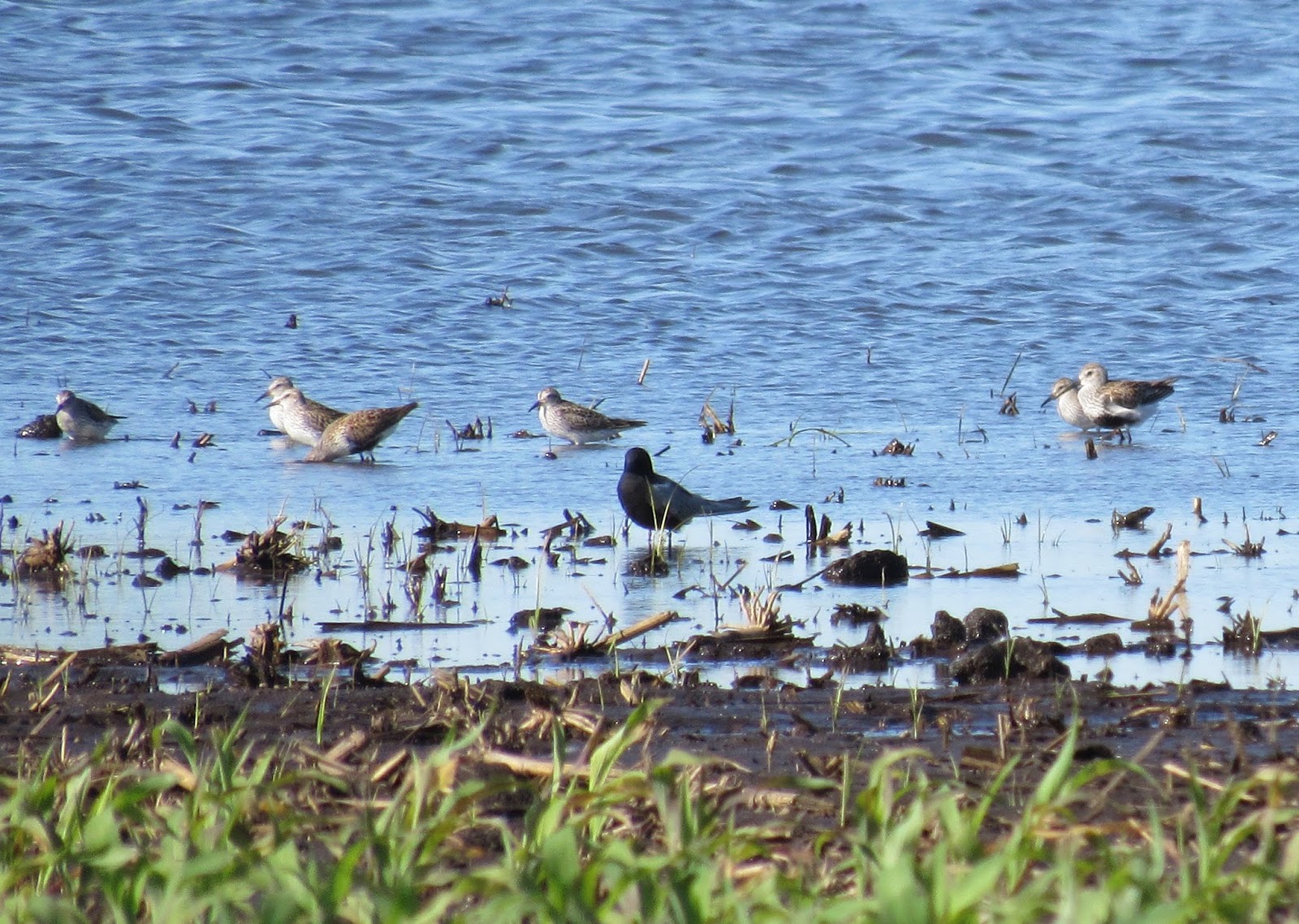

A few White-rumped Sandpipers (Calidris fuscicollis) hid among the terns on shore.  These are distingushed by having longer wings, slightly larger size, and white rumps when in flight.


Dunlin and White-rumped Sandpipers weren't the only species present. The majority were Semipalmated Sandpipers (Calidris pusilla), the small, pale, plain ones in the photo above.


 A few Stilt Sandpipers (Calidris himantopus) also hung about, including this one cleaning its feathers. They were a nice side bonus to the day.

The highlights, however, were the Phalaropes.  Phalaropes are among the oddest birds in the world.  The Red-necked Phalarope (Phalaropus lobatus)below in the center (Killdeer [Charadrius vociferus] on the left, Semipalmated Sandpiper on the right) is a female, and the females are more colorful than the males.  This is common among humans, but generally not among birds. Furthermore, Phalaropes are in the group called shorebirds, but the Red and the Red-necked Phalarope both winter out on the deep sea, eating plankton and swimming on the surface of the water, far out of sight of shore.  Odd for a SHOREbird!


 Perhaps most fascinating about this group of shorebirds is how they feed- they spin in a circle to produce a current and stir up their food.  At any rate, this was my first Red-necked Phalarope, and these aren't easy to find in Illinois during the spring, so I was quite happy!


A second one can be seen on the left side of this photo.  I watched them spin for a bit, among the many Semipalmated Sandpipers, before moving on.


Other odd birds included State-threatened Wilson's Phalaropes (Phalaropus tricolor) (right, above) and  a pair of late Northern Shovelers (Anas clypeata).  Duckwise, I saw 5 Blue-winged Teal,  the 2 late Northern Shovelers, and 2 (breeding) Hooded Mergansers, which with Mallards and Wood Ducks makes 5 species- not bad for the end of May! The photos of these birds, so far away, were obscured due to the haze of humidity from water evaporating out of these ponds.


We were briefly interrupted by the arrival of a speeder getting pulled over, and this inspired us to go looking for Common Gallinules where they breed nearby.  We found one of these state-endangered birds, among a flooded marsh/prairie with breeding Pied-billed Grebes and American Coots calling, when a Black-crowned Night Heron (Nycticorax nycticorax) showed up.  This State-endangered species is rare away from Northeastern Illinois and Emiquon, to my understanding.  I also saw a Green Heron, a Great Egret, and Great Blue Herons here.


Calling Dickcissels  were everywhere, as, deeper in the grasses, were Northern Bobwhites and Ring-necked Pheasants.  A few Indigo Buntings also sang, though I didn't get any good photos.


We then went over to the nearby Meredosia National Wildlife Refuge, looking through prairies with the bluffs above the Illinois River in the background.


A few American Goldfinches (Spinus tristis) hopped about in a field where the uncommon if uncomely Henslow's Sparrows had been seen, though we heard and saw nothing more exciting than a Grasshopper Sparrow, another little brown bird non-birders don't care about, here.


Next, we went looking for a Blue Grosbeak at another spot, just north of this.


This spot had my first Illinois Orchard Oriole (Icterus spurius), though I did recently see a few of these for the first time in Missouri, in this post here.


Last migrants, the Cedar Waxwings (Bombycilla cedrorum) are flying north, and I've seen a few hundred in the last few weeks or so, mostly at times and places it's inconvenient to record them.


Little Common Yellowthroats (Geothlypis trichas) love grassy areas throughout the state, and they are one of the few warblers I can easily find in Illinois.  After finding a few more birds, but not our target Blue Grosbeak, we turned around, only to spot something...


My second-ever in Illinois Blue Grosbeak (Passerina caerulea), a female, looked over at me from its perch and posed perfectly for the camera.  This is one of several bird species far more common at Meredosia National Wildlife Refuge than most other spots in Illinois.


Another bird in that same category is the Yellow-breasted Chat (Icteria virens), and here's one below.  This unique "thrasher-warbler" (it's a warbler with the song and behavior of a thrasher/mockingbird) is one of the more common "rarities" in Illinois.  It seems to me that birds in Illinois sometimes have their rarity determined based on how many times they are seen in Chicago. Chats seem fairly easy to find in sandy, brushy areas downstate.


Just as we began to leave again, a state-threatened species, the Black-billed Cuckoo, a third lifer for me, flew across our path and into the bushes.  We stopped leaving once more, and began looking for it.  Black-billed Cuckoos are a nemesis of mine I'm glad to have conquered, albeit with a lack of a photo.

Though we didn't refind it, I did see a Bell's Vireo (Vireo bellii) and took its photo.  These rarely-seen birds were calling all over, but I hate to report them if I don't see at least one.  This is usually about as much as you see of a Bell's Vireo, and to be fair, it isn't the most exciting bird in Illinois.  The fact that I found my first one only a week before is far more exciting to me, however.  Bell's Vireos are a little gray Western bird that are locally abundant in Illinois.  Some spots have many, most have none.  They like shrubs on the edge of prairies in western Illinois.


 I drove back home along the scenic bluffside roads an extremely happy man. Three lifers is a very good day, and with all the other birds on top, today was probably my best birding day of this spring. And I wasn't even expecting to go to Meredosia as of that morning!

 Bird of the day, among so many good birds, would have to be the Black-billed Cuckoo, followed by the show-stealing Black-crowned Night Heron and the Red-necked Pharalope. However, over half of the birds I saw today would be the highlights of any other average day. Heck, seven of these birds are state-listed as threatened or endangered. (To be fair, the Black, Common, and Forster's Terns and the Wilson's Pharalope are kind of cheating on that, since they're fairly common migrants.) Seeing the state-listed Black-billed Cuckoo, Common Gallinule, and Black-crowned Night Heron made my day just as much as the lifer shorebirds. Thanks to Vaughn for showing me around!


(P. S. I had one last stop at Centennial Park, just a second or two late for the setting sun, but not too late to capture the Foxglove Beardtongue spectacle at the park's prairie restoration)


Ebird Checklists

Four Corners (I have 51 species- this may be my longest checklist ever!)

http://ebird.org/ebird/view/checklist/S37301701

Meredosia National Wildlife Refuge

http://ebird.org/ebird/view/checklist/S37301834

Monday, May 29, 2017

"I don't think I'll find THAT many new birds..." Visiting the Ozarks, Part 3

Ozarks Spring 2017 Series
This is Part 3


One of the most unexpected highlights after the first hour or so of hiking in the Ozarks was the birdlife.  Almost none of the birds were migrants, save for a Veery or two I heard.  However, the breeding birds I got to see and hear were incredible. Every morning and evening at our cabins, this Indigo Bunting (Passerina cyanea) would come out and sing.


The pond behind our cabins was simply spectacular.  It was called Beaver Pond, but there was a lack of beavers.  I'd call it Birdwatchers Pond, personally.  The birdlife here was full of birds I'm not used to seeing in Illinois.  The Indigo Bunting (which I find in Illinois) was only the tip of the iceberg.


We could see an unknown mountain as we looked out from our campground.


The turtle diversity was impressive.  We recorded Northern Map Turtles, Painted Turtles, Red-eared Sliders, and this Common Snapping Turtle (Chelydra serpentina)- all in the same pond!


The pond did have one downside- the grassy edges were full of ticks.  I found fifteen-odd ticks while walking around the pond to take this photo.  Thankfully, none of the ticks I found on this trip were attached.  Still, the numbers are quite alarming for me.  I never had a tick until about the age of 10, and I also had a childhood acquaintance nearly die of tick-born Rocky Mountain Spotted Fever.


So, after that hike, we remained on the cabins side of the pond, but thankfully so did tons of birds.  This Eastern Phoebe (Sayornis phoebe) had a nest in the eaves of my cabin.  A few oaks with dying branches near the cabins made for excellent photography spots.  Apparently, I read after the trip that there was a drought in this area a few years ago, and as a result many of the oaks in dryer spots had a number of dead branches.  All the better for photography, I say!


I'm not sure what this Tufted Titmouse (Baeolophus bicolor) was doing, but it held this pose for about thirty seconds before never showing up again.  This titmouse was the only one of the trip, oddly.  I'd expected to find more of them, but I wonder if they prefer moister woods than the Ozarks.


Another great bird was a Ruby-throated Hummingbird (Archilochus colubris).  This little humdinger loved the Beebalm plants growing abundantly nearby, and regularly fed on them.  Also, it surprised some members of our group by sitting down on a branch for a few moments.  I'm curious how they thought Hummingbirds nested and laid eggs, but I presume they hadn't thought of that.


Also abundant, the little Common Yellowthroat (Geothlypis trichas) warblers called from all over the grasslands, though these shy birds were rarely seen.

However, all of these birds are regulars in my area.  The following ones are rarities for me or straight-up lifers- birds I've never seen before.


The first lifer I had was this Mississippi Kite (Ictinia mississippiensis), a hawk I've always wanted to see.  I'm aware they are far more common in Southern Illinois, but even so, anywhere in Illinois this is a state-listed bird.  I'm hoping, next time, to get a better look at one- as this photo is about as much of a view as I had!  The Mississippi Kite is a species of bottomland old-growth forests... I'm not sure what it was doing over the uplands of the Ozarks, but I suspect it was migrating through the area on its way to better habitat.  It might reside down near the Black River, however.


This White-eyed Vireo (Vireo griseus) was a sort of a lifer- I'd just head a White-eyed Vireo at Revis Hill Prairie back in Illinois (more details here), but this was my first photo and look at one in the wild.  This bird is SO shy.  I heard it near-constantly, but I only ever got this one look at it for about twenty seconds, over three days.  It always called from a nearby clump of bushes, every day.


Equally vociferous, and somewhat less shy, was this Yellow-breasted Chat (Icteria virens).  This unusual bird is sort of  a cross between a Common Yellowthroat warbler and a Mockingbird.  It imitates other birds and nearly equals the noisiness of the Mockingbird, including the tendency to call in the middle of the night.  However, it has the Common Yellowthroat's colors, and its behavior is intermediate between the two.  It's not half so bold as a Mockingbird, but neither is it as shy as a Yellowthroat.  In looks, in habits, and in calls, this is a perfect hybrid of the two.

 (Mockingbirds are in the group of birds called thrashers or mimids.  I'm not sure why they're called thrashers, to be honest.  Mimids comes from mimic- these birds mimic other birdcalls and noises.)

At present, the Yellow-breasted Chat is a taxonomic oddity.  It's currently considered a warbler, but in habits it acts more like a thrasher. I'd categorize it as the one and only Thrash-Warbler.


At this point, a genuine warbler showed up- the Prairie Warbler (Setophaga discolor), one I'd been wanting to see for years. There were three birds seen on this trip I'd been wanting to see for years- Mississippi Kite, this Prairie Warbler, and one upcoming one.

This Prairie Warbler also helps to prove that more species of warblers exist, something I've come to doubt as of this spring.  Here's why:  I have seen nine species of warblers in Illinois this year.  There are thirty-six species of warblers that are regularly recorded in Illinois, and most of these are migrants only around for about two months or so. So, I've missed 3/4 of the warblers in Illinois this year.  However, this Ozarks trip got me several I've missed, so I'm up to 14 species for the year.  I really need to just bite the bullet and go to Montrose Point in Chicago, widely considered the best spot to find warblers on migration in Illinois.  I've missed spring migration, but fall migration is a thing, so...


Anyway, this Muskrat (Ondatra zibethicus) accurately represents what most people have done at this point, I assume -dived down to more interesting content.  Oddly, this was the only mammal we saw near the pond.  For all the deer ticks, the deer were lacking in visibility.


What wasn't lacking was lizards, as I've mentioned before.  Nathan mentioned seeing something with a blue tail and an orange head on the steps, so we went back and found this skink, probably a Five-lined Skink (Plestiodon fasciatus), though the ID group to which I submitted it was in doubt.


It proved to be quite fond of sunning itself on the rockwork of our cabin.


Nearby,  a second skink, presumably another Five lined Skink, rested on the wall. They hid in cracks in the wall whenever we approached too closely.


While looking at skinks, we found this hidden Luna Moth (Actias luna) under our deck's bench. This was initially thought to be the best moth of the trip, but it proved not to be...  However, it was one of the best, and finding a Luna Moth is always great.  They only live for a week as a moth, so finding Luna Moths is somewhat a matter of luck and somewhat a matter of timing.

The skinks reappeared, vanishing after a certain time in the morning.  Hayley spotted them fighting each other at one point, or at least biting each other.  I'm not entirely sure what they were up to.


Now, at night, the shower house attracted a huge variety of insects, including this four-inch-long Narceus millipede.  I call these Patriotic Millipedes because they are red and blue-striped.


This lifer Io Moth (Automeris io) is a female, due to its duller brown coloration.  I'd never seen an Io Moth before, so this was very exciting!  I would say that this is the best moth of the trip.


This moth that looks like bird poop is named the Beautiful Wood-nymph (Eudryas grata), which proves that the people who name moths are crazy. Mothing has taken off as a hobby in the US, and I can certainly see the appeal in the case of these unusual moths!


A Harnessed Moth (Apantesis phalerata) fell into the two groups of moths; the colorful and the camoflaged.  It is in good company with the Io and Luna moths for that.


This Lichen-like moth was the last interesting moth we saw. I'm not going to try to bring it to species- that's for mothers.  (MOTH-ers, not mothers.  Mothers is not going to catch on as a title for those whom go out looking for moths, I suspect.  Mothwatchers?)


This notice was posted on the side of the shower house.  Needless to say, it was a slight concern after the events of the Scour Trail hike!  We probably weren't cautious enough while out at night.


The last day got us a few new birds for the campgrounds, as we were "packing", including this Blue Grosbeak (Passerina caerulea), a bird people in Illinois go nuts over. However, they seem fairly common in Missouri- this is the third one I've found in Missouri in the past month!


The third of the three lifers I really wanted to find, this Orchard Oriole  (Icterus spurius) was one of several that hung about our campground all three days.  The last one posed the best, however.  Orchard Orioles look like a Baltimore Oriole that was burned in a campfire, and they retain a sort of smoldering look to them.  I don't mean that as a detraction, but merely as a metaphor.


As we were getting supplies into the van to leave on the last day, a Green Heron (Butorides virescens) landed in our tree.  It was the last species we found at the cabins before we left.


On our drive to Taum Sauk Mountain, the highest point in Missouri, on the last day, we found not one but two Three-toed Box Turtles (Terrapene carolina triunguis) crossing the road.  I took this quick photo as a reminder that we'd found these lifer turtles.


Taum Sauk Mountain, the highest point in Missouri, (at 1772 feet) looked out over much of the rest of the Ozarks.  The glade below looked fun to explore, so I went down there.


I found some Gray Beardtongue (Penstemon canescens) here, and then noticed about twenty ticks on my legs.  The total, after much pulling, was 22. Bear in mind, I walked twenty feet into the glade, took a few photos, and then walked out once I saw some ticks on me.  That had to have been five minutes, tops.  This is why I complain about all the ticks so much!


Back on the overlook, I spotted another Ruby-throated Hummingbird, while listening to a Yellow-throated Chat declare its presence in a nearby tree.  The views behind this were spectacular, too, as we could look out over dozens of peaks.  Our cabins may have had much in the way of birdlife, but I wonder if I sat down at the overlook for the same amount of time, how much I would have seen?

At any rate, there were LOTS of birds I didn't even mention: the Whippoorwills that Hayley loved so much because they kept her up at night (and which I finally got to see in person!), the Turkey Vultures that sailed right over the pond, the Brown Thrashers fighting on the road, and so many more.  If you want to know all the birds that we saw, click the Ebird links below.

I have one last blogpost in the Ozarks, and then I have to start posting about my Kentucky trip!  This spring has been very busy (another reason for the lack of warblers), and I'll have many adventures to write about.  I've made it my motto lately that I can sleep in July... there's too much to see now!


Campgrounds:
First day:
http://ebird.org/ebird/view/checklist/S37025497
Second day:
http://ebird.org/ebird/view/checklist/S37025633
Third day:
http://ebird.org/ebird/view/checklist/S37026063

Taum Sauk Mountain:
http://ebird.org/ebird/view/checklist/S37026095