In the birdwatching world, there are many kinds of birdwatchers. Some set up a feeder and just sit by and watch the birds eat. Some people relentlessly chase down any rare bird in the state, trying to get as many as they can on their life list. Others enjoy studying how migrations change from day to day and year to year. Still others do Big Days... and they are the crazy ones.
A Big Day is finding as many species of birds in a day as possible. The Illinois state record is 191 species, and you can read about how that happened
here on the official American Birding Association website. Finding, by the way, includes hearing birdcalls only, so long as it's identified. This is a personal problem for me, as I don't know most bird calls unless the birds live in my neighborhood.
In order to do well on a Big Day, you have to get out early and stay out late, spending most of the day on the road. You have to know where certain species will be and go straight to those locations. Basically, you can't bumble about, waiting until well after dawn and coming in just after twilight, spending lots of time here or there, getting lost, driving hours out of your way after random plant species. Or you could do exactly that and have a great time anyway... like I did.
I had originally intended to get out at 5:00 AM and bird Revis Hill Prairie Nature Preserve for Eastern Towhee, Carolina Wren, and whatever sparrows I could scare up. However, I also had begun Stranger Things, the Netflix TV show, recently, and I was on the last episode. At that time of night, the decision was to continue and watch the very last episode of Stranger Things or get out early and birdwatch at Revis Hill Prairie. (These are the tough decisions I have to make in life.)
If you've seen Stranger Things, you'll know what I did and probably why I did it. I know Revis to be an underrated naturalist's paradise, and I will return to prove it another day. I never found any of the species I listed above anywhere on the trip. Missing Revis cost me any chance at beating records, which in my book is fine- I'm out to have fun.
My theoretical first stop of the day was actually not going to be for birds- I was after Snow Trillium. I believed that some might be found at Parklands Nature Preserve. That, however, would require finding Parklands Nature Preserve in the first place. As an old-growth woods, I hoped for some of the woodland birds on the side, too, maybe even an owl. Yeah, nothing happened there.
My actual first stop of the day was at Elkhart Hill. There's a private nature preserve on the hill, with an old-growth woods, and I figured I might get Carolina Wren or Eastern Towhee here, which as mentioned didn't happen. Instead, I heard a Pileated Woodpecker as I took photos of the little stone chapel in the cemetery adjacent to the nature preserve. This is a fairly large woods, but it's very isolated, so the Pileated Woodpecker surprised me greatly! It was the first of many surprises to come.

Next stop was Parklands, in theory. It's inside Mackinaw State Fish and Wildlife Area, so I assumed there might be trails to get to it. That would not be the case. I never found Parklands Nature Preserve, although I knew its general location. In this case, there was so much brush and ravines, and so few birds or flowers, that I was uninterested in proceeding further. I returned to the parking lot, which proved to be wise. I spotted a Yellow-breasted Sapsucker, a very hard woodpecker to find this year, and then I spotted an Eastern Bluebird (
Sialia sialis), the only one of the day. (that phrase will come to be repeated often):
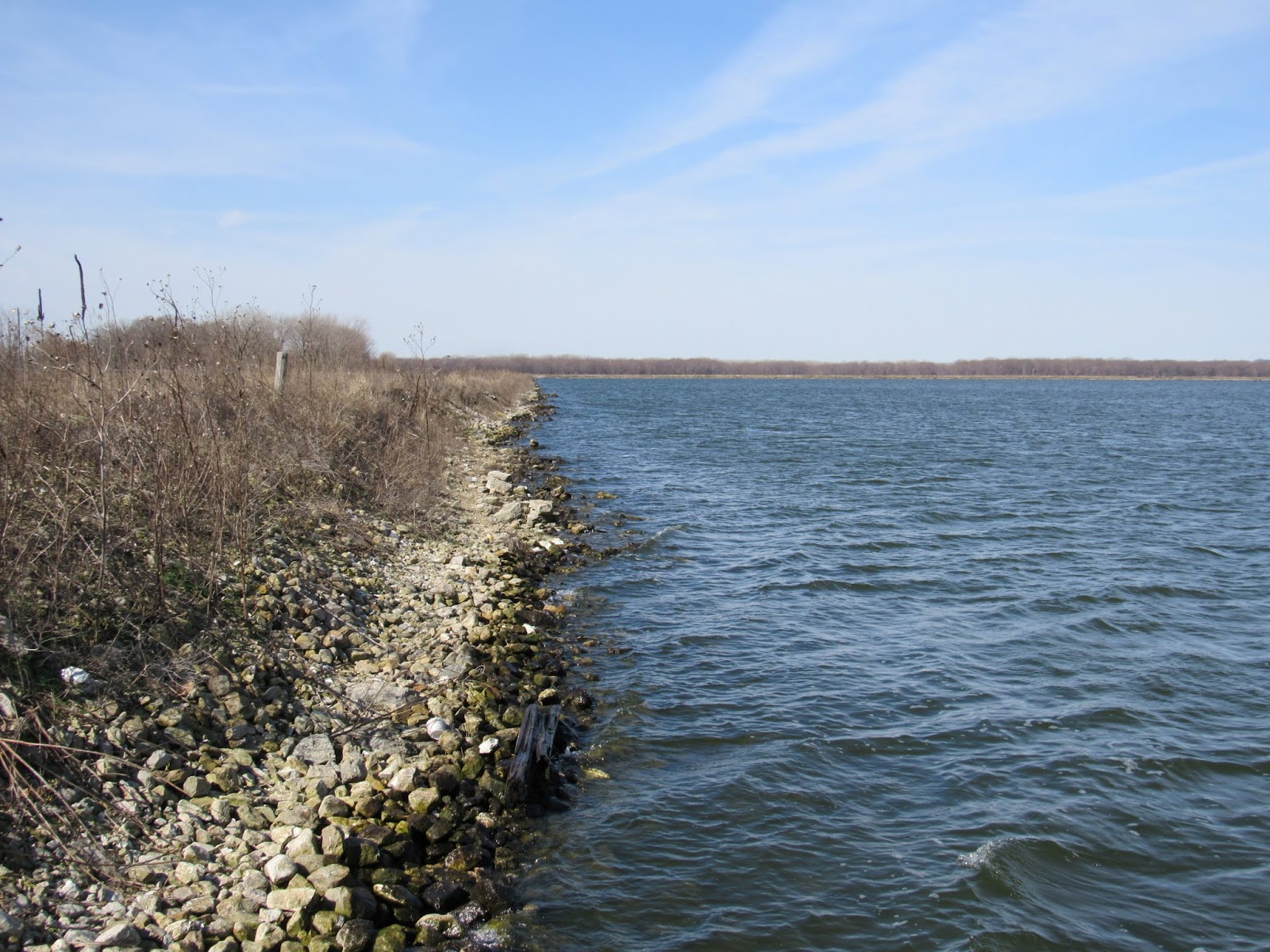
Wild Turkey and Wilson's Snipe along the side of the road brought up the day's total to twenty-six species, and it was nearing 10:00. It was at this point I realized I'd be setting no records. Generally, in a Big Day, you get most of the species you need early in the morning, giving you the rest of the day to tick off the ones you missed. Still, I rushed across Tazewell County, and decided to try my luck at Powerton Lake, a reservoir in the Illinois River Valley that had some wet woods behind it and a huge expanse of open water... and cold wind. I did not pack a warm jacket, as it was sunny and the forecasts had varied widely, from low fifties to high sixties. I prepared for higher temps, and the actual temperatures went lower.
Powerton Lake got me a few good birds to add to the day's list. The day's only Belted Kingfisher called from the creek behind the lake. I got a few more birds here, but overall it was very species-poor and I was cold, so I went to my next stop, Spring Lake.
Spring Lake, which I had never visited before, proved to be one of the best stops of the day. Mute Swans (
Cygnus olor) were everywhere, with a couple of Trumpeter Swans thrown in the background for no reason. I only noticed them later in the back of a photo!
A Bald Eagle (
Haliaeetus leucocephalus) on a nest provided my first look at this fairly common species. Actually, this nest is remarkably easy to see, and you can easily get too close.
A small neighborhood on the shores of Spring Lake looked far nicer than most settlements along the river. Someday I will get a picture of the unincorporated community of Goofy Ridge to demonstrate what I mean. Suffice it to say I've never seen so much littering in my life. Therefore, it was quite nice to see a river settlement that wasn't actively polluting everything around it!
Speaking of litter, the south end of the lake was littered with American Coots (
Fulica americana). After Red-winged Blackbirds, this was the most numerous species seen all day. I saw about a thousand total, which is actually somewhat lower numbers for this part of Illinois at this time of year.
One of the more interesting birds along the Illinois River is the Eurasian Tree Sparrow (
Passer montanus), simply because it's the easiest place to find this range-restricted bird. When I say range-restricted, I mean in the United States. Technically, it's found throughout Eurasia and has been introduced to almost every continent outside the Old World. However, in the United States, this bird is found almost entirely within Iowa, Missouri, and Illinois. It was introduced in St. Louis in the early 1900s, and it hasn't gotten much further in a hundred years.
On a side note, this is my first time seeing this bird in a genuine tree! They seem to prefer bushes.

As the sky clouded over, I spotted a huge flock of mixed ducks on a shallow pond adjacent to Spring Lake. Within moments, I had twelve species of ducks, including my two favorites, American Wigeon (
Anas americana) and Bufflehead (
Bucephala albeola), above. (Male and female Bufflehead, and American Wigeon in foreground)
Overhead, American White Pelicans (
Pelecanus erythrorhynchos) soared on their huge wings. I'm amazed something so large can stay in the air so effortlessly.
Below them, Eastern Meadowlarks (
Sturnella magna) hid in the brush and I scared Chorus Frogs, seeing some for the first time all year. The noise of calling frogs from the nearby bottomlands was quite loud! I looked in vain for the elusive Illinois Chorus Frog, but I couldn't even get a photo of the usual Western Chorus Frogs in the area.
After about ten or fifteen minutes, I realized it was time to leave. The gnats were becoming obnoxious, which isn't something I usually say in March and which does not bode well for the summer. Every dark speck on the car window below is a gnat, and they all wanted to fly in and bother me:
Hoping the gnats would improve down the road, I went to Chautauqua, passing through the aptly-named hamlet of Goofy Ridge on my way to that parking lot. A Hairy Woodpecker waited in the parking lot and after being identified immediately departed. "You need me, right? But a photo wasn't in my contract! Goodbye!"
A mass of calling blackbirds in the wet woods adjacent to Chautauqua's Mud Lake made me curious if any of my nemesis Rusty Blackbirds (
Euphagus carolinus) were present. They were!
I've been looking for Rusty Blackbirds for a bit, so I'm glad to finally find a few. Once you get over 200 species of birds in a state, it's a lot harder to find new ones! Rusty Blackbirds dwell in wet woods, presumably because some bird has to and they drew the short straw.
Red-winged Blackbirds (
Agelaius phoeniceus) were FAR more common. Indeed, they were the most common bird of the day, easily outnumbering everything else except possibly American Coots.
The nearby lake was full of ducks, but all of them except one species I'd seen before. That species was the Ruddy Duck (
Oxyura jamaicensis), one of my personal favorites:
As you might be able to tell from the spray, this diving duck had just emerged from the water. Ruddy Ducks are in a special group of ducks called Stiff-tailed Ducks. There's only five species, and for some reason there's one to every continent (excluding Antarctica and lumping Eurasia together.)
Many sparrows flew up around the edges of the lake, but they were all Song (
Melospiza melodia) and Tree Sparrows, so far as I could tell. I missed out on a large number of sparrows by not visiting more prairie fields. After seeing something that looked suspiciously like an early Osprey, but which flew out of view before I could identify it, I moved on to the refuge's headquarters.
It was while driving between the two that it hit me- I wasn't enjoying trying to get as many species as possible. From then on, I'd take my time and enjoy the places I visit, like I would on any other trip. At the Headquarters, I heard an odd-sounding Sandpiper, but I could not identify it from the call and I could not find it by the lake. I then went into the woods. where I got quite lucky.
All at once, Tufted Titmice, White-breasted Nuthatches, Red-headed Woodpeckers, and the Golden-crowned Kinglet (
Regulus satrapa) seen above appeared, all three of which had eluded me earlier. I may have called the Big Day off, but it wanted to keep going! I was sitting at sixty-seven birds by the time I left for Emiquon Nature Preserve- in other words, the majority of the species I would find.
The Red-headed Woodpecker was the last of all seven species of woodpecker in Central Illinois for me to find that day. Finding all seven is known as a Woodpecker Shutout. To top that off, I got my best-ever photos of a Downy Woodpecker (
Picoides pubescens) only ten feet away from me:
Emiquon may not have gotten me many new birds, but I did find more species there than I expected. I found these Northern Shovelers (
Anas clypeata) with many other ducks, including my first Hooded Mergansers. However, for sheer number of duck species, I found nothing to rival Spring Lake Bottoms, which I would consider the third-best find of the trip, first two being new species.
Not everything in the area was ducks- this immature Bald Eagle (
Haliaeetus leucocephalus), eating a fish, proved a wonderful photography subject!
Then I found a bird or two I didn't expect, as a few lingering Snow Geese (
Chen caerulescens) flew overhead. A few weeks ago, this area would have held hundreds of thousands, possibly millions of Snow Geese. Even earlier that morning Chautauqua had hundreds, according to an employee I met up there. Only a dozen remained at Emiquon, insofar as I could see.
On the shoreline, these Killdeer (
Charadrius vociferus) battled it out among themselves, ignoring me as the two on the right chased away the two on the left. The
vociferus part of their name was well-earned! They wouldn't shut up at all, especially not when they finally decided I was too close.
For some reason, their cries didn't disturb the world's best hidden bird, in the photo below:
If you give up, it's just a little above the lower left corner. Here it is, the second lifer of the day, the completely unexpected Snow Bunting (
Plectrophenax nivalis):
Snow Buntings deserve their name- they breed in the Arctic Circle, which is really, really, really far north, and winter down here. This bird, as you can tell, has a thick layer of insulating feathers to keep warm on cold nights. Actually, Emiquon's almost as far south as they've been seen this winter. This bird should be on its way north by now.
However, as you can see below, all the wing feathers have been ripped out on one side. I don't know why, but I suspect some predator has attacked this bird, only for it to escape. It has plenty of food in the spot where I found it, and I let it be. Even with its injury, this bird was remarkably tame, letting me approach without running away. The Snow Bunting didn't seem to be doing this out of weakness, as it ran up and down the shoreline multiple times while I stood about looking for ducks.
Even with its injured wing, if the Snow Bunting can regrow its feathers and that's all that's wrong with it, it has a chance. After all, it's not the easiest bird to see. Find it again, I dare you.
(It's halfway between the big dirt mass on the shore and the left side of the photo).
Another unusual bird for this time of year was the Tree Swallow (
Tachycineta bicolor), a very early migrant feeding on bugs like the gnats from earlier. Since the bugs were up sooner than usual thanks to the warm winter, the Tree Swallows have come north to eat them. I wonder how many birders have observed a Tree Swallow and a Snow Bunting at the same time?
Overhead, another surprise came, in the form of Greater White-fronted Geese (
Anser albifrons), which I assumed had moved north a bit earlier, like the Snow Geese with which they often associate.
Like the geese, I moved north, deciding to visit the areas to the north of Emiquon. I was cruelly tricked by someone's Snow Goose hunting decoys, and drove past a fithy cattle pond as I went to go see the imitation geese. This pond proved to be full of Wilson's Snipes (
Gallinago delicata), whose appetites weren't so
delicata as their Latin name suggests. Unfortunately, it was still overcast, so the lighting was execrable. That's a word I recently found, and intend to use.
Still, I had a great few minutes watching the snipe, and I spotted a flyover Rough-legged Hawk at the same time, pushing me to 72 species. I feel that I've become quite a proficient snipe hunter in the space of a week! Literally, it's been a week since I saw my first one.
At this point, it was getting late, so I drove back across the river. Sitting in a tree directly left of the bridge was a Red-shouldered Hawk, species 73 for the day and completely unexpected. I drove around for a bit near the Havana Power Plant, which has given some birders very good birds. I got a Northern Mockingbird once I got lost in the vicinity, species 74. I found my way out and to Matanzas Prairie Nature Preserve, a place for Illinois Chorus Frogs. At this point, however, it was too cold for any calling frogs, so I looked at flowers.
This is the Pussy Willow (
Salix discolor), a new plant species for me, and one quite abundant in the wet shrub prairie. It got starring role as the title photo, though I had to hold the branches tight to keep them in focus! This plant is used by certain churches as a replacement for palm branches on Easter Sunday, especially churches in Eastern Europe.
After finding the Pussy Willow, I then went looking for American Woodcocks. (Yes, I know. I can hear my family now- "Watch your language!") At this time of the year, Woodcocks, which I prefer to call Timberdoodles, are mating in Sand Ridge State Forest. They make a sort of call in the woods that sounds like "Bzzeeent! Bzzeeent!" Once they have the attention of the female, the male Timberdoodle flies hundreds of feet straight up in the air and then comes back to earth. Then they go back to "Bzzeeent!"-ing again. I saw this just after sunset, and, exhausted, went home.

The High Senior General Grandmaster-Admiral of Illinois Big Days, Greg Neise, who was one of the members of the group that did the record Illinois Big Day, commented on my Facebook post about this: "72 for early March isn't bad at all!" (Technically, it was 75, I forgot the Pileated Woodpecker and the Rock Pigeons in the initial count and I found the Black Ducks in a photo afterwards.) This makes me feel quite good about the thing, and I might do it again- with someone else. A solo Big Day is somewhat tedious at times, if still good fun.
In summary, I had a great time doing a Big Day, but it certainly is exhausting and not my preferred method of birdwatching. I'm an explorer at heart- I want to see new lands and new spots. I also like more than just birds- I was looking for plants and herps too! In my mind, the perfect trip combines all of these interests, so this trip, while amazing, didn't suit me perfectly. I'm glad to have found this out, and I got two lifer birds in the process!
All Ebird Checklists:
Elkhart Hill
http://ebird.org/ebird/view/checklist/S35091801
Mackinaw State Fish and Wildlife Area
http://ebird.org/ebird/view/checklist/S35078366
Mackinaw
http://ebird.org/ebird/view/checklist/S35078513
Powerton Lake
http://ebird.org/ebird/view/checklist/S35078592
Spring Lake
http://ebird.org/ebird/view/checklist/S35078799
Spring Lake Bottoms
http://ebird.org/ebird/view/checklist/S35078868
Chautauqua- Goofy Ridge
http://ebird.org/ebird/view/checklist/S35079046
Chautauqua- Headquarters
http://ebird.org/ebird/view/checklist/S35089149
Emiquon- southern pullovers
http://ebird.org/ebird/view/checklist/S35089969
Emiquon- Visitor's Center
http://ebird.org/ebird/view/checklist/S35079373
Cattle Pond
http://ebird.org/ebird/view/checklist/S35085121
Bridge
http://ebird.org/ebird/view/checklist/S35078880
Havana Power Plant Lake
http://ebird.org/ebird/view/checklist/S35079166
Sand Ridge State Forest
http://ebird.org/ebird/view/checklist/S35088981