Showing posts with label Lincoln Land Community College. Show all posts

Thursday, October 20, 2016

Vertebrate Zoology Field Trip #8- LLCC Bird Banding Station


Lincoln Land Community College

Thursday October 13, 10:40 AM to 12:05 PM

Temperature: 55-ish degrees Fahrenheit

Weather:  Sunny, light winds out of east

If you would like to know who is responsible for my current obsession with birds, I can give you two names.  One of them is the LLCC Bird Banding President, Vern Kleen, and the other is the professor who helped to bring the aforementioned man to Lincoln Land Community College in the first place, and who is the same professor for which I am writing all these journals, Tony Rothering.  Thanks to them, a couple of Northern Harriers, and a few hundred ducks in early February, I am now hooked.

It's days like the one I am going to describe that keep me hooked, too.  I went out of a class Thursday morning, and decided to venture over to the banding station and have a look around.  When I got over, Vern Kleen and the assistants, who are all volunteers, were joyous.  I looked at the board (above) and became quite joyous myself!  All those four-letter words on the side are codes for bird common names.  For most birds, you take the first two letters of the first name and the first two letters of the last name. Tennessee Warbler, for instance, becomes TEWA and Song Sparrow becomes SOSP.  It varies according to the bird's common name, but for the most part, these four- letter codes are understandable, if you know the bird's common name.  Either way, seeing 23 code names on the board is a sign of a great day, as that means  23 bird species have been caught and banded.  That's a LOT for this bird banding station, so I stuck around and watched the next round be brought in.


While the first two main surprises of the day were already caught before I got out there (a first-ever-for-the-station- Grasshopper Sparrow and a first-of-the-season Slate-colored Junco)  the next main surprise was a Blue-headed Vireo (Vireo solitarius), a bird which by all accounts should have migrated already.  This was also only the second one ever banded at the station.  Like all Vireos, even when handled carefully it was a bit nippy.
A Vireo, for the unaware, is one of a group of birds that lives high in trees, rarely sits still, and hunt insects.  Most of them are only slightly colorful, and often several species will all resemble one another.  This Blue-headed Vireo is probably the best of them all, being distinctive (at least in this part of the world, not so much out west), fairly colorful, and recognizable with its distinctive blue-grey head and white "glasses".


Another good bird was this Swamp Sparrow (Melospiza georgiana), one of three I saw banded.  It should be noted for some people that there is minimal harm done to these birds, as it's a swift process of catch, band, and release, and the occasional photo in between, taken as quickly as possible.

It works like this.  The bird banders set up nets around a large section of prairie/woodland on campus.  These nets, mist nets, are hard for the birds to see, especially windless days.  The bird banders, who are trained in removing the birds from the nets (I am not) do so and put them in small cloth bags which allow the bird to move freely but not injure itself.  These are then carried back to the spot where the bands are, where the aluminum bands are put on the left leg of the bird.  These bands come in dozen of sizes and they are loose enough and small enough that they don't bother the bird. After this, one or two photos may be taken.  The bird is then released back into the wild.  If a banded bird is caught, the banders will record the number in order to figure out where it came from.


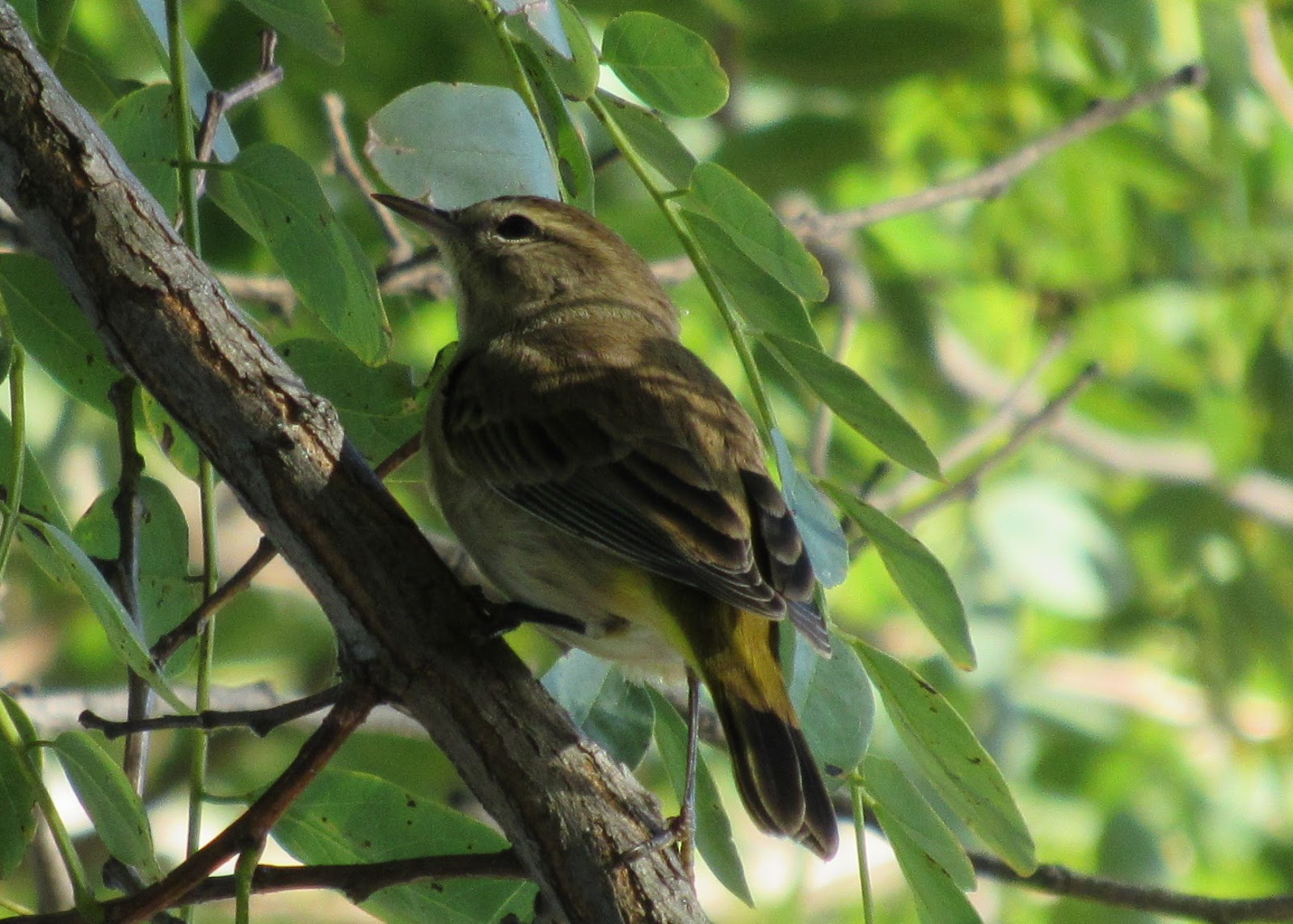
It's getting a bit late in the season for most warblers, but this Western Palm Warbler (Setophaga palmarum palmarum)  (one of six I saw) was one of a number of warblers we saw.  Warblers, for the unaware, are small, colorful, often hard-to-see birds, and there's one heck of a lot of them.  Furthermore, they often look similar, and they change plumages between spring and fall, usually becoming much drabber in the fall.  Other warblers seen and/or caught included:


Tennessee Warbler (Oreothlypis peregrina)


Two Orange-crowned Warblers (Oreothlypis celata), a Common Yellowthroat and not in the nets, but just above them out of reach...


A Pine Warbler (Setophaga pinus), which I had only seen once before in my life.


Add to this about 15 Yellow-rumped Warblers, and you have the total number of warblers.  However, there were dozens more birds than just these.  A Great Blue Heron, around ten Turkey Vultures, two Mourning Doves, about fifteen Chimney Swifts, twenty-five odd European Starlings, two Red-bellied Woodpeckers, one Downy Woodpecker, four Northern Flickers, three Blue Jays, eight American Crows, a White-breasted Nuthatch. and one Eastern Bluebird were all seen flying outside of the nets.


Inside the nets, we had both species of kinglets. Ruby-crowned Kinglet (Regulus calendula) is above.  Golden-crowned Kinglet (Regulus satrapa) is below.  The only birds smaller than kinglets  in this state are hummingbirds, so you know that these are truly tiny birds.


Here's a short list of the birds I saw caught in the nets on that day:  a Tufted Titmouse, a Black-capped Chickadee, one House Wren, two Northern Flickers, two American Robins, three Chipping Sparrows,  three Swamp Sparrows, and one White-crowned Sparrow (Zonotrichia leucophrys) pictured.  Overall, there were a LOT of birds, as per usual.

In the time since this was first worked on, two banding days with over one hundred and fifty birds have happened.  The first of these had over two hundred and forty birds captured, a station record! The majority of these birds have been sparrows, like the one below.  The records of what I have personally seen are below.  Feel free to drop by the bird banding station any time on a Monday-Saturday morning from now until mid-November.  The best days to stop by are cloudy, windless days after cold fronts, as the birds, pushed south by the cold fronts, have a harder time seeing the nets on cloudy and windless days.  As the station is open to the public (with some rules for conduct), please, if you're interested, consider a visit.  Like me, you might pick up a new hobby!


Ebird Checklists

http://ebird.org/ebird/view/checklist/S32020784

More Recent Ebird Checklists (to show recent bird counts)

http://ebird.org/ebird/view/checklist/S32115820

http://ebird.org/ebird/view/checklist/S32115981

http://ebird.org/ebird/view/checklist/S32115994

http://ebird.org/ebird/view/checklist/S32130568

Tuesday, October 4, 2016

Half a Dozen Birding Mysteries


There are a LOT of birds that I see that I can't identify, but most don't get photographed.  These are the lucky ones.  Above is an Empidonax flycatcher species, which I think might be a Least Flycatcher.  Does anyone disagree with this, and if so, how do I tell what it is in future?


I found this gull on the right in a group of Ring-billed Gulls, like the one on the left.  It's a bit smaller, and its wingtips seemed oddly colored with the line and dot patterning.  I have no other photos.  Is it safe to assume that it might just be an oddly-patterned Ring-billed Gull?

This bird, just over or around the size of a Blue Jay, flew past me at Marine Point.  This is the only photo, as it vanished into the trees at the end of the point.  It flew mostly in a straight line.  I don't know what species it is, but the wingtips and dark cap seem unusual.


This is the back of a rather unusual flycatcher I found at Chatham Wildlife Sanctuary:


Is  this just an uncommonly dark form of the Eastern Wood-Pewee, or is it something else?

And then there's this sparrow I found skulking in the weeds on the observation mound at Nipper Wildlife Sanctuary.  I have provided all the photos I took of this bird, which vanished into the weeds shortly thereafter.  Thoughts?


Accompanying the bird above is the bird below.  This bird below was small, almost Carolina Wren-sized.  If not for the short, stubby bill,  I would have assumed it was a wren or maybe a warbler.  The lake of wing bars and generally shy demeanor keep me from calling it a goldfinch.  I'm guessing this is a female or a juvenile of something I know better in another plumage.  Any ideas?


As I'm posting this in IBET, please email me or comment down below with thoughts and ideas.  Also, so I stop spamming IBET with ID questions, what are some good ideas for resources to identify these birds?  I've used field guides on these, to little avail.  I've heard of a Flickr group that identifies birds based on submitted photos.  Any other ideas?

One Week of Ospreys, One Week of Sabine's Gulls - Lake Springfield Birding


Welcome to the grand week of Ospreys (Pandion haliaetus).  Every other day during this particular week in the latter days of September, I had an Osprey, which is unusually regular for this bird on Lake Springfield.  (The photo above is at the abandoned Beach house.) I've had a LOT of birds lately, in addition to the Ospreys, so this will be a bit long.  I've decided to organize this not by date, but by location, starting near the middle of the lake and going up to its end.  

First is the illustrious birdwatching spot of Lincoln Land Community College's parking lot, where I spotted these twenty-five American White Pelicans (Pelecanus erythrorhynchos) flying southwest.  If there is any bird in Illinois that bears a slight resemblance to a pterodactyl, it is surely this one.

From the great to the small, we come to the Yellow-Rumped Warbler (Setophaga coronata).  Evidently, at this time of year, birds flock to poison ivy vines to eat the poison ivy berries, especially, it seems, woodpeckers and warblers.  The poison ivy appreciates this, as the seeds pass through the bird's digestive tract and are deposited wherever the bird leaves them.


Out on Macoupin Lake, the college's small pond just north of the main halls, I found a Spiny Softshell (Apalone spinifera) and a Pied-billed Grebe (Podilymbus podiceps), both seen above, more or less:  (I know it's a Spiny Softshell turtle because I've seen it here several times previously.)

In the crabapple trees north of the lake, meanwhile,  I spotted a substantial number of warblers, which excited me right up until I realized they were ALL Palm Warblers (Setophaga palmarum):


However, despite being all one species, these were still warblers, feasting upon crabapples. Speaking of which, the local crabapples, as you can see below, occasionally flower in the fall.  I assume it's because they are genetic hybrids and some genetic error is causing this, but I have no idea.


Continuing onward, I spotted a young Eastern Bluebird (Sialia sialis) in the grass:


Just on the edge of the crabapple trees, I spotted this Empidonax flycatcher, which is in a confusing group of North America's hardest to identify birds.  There are five Illinois species in the genus Empidonax, almost impossible to distinguish without hearing a call.  I would like an exact identification, but for now, I'll just call it a flycatcher and thank it for its services in removing flies.


Just south of Lincoln Land was my next stop, Marina Point.  Here, an interesting assortment of Pokemon Go players, potheads (more on that later), joggers, lovers, fishermen, pedestrians, boaters and occasionally birdwatchers spend their time.  It's amazing what a strip of gravel in the middle of a lake attracts, both animal-wise and people-wise.  I spotted an American Golden-Plover here, for instance, only to have it scared off by an unwitting Pokemon Go player.  As I didn't have my good camera, there is no photo to accompany that bird.


Flying overhead, for instance, was a group of seventy-eight Blue-winged Teal (Anas discors) heading south for the winter, among our first ducks to do so.


Every morning and evening, around a hundred Turkey Vultures (Cathartes aura) fly over Marina Point, coming in and out of their roost at this end of the lake.  On this particular day (September 20) something else appeared, the aforementioned Osprey (left above, centered in both shots below).


I haven't seen it in quite awhile, so it has probably left.  Still, the Osprey isn't a common bird here by any means, and as it is State-Endangered here in Illinois, it's quite impressive to see one, even if it is during migration when they're far more common.


Below, you can see a small subset of the Turkey Vultures.  I always wonder how many of these vultures other people see.  It's quite impressive to me to see hundreds of vultures circling overhead., and I feel as if most of the people here never see this, so glued are they to their phones.  I understand why, as from what I've been told the easiest way to get the strongest Pokemon in Pokemon Go is to go to places near water, like Marina Point, and level up the Pokemon found there.  Still, while you're leveling up your Pokemon, you're missing most of what's going on around you in nature.  I miss much of what's going on around me in nature, and I'm looking for it!


Also out at the lake a flotilla of American Coots (Fulica americana) came across the lake:

 On a later day, I spotted a pair of Bald Eagles (Haliaeetus leucocephalus). The juvenile is below:


And of course,  I also found more Palm Warblers on the same day I found all the other Palm Warblers.  I sometimes wonder how many Palm Warblers came through the Lake Springfield area that day, because I saw about twenty-five on my own while looking at only two spots.


More recently, three Sabine's Gulls were seen in the area shown below.  Sabine's Gulls are the sort of birds that provide frustration in spades.  Only serious birdwatchers will even try to find them, considering they are small gulls that live in the middle of the lake, well out of range for even the best unaided eyes.  Even with a scope or binoculars (or a camera with fairly good zoom) if the Sabine's Gulls are resting on the water, they are nearly invisible.  Ordinarily, Sabine's Gulls live on the ocean, and thus are a rarity to find inland. Thus, finding one is fairly worth it, but it's a struggle.  And then, when you get very excited about finding the bird, your non-birdwatcher friends and family don't understand your enthusiasm.  To them, it's just a gull.  They understand that it makes you happy to find, but it's still hard for them to be very enthusiastic about a gull.

The week after the Ospreys, I  began to hunt for Sabine's Gulls, but the weather decided to actually act like it was fall, and began to sputter a bit of mist every so often, mixed with partially-cloudy open skies.  I got my first fall Ruddy Duck (Oxyura jamaicensis) (furthest left in the picture below), as well as a few coots and Loch Ness monsters, but it was abysmally misty and I just stayed in my car until the weather began to clear.

(I'm joking about the Loch Ness monsters.  For one thing, this is Lake Springfield, not Loch Ness.  For another, that head in the back right of the photograph below is that of a Double-crested Cormorant (Phalacrocorax auritus), but it looks like Nessie in the fog to me.)


Soon, in the middle of this mist, a beaten-up beige sedan and a large brown van with a busted window arrived and parked in the middle of Marina Point.  The drivers then proceeded to blast out some rather offensive, profanity-laden rap, complete with earth-shaking base.  I got out of my car to complain, and from thirty feet away was made sick from the stench of marijuana emanating from their vehicles.  I made my complaints, which they ignored, and while walking around for a minute, concluding my observations, ran into a fellow birder,  Jim M.  He and I decided to make our way up to the old beach house and look for any unusual gulls there.  Before leaving, I snapped this photo  of a Ring-billed Gull (Larus delawarensis) in the clouds, which had begun to break.


 Jim M. and I, found little of interest besides a single Franklin's Gull (Leucophaeus pipixcan) trying to rest on the beach.  However, as soon as it saw us, it departed for other lands, leaving us with dozens of Ring-billed Gulls and...


... a Great Egret (Ardea alba), busily swallowing a fish.  It amazes me what large fish these birds eat.


Jim M. and I didn't find any Sabine's Gulls, however, and he had to leave, so I remained alone by the beach.  I'll return to that story in a bit.  Here's the view of the beach, currently fenced off to keep out trespassers, which, as I've said before, makes it a fine habitat for resting gulls and other waterbirds.


The Caspian Terns (Hydroprogne caspia) finally left, with none, to my knowledge, having been seen since September 27.  They will be missed.


Another bird species that has finally left is the Least Sandpiper (Calidris minutilla),  and the very last one which I saw is below, seen on September 22.  Only a few Killdeer (Charadrius vociferus) remain, and even those are beginning to migrate south.


To be fair, I'm assuming this IS a Least Sandpiper, but if it isn't, let me know.


Also having departed is this Forster's Tern (Sterna forsteri), the little bird in the photograph below.


In arrivals on September 26, meanwhile (I sound like an airport announcer), we have the Northern Shoveler (Anas clypeata), a favorite of mine, simply for the oversized bill.


Moving on from that, I'll get back to the Sabine's Gull.  I went from the beach house to the boat launch south of the marina.  This sheltered lakeshore is often a great spot for birds trying to evade the north winds, or which just like being on the widest part of the lake, like these pelicans:


I went down to the edge of the lakeshore looking for warblers, and I came across these Yellow-rumped Warblers, about thirty of them:


Going back up to the top, I spotted a birdwatcher with a scope trained southwards.  I introduced myself to this man, who turned out to be the renowned birder Dave B., likely the finest birdwatcher in Sangamon County.  Prevailing upon his generosity, I got to look through his scope and after a minute's effort, I found the Sabine's Gull, too far away for photography.  It took me three locations and two birdwatchers, but I got my Sabine's Gull.  Now I just need a photo...


Thankfully, these two Osprey were far more photogenic when I'd photographed them.  If you're wondering whether this is going to be a collection of Osprey photos in the midst of a muddled expedition to find Sabine's Gulls, you'd be right only partially.  There's still half the lake to discuss.


(I've run out of transitions at this  point.  If you are getting temporal whiplash, that's understandable, as I'm cramming together half a month's birdwatching into one post.) The Yellow-rumped Warbler is also known as the Butterbutt, for its bright-yellow rump.  Here in this photo taken at Center Park, you can see that perfectly:


Speaking of butts, this Fox Squirrel (Sciurus niger) was in an interesting position as it buried its acorns.  It's not particularly a fox, but more or less a camel...


In the trees above, I spotted several Cedar Waxwings (Bombycilla cedrorum), which are among my favorite birds.  They love berries, and with their little black masks will rob you of any and all berries.


Continuing down the lakeshore, I stopped in Lincoln Memorial Gardens some days previously.


There wasn't much birdwise, but I did find something far more interesting on the forest floor...


It's in the lower center part of the photo.  Can you see it?  No?  Well, here it is:


I've been to Lincoln Memorial Gardens dozens of times, and this is my first discovery of an Eastern Box Turtle (Terrapene carolina)here.  A day is 17.2% better when you find a box turtle, in my opinion.  (Also, I've heard 85.37% of statistics on blogs are made up.)


From there, I went onwards to the Springfield Marina, where there was very little but Ring-billed Gulls on the nearby roofs... and a few Turkey Vultures on the nearby radio towers!


Last but not least, I visited the Chatham Wildlife Sanctuary, where the local White-tailed Deer (Odocoileus virginianus) herd recognized me and promptly ran off:


Up in the trees above, meanwhile, I spotted about sixty Cedar Waxwings, only a few of which were close enough for a good photo:


The final stop of the day was at the pelican spot, the mouth of Sugar Creek where it feeds into Lake Springfield.  Here, dozens of pelicans gather during migration:


In one night, I counted fifty-two pelicans here, in one tiny pool of the lake:


Behind the pelicans, in the gathering twilight, about a dozen Great Egrets foraged on the shallows.  I stayed here until just after sunset, and then departed, having circled all around the lake for birds.

By the way, in a day or so I'll have a few birds that I REALLY want identified.  So, get ready for that.


Bonus picture for Cherry Hills Baptist Church members; Here's what the intersection looked like the night we had our Fall Celebration.  I'm throwing it in here because that's when most of the pelicans and about a third of the birds pictured above were seen.