Saturday, August 20, 2016

Prophesying a Little Blue Heron? (Lake Springfield Birding)


I don't know how many of you have seen the news about it, but this is old hat to those who live in the area.  We had a bit of a storm on August 12.  By a bit of a storm,  I mean that the area got five inches of rain in only a few hours, the majority falling in about an hour and a half.  I drove through this storm on my way to a friend's house. All I could see was the taillights before me, about ten feet of the road, and a gray fog around me. It was easily the hardest drive I've ever done in my life.  In the friend's neighborhood, I was driving up a road which had streams of water pouring down, pushing me back.  Every sewer alongside the road was spewing back up.  Finally, I made it to the house.  However,  the friend's front yard and drive were flooded and at least a foot deep:


I had another friend stranded at the Illinois State Fair that evening, where many vehicles and exhibits were ruined by up to five feet of water.  For more on the State Fair flooding itself, see here.

I decided to go out on a drive the day after the flooding, a fine Saturday afternoon.  I meandered over to Lick Creek Wildlife Area, where I found that a Raccoon had been there before me.


Another animal lay hidden in the grass. quite well camouflaged.  Let's see if you can find it, above.


This Leopard Frog ( Lithobates spp.) hid in the grass nearby.  Leopard Frogs are a confusing genus.  This could be one of at least three species  (Northern, Southern, or Plains) found in the area.  My personal guess is Northern Leopard Frog, but I leave it to the experts.


Along the edge of the road, I found several small pools.  Most were silt-covered, but the two closest to the end were clear and contained life, like this tadpole.


Several strange larvae, likely dragonfly larvae, swam about in the muck at the bottom of the shallow pool, food for a future heron, raccoon, or other predator that might wander past.  A single tire could wipe out this pool in an instant.  Frankly, considering the location, I'm surprised to find all this life.


The tadpoles blended in quite well against the dark tan soil underneath.  After looking around for a bit, I wandered into the woods, surprised at the apparent lack of mosquitoes.  After encountering a large spider in its web across the trail, I retreated and turned around.  That was what the mosquitoes had been waiting for.  I got eight bites in a minute and a half.  The moral of this story is never turn your back on mosquitoes, or they will suck you dry.


Someone else was waiting on my car to suck me dry, but I spotted it first.  This is some kind of Horsefly, with some of the weirdest eyes I've ever seen.  It was sitting on top of my car, just waiting for me to come back.  I got in my car after taking a few pictures and managed to avoid any more bites.  After that, I drove off to the UIS campus.  Since it had rained, the athletic fields were slightly flooded.  If you don't know what that means, it means shorebirds.


Oh, and this fellow.  One Northern Flicker (Colaptes auratus) randomly decided to perch here, at least a hundred feet from the nearest trees. This is a female, since there are no "moustache" lines.


 Considering the flooding has driven ground-dwelling insects up from underground, and that the Northern Flicker is often on the ground digging for ground-dwelling insects, I'd imagine this bird has found a buffet, like the nearby sandpipers that I was hunting for.


This is a Least Sandpiper (Calidris minutilla), photographed through a fence.  These tiny little birds are kind of (dare I say it?) just darn cute.  For one thing, it's the size of a House Sparrow (for my non-birder friends, those brown birds you've all seen in your backyards).  For another, they're fun to watch as they trot about, dipping their bill in the shallow grassy puddles and muddy spots.

The bird in the back of this photo has stumped several birders, but it's likely either a Semipalmated or a Least Sandpiper.  Either way, both of these birds have a VERY long trip ahead of them.  Least Sandpipers fly from the Arctic Circle to as far away as Brazil  or Chile... and back.. every year.  On the way, they stop through Illinois, generally in May and August.


By contrast, the most common sandpiper species in Illinois, the Killdeer (Charadrius vociferus), stays here or goes just a bit south.  About sixty of these birds were resting on a gravel strip nearby.


The best birds, however, were a pair of  Lesser Yellowlegs (Tringa flavipes), foraging in a nearby temporary pool which this year has not been temporary.   There are at least sixty Canada Geese in the vicinity, so I recommend birdwatching from the car at this locality.  Also, since school begins soon, I don't recommend birdwatching here at all from now on.

Like the Least Sandpipers, the Lesser Yellowlegs migrates a LONG way away, but in this case, these birds go as far south as the Straits of Magellan, north to the Yukon.  That's a lot of miles.  I want to drive it all someday.  Just so you know, it is a life goal of mine to drive from Alaska to Argentina.  Currently, I can't, thanks to about sixty miles of road missing from southern Panama.  Lesser Yellowlegs, of course, can just fly right on by.


While we're on the topic of migration, I'd like to mention an unusual type of migration.  That would be the instance of a southern bird migrating north.  While a couple of oceanic birds do migrate from South America north, the few other examples are birds that fly north from the South in late summer.  This happens often enough that we can't just call these birds lost, per say.  One of these is the Little Blue Heron.  Immature Little Blue Herons, which are white in color, fly north in late summer, in what scientists have termed post-breeding dispersal.  In other words, the kids are moving out, and they don't know where to go.  Sometimes they go to Illinois, until they realize where they are and leave.

Now, I've been dying to see a Little Blue Heron (Egretta caerulea), and I was thinking about this rather suddenly as I crossed the Lindsay Bridge to get to Lake Springfield Beach.  I literally thought, "Wouldn't it be funny if I saw a little blue on the beach?"  Well, lo and behold:


Yup.  It is.  In one of the more interesting incidents of my birding career of the last eight months (and that's saying quite a bit, considering all that's happened), I thought of a bird that has no rights to be here in Central Illinois, and it was.  Coincidence?  I think so.


Now, some of you may be wondering how I can tell this apart from an egret or some other white heron-like bird.  First off, it's tiny compared to a Great Blue Heron.  Second, it has a metallic blue upper bill, quite distinctive in the photo above.  Third, I had an egret to compare it with:


While Great Egrets (Ardea alba) are not uncommon in Central Illinois, they are very uncommon at Lake Springfield Beach.  And yet here one was, foraging on the outer swimming divider, which is usually not underwater as it is above.  Nor was this the last rare bird to be seen here:


Among the sixty or so Ring-billed Gulls, about forty Caspian Terns (Hydroprogne caspia) could be seen resting on the beach.  This has since swelled to about a hundred Caspian Terns in the week following.  Caspian Terns have been present off and on here all year, but ordinarily would be found further north.  I think it is solely the refuge of the fenced-off beach that has kept them here.
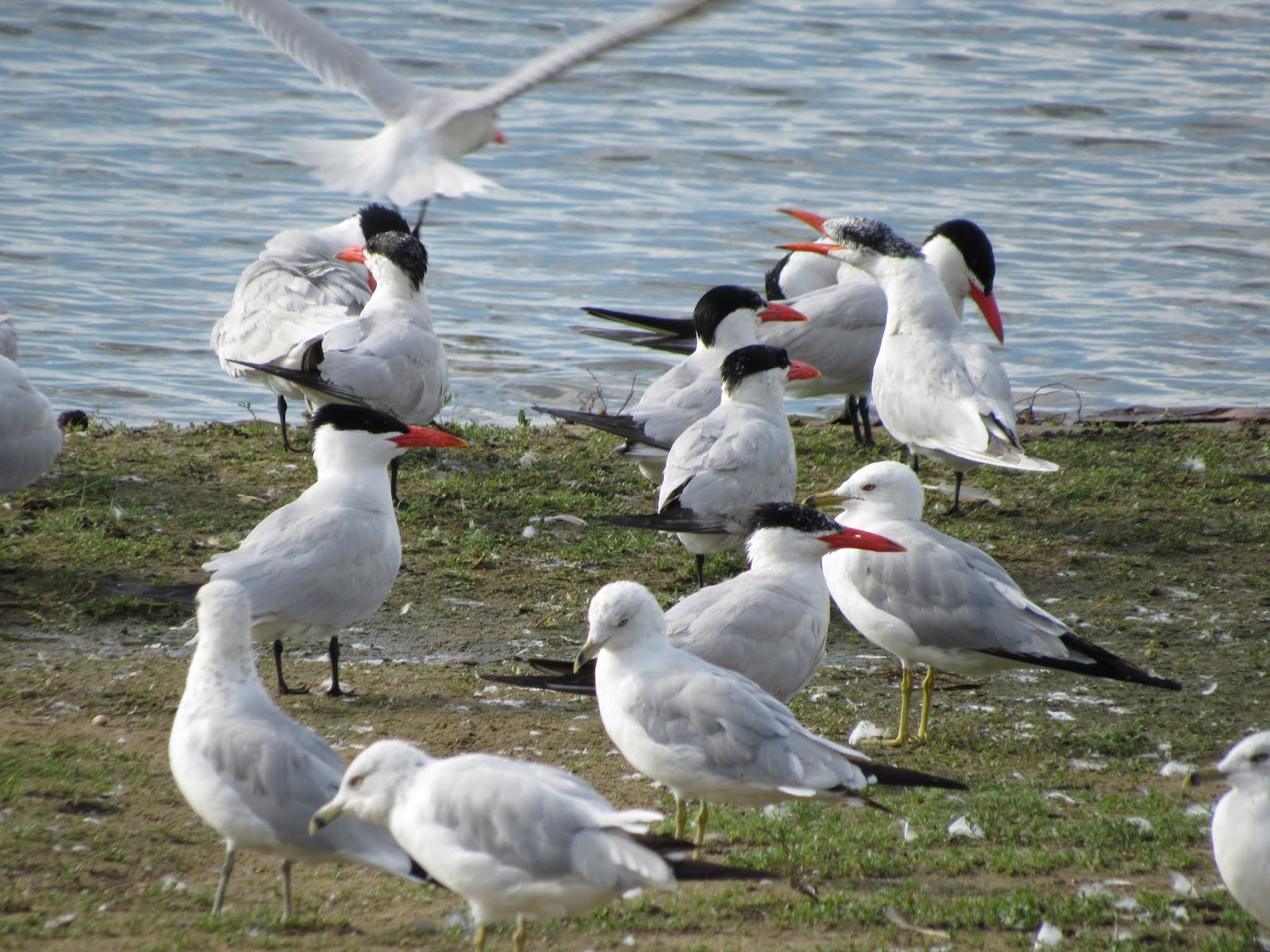

So, in this one spot, we had two traditionally southeastern herons and a traditionally northern tern species.  Furthermore, that wasn't all.  A lone Spotted Sandpiper  (Actitis macularius), the first I've seen in winter plumage, foraged in the shallows between the Little Blue Heron and the tern colony.  It was a remarkably busy place, and whilst I'm photographing all of this, there was a wedding in the Beach House.  Occasionally, the guests would stare at me from the veranda.  I'm used to getting a few weird looks and questions as I run about photographing birds, so this was fine.

I then left the wedding (and the birds) alone.  During the night, the Little Blue Heron and the Spotted Sandpiper flew off.  I wonder if they'll ever come back.  Recently, I learned that the beach is scheduled to reopen to visitors as soon as next year.  This spot is the #2 birding spot in Sangamon County, and I'm thankful that I found these birds whilst it is still intact.  The following morning, I took a trip with a friend...

TO BE CONTINUED

Tuesday, August 16, 2016

Michigan! (w/ Video)


This is a bit more personal than usual.  Also, some of the photography is worse than usual, since I spent most of the time hanging out with friends instead of taking pictures for my blog.

Recently, I took a trip with a few friends up to Rockford, Michigan, where my former Sunday school teacher, Chris Paoni, above, had recently accepted a job as pastor.  (He's very good at it, too.  More on that Sunday in a bit.)  While staying at a local house and visiting, I took a walk in the backyard.


Michigan has a large variety of plants that are not present in Illinois, and the weeds are equally as different.  In this part of Michigan, the soils were acidic and sandy, as opposed to the alkaline clay-loam most prevalent in Central Illinois.  As a result, the weeds were vastly different.  I found this Field Horsetail (Equisetum arvense) growing in a well-trampled area next to a playground.  By contrast, in Illinois I have only ever seen this plant in moderately well-preserved landscapes.


A nearby backyard pond also gave me the chance to find  Northern Green Frogs (Lithobates clamitans melanota), a species common in Illinois.  These are not Bullfrogs, which are far larger, but everyone I know calls them Bullfrogs.


The nearby woods were quite a bit different, with Partridge Berry (Mitchella repens) and Doll's Eyes (Actea pachypoda) growing under  the shade of maples and beeches.


This forest would have been a nature preserve back home, with its complete lack of bush honeysuckle making it even better.  I could stroll through it completely upright, without needing a machete.


Speaking of beeches, I found the parasitic plant Beechdrops (Epifagus virginiana) in seed.  This strange plant, rare in Illinois, has no leaves and sucks nutrients from the roots of Beech trees to survive.  As beeches are infrequent in Central Illinois, this plant is restricted to the forests of the Wabash and the Shawnee National Forest counties.  Most people probably think it's just a few sticks.


Thanks to the cooler weather this far north, some spring-flowering plants were still visible, like the leaves of this Trillium.  The tree behind it I believe is a Beech (Fagus grandifolia).  After I was done hiking, I rejoined my less-than-nature-enthused friends and went on to further adventures. On one of these then visited the city of Rockford itself, easily one of the most attractive small towns I have ever visited. Rockford is a tourist town centered around the Rogue River, which is dammed in the center of town, as you can see below:


Rockford loves its dam, and has made what could be a hideous flood-control structure into a highlight of the town's area.  We had ice cream from one of the many ice-cream sellers and walked along.  One of the restaurants along the riverfront bore this amusing name:


As always, I kept an eye out for wildlife, and walked around with my camera, ready for action.  One man on the dam asked me what I was doing with it, and I told him birdwatching.  This necessitated a bird, and North America's deadliest bird was close at hand:


Why do I call this Mute Swan (Cygnus olor) North America's deadliest bird when it isn't even native?  Two reasons.  First, thanks to prolific breeding, this invasive species is now firmly established in North America.  Secondly, over in Eastern Europe, these birds reportedly killed a toddler too close to their nest.  More recently, in the Chicago area, a Mute Swan knocked a man out of his canoe, which led to the man's death by drowning. The link to that story is here.  Don't get close to this swan.


I then turned my attention to the turtles, which turned out to be Common Map Turtles (Graptemys geographica), a species I don't believe I've seen in the wild before.  It's odd to me to see turtles that aren't Painted Turtles or Red-eared Sliders, although I have seen the Ouachita Map Turtle before.  Chris's son L. and I watched the turtles for quite awhile, and so the turtles watched us too.


The Rogue River was quite lovely, here shown not far behind the dam.  A trail runs alongside it for several miles, and canoeists are extremely common.


Also extremely common was one of my favorite birds, the Cedar Waxwing (Bombycilla cedrorum).  These berry-loving birds are uncommon in Central Illinois, but further north they seem prevalent.


One decided to pose for me in the setting sun, in one of my favorite pictures I've taken this year.


It wouldn't be a trip without a mystery plant, and this one was it.  At first, I thought it was Poison Ivy, but it has five leaves, not three.  This is in fact the sapling of the Boxelder Tree (Acer negundo).


Downtown Rockford has an antique train parked near one of the canoe rental places.  It's a bit odd, but it adds to the charm of the city.  We rented canoes at this place, and set out on an adventure. Foolishly, I took my camera and wallet along.  Don't do that.


We disembarked on the Rogue River near this meadow.  Virgin's Bower (Clematis virginiana) blooms in the foreground, the first time I have ever seen this plant in the wild..


In the boulder-strewn river, we found crayfish, trout, and even a few leeches, as both I and the man below can attest.  I detest leeches, and therefore removed it without even a photo.


This is Big Hoss (M. pemberton), King of the Gators.  In a bit of goofyness, some of our group called every animal they saw a "gator".  We saw plenty, too, quite even possibly a bobcat.


I sat in a canoe between Chris Paoni and a man known as Tackett, neither of whom were experienced at steering a canoe.  As a result, we ended up in several snags.  Tackett got a trifle annoyed when I called out every snag, but we hit most of them.


A greater danger to my camera was the occasional splashing wars we ended up participating in.


Here, Big Hoss lies in wait to ambush and splash for two more of our party.


Despite the occasional rowdiness, we enjoyed the tranquil, clear river and cool, fast-flowing water.


I enjoyed it so much that I fell in it, twice, although with enough grace to keep my camera above water.  Tackett and Chris were less enthused, considering I'd tipped the canoe twice with them in it.


Here's my canoeing view of the world, from behind Tackett's shoulder.  In a fit of silliness, we got in front and decided to ambush the rest of our party from the shore and scare them.  After sinking into the two-foot deep mud, Tackett lost his shoe, which he only found again because of the bright green soles.  After this, I tipped the canoe (although I hold Chris 41% responsible), and Tackett got back in, only for us to tip the canoe yet again.   After this, I baled out the canoe with an old Doritos bag.


Still seeking to ambush our fellows, we paddled back to the front and stopped on firmer ground.  While there, I found this colorful Damselfly, likely some sort of Jewelwing.


While also there, I discovered Cardinal Flower (Lobelia cardinalis),  Sensitive Fern (Onoclea sensibilis) and Stinging Nettles (unpictured, and boy, did they hurt.)  Tackett did manage to almost get a reaction out of Big Tex ( D. Moorman), but overall the ambush attempt was a failure.


Back on the river, the water grew somewhat deeper as we neared the dam.


Everyone except me was quite tired, and I was quite wet.  Thankfully, my camera case had kept my camera from getting wet.  After all, having just replaced it, I would hate to break the camera again.


We beached our canoe and kayaks  just in front of the dam, where a plethora of bird life had congregated.  Several Canada Geese (Branta canadensis), two feuding Ring-billed Gulls  (Larus delawarensis), and a Great Egret (Ardea alba) as a white blur in the back can all be seen above.


Easily the rarest bird was this juvenile Hooded Merganser (Lophodytes cucullatus), a small diving duck I haven't seen in several months.


Along the banks of the Rogue River grew the Water Forget-me-Not (Myosotis palustris), in great quantities, such that I will not likely forget it.  This was the last flower I saw that day.  After that, I went to the excellent resteraunt Vitale's.  The pizza and cinnamon breadsticks are easily the best I have ever had.  We enjoyed these at four in the afternoon, having kayaked through lunch.  Overall, Rockford, Michigan is easily one of the finest towns I have ever visited, and I'm glad I was with the friends that I was. This, of course, is thinking after the fact. At the time I was wet, cold, and tired.  Still, it was a great day.  I have a video, below, of our group kayaking.


The Fifth Orchid of the trip was a new bird species for me.  On the very last day of the trip, before we left for home, this hawk landed on the Wood Duck box over the pond.


After considerable review, I deduced this was a juvenile Red-Shouldered Hawk (Buteo lineatus), a small hawk much rarer in Illinois than it is in Michigan.  You can see the shoulder below:


A last note:  Driving back was nuts.  From the Kalamazoo River in Michigan all the way to Joliet, Illinois, the traffic was so heavy that it turned an ordinarily 5.5 hour drive into an 8.5 hour nightmare.  One brave Tackett drove the whole thing for us, and he deserves the heartiest congratulations.

Overall, I haven't even covered half of what went on, but as we all know, what happens at "FUGE Gone Wild" stays at "FUGE Gone Wild", except for the bits I've made available above.  Sometime next year, I hope to visit Chris again, albeit with more time and no wallet in my pocket on the canoe.