
(Note: I have been extremely explicit with the locations where we found these birds. The reason for this is simple- if I redo this section of the Christmas Bird Count, or if someone else does and wants to find the majority of species as quickly as possible, this blogpost should help with finding the best numbers of birds, insofar as I know.)
The Christmas Bird Count, or CBC, is the Audubon Society's yearly bird count. Each count falls between 23 possible dates, from December 14 through January 5. A circle is drawn up, with a ten mile radius, and the circle is further broken up into sections at the compiler (the person in charge)'s discretion. Volunteers go out to look for birds throughout that one day and see all that they can see, then they come back at night and count up what they saw. For more accurate and complete information, see this link here, to the official web site. If you want to see our specific circle, see this page here and zoom in on extreme south-southwest IL.

I was invited to participate in the Southern IL count at Horseshoe Lake Conservation Area (and the surrounding environs.) Our complier was one of the men who got me into birding, V. K. Another volunteer was K.M. who had been on 440+ Christmas Bird Counts (there's 23 possible per year, remember), the second most of anyone in the world. ( I hope that number is correct. and it will change if it is not.) Another, the man who drove me down to the CBC, was my bio professor, T.R, who'd invited me in the first place. Compared to all of these, especially V.K. and K.M., I felt a bit out of place. Still, it was an amazing experience to see these people, especially V.K. and K.M.. who had dedicated their lives to birds and birdwatching.


I didn't expect a last new plant of 2016 from this trip, but I got one. I had no idea until recently that American Mistletoe (Phoradendron leucarpum) ranged into southern Illinois. However, as you can see above, it does. There may not be snow here often, but there's still nature's Christmas decor!

Another southern plant extremely common at Horseshoe Lake is the Bald Cypress (Taxodium distichum) tree, as you can see above. With all the southern plants, I kept expecting an Alligator to pop up out of the water, but they're still a few states south of here in terms of range. I'm glad about this. My parents are concerned enough about my running around with all the venomous snakes down here in Southern IL (during the summer). Alligators are fascinating animals, but they have no need to expand their range north.

We continued along the road, spotting ducks, woodpeckers, and Bald Eagles (Haliaeetus leucocephalus) as we went. This short drive had four Pileated Woodpeckers, two Brown Creepers, and nine Bald Eagles, among other good birds.

I did mention there were thousands of Snow Geese, right? For a few hours, this was our view overhead, flock after flock of Snow Geese. I'm fairly certain if we had been trying, we probably could have seen over 4,000.

Out in one of the fields, American Mistletoe covered this tree. Far away, just south of the tree and the barren stubble of the crop fields, we could see a pond...

Greater White-fronted Geese (Anser albifrons) landed as Snow Geese flew past in the background.

In a nearby tree, an immature Bald Eagle watched us as we watched the geese, answering the age old question, "Who watches the watchers?"

Two more Bald Eagles sat out in a tree, below. (The second is towards the top center, and is an immature pretending to be a large tree branch)

The Snow Geese from earlier landed in the pond. Behind them lies the woods of Horseshoe Lake Nature Preserve, a place full of Mole Salamanders and other uncommon and/or traditionally southern animals and plants I hope to discover someday soon. In the grasslands behind this marsh, we also saw our only Northern Harrier of the day.

We drove down to Promised Land Road, where another flooded field turned up even more geese. Here we also spotted some Cackling Geese (Branta hutchinsii), the small two in the middle below:

Our "best" birds of the day were in a small cluster of shrubs on Promised Land Road. Two Chipping Sparrows (Spizella passerina), unusually far north for this time of year, were feeding with some Juncos. These birds should be down in the Deep South currently! This is one of a number of records of this species unusually far north this year, likely due to the late warmth of the fall.

After some scouting about done on Promised Land Road, we drove on Miller City Road south through what I would like to call "The Wasteland". I would be afraid of offending someone who lives there by calling it that, but from all the abandoned houses we saw along the way, I'm not sure that there's anyone to offend left! This area suffered badly during a recent flood, leaving parts of the area little more than bare sand, especially close by the river:

Overhead, a few more groups of geese flew by, and every so often, we'd see a hawk, a crow, or some Horned Larks fly by, as well as a few Bald Eagles sitting in the trees along the river.

Still, I've been to some desolate parts of Illinois. This was the most barren and uninhabited part of Illinois I've been to in my life! In retrospect, I did't get enough photos of it. Just south of the corner of Miller City and Watson Road, we found this young eagle enjoying a fish in the sands.

The rapidly-clouding skies also didn't help the melancholy atmosphere. We began to hope for better habitat for songbirds, and quickly!

At Schildler Cemetery Road, in a field just south of the creek/drainage ditch running east-west. we got our wish. A brushy field, full of sparrows, greeted us with rustlings and alarm calls. Most numerous were the Song Sparrows (Melospiza melodia):
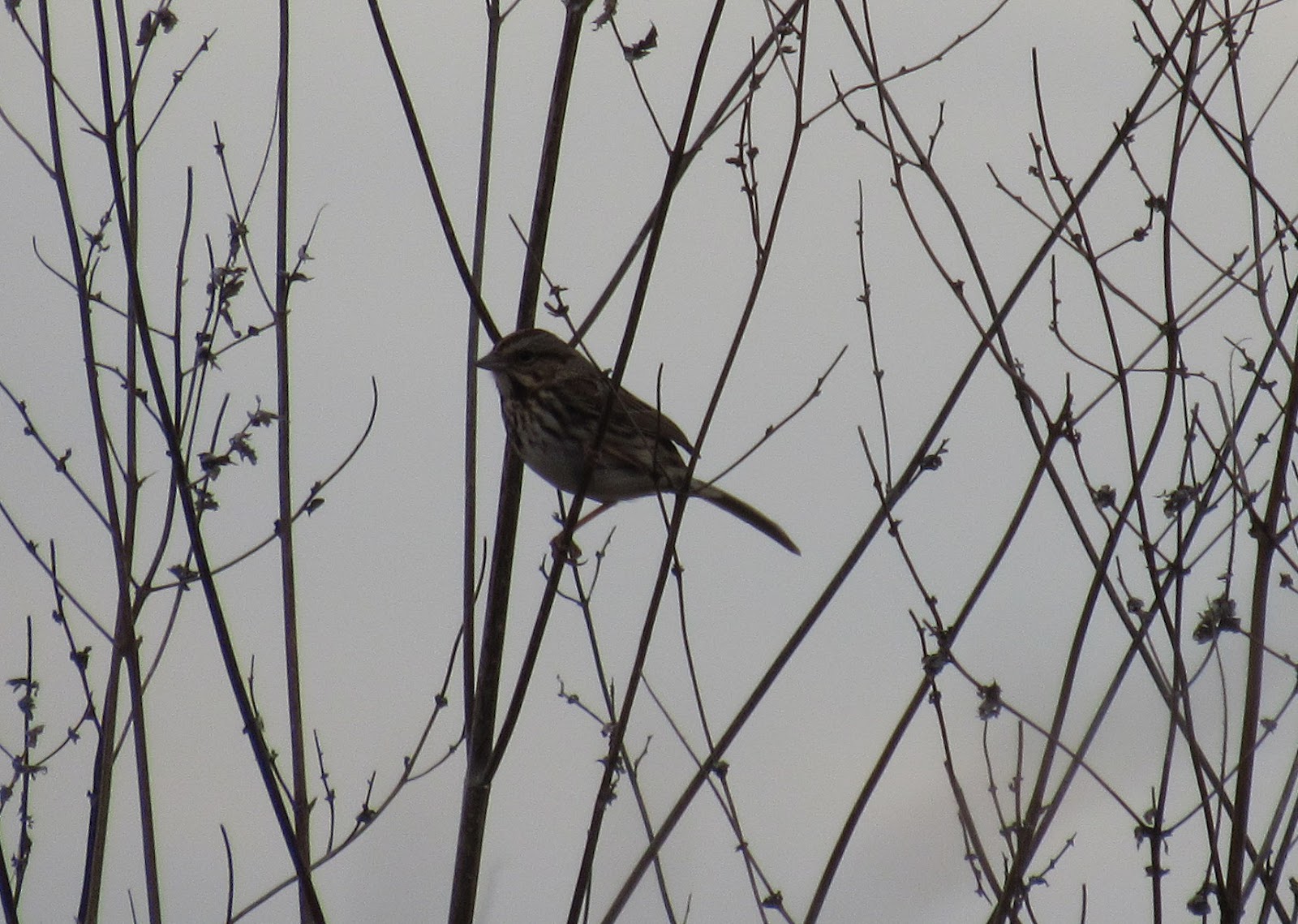
These birds are masters of disguise, their brown shades concealing them well, if only they'd stop flying around so much. (That may have been intended as a joke.)

We got over sixty sparrows of five species (Song, White-crowned, White-throated, Swamp, and Field) from this field. This is definitely one to remember for the future!

After this, we spotted three Bald Eagles and many more crows (we under-reported our numbers of crows somewhat), before venturing to Roth Crossing Road, just north of the (apparently abandoned) post office. I, meanwhile, pulled off some burrs gained in the sparrow field. These turned out to be some species of Cocklebur (Xanthium sp.).

In the woodlands and then the fields on Roth Crossing Road, we picked up our first Eastern Phoebes (Sayornis phoebe) of the day, two out of the six:


Singing Bridge Road was one of the highlights of Area 2. As soon as we arrived there, we picked up the majority of our Yellow-rumped Warblers (Setophaga coronata, below), as well as a bunch of Carolina Chickadees, Tufted Titmice, a Yellow-bellied Sapsucker, and more.

My second and final lifer bird of the day, and the only one of which I took a photo, was this Purple Finch (Haemorhous purpureus). The dark "mask" at the eye is a major identifying mark.

Area Five, the lands east of the Cache River, was full of more and different birds than before. Far more wooded and hilly, We drove up Lufkin Road, in search of what we could find. The east-to north 90 degree bend in Lufkin Road had several birds, few of which I managed to photograph.

Just beyond that, the small strip of woods on the east side of Lufkin Road, just south of the junction of Lufkin and Shiloh Roads, also turned up two more Purple Finches, our only American Tree Sparrows, and a surprise, more Chipping Sparrows! Someone else in our group, K.M, had over forty, so I guess they're really here in big numbers this year!

Driving east on Shiloh Road, we came to the corner of Shiloh and Buchner Roads. To the northeast lay a field which was unusually black:

About fifty thousand blackbirds of three species (Red-winged Blackbirds, Brown-headed Cowbirds, and Common Grackles) flew about in front of us.

As we slowly drove forwards after gathering our data from the group, we realized they were on both sides as the air blackened with blackbirds.

As we drove onwards over the rivers and through the woods (but not to Grandmother's house, since I'd done that the week before) it began to rain, and the birds dwindled out. Thankfully, the rain quit about an hour or so later, but I have to wonder how many other species we missed thanks to the rain.
 We eventually came across the sign, in someone's front yard, "No Civil Rights in Pulaski County!" I don't think I want to know what they mean by that. We left them, and checked a few birdfeeders along Villa Ridge Road as we drove south. We also found a Turkey Vulture (Cathartes aura) right along the road, eating a dead squirrel. We found both species of vultures.
A yard just west of Villa Ridge had this beautiful Red-shouldered Hawk (Buteo lineatus), the sixth and final one of the day. Until that day, I had never seen Red-shouldered Hawks in Illinois before.

A brief drive through the north end of Mounds got us pigeons. It was the first time I've ever really been looking for pigeons before. The cemetery in that area had a beautiful Southern Magnolia (Magnolia grandiflora)

Our "big misses" of the day were Hermit Thrushes, Fox Sparrows, and Killdeer. Our best birds of the day were the Northern Harrier, sixteen Bald Eagles, all three common owl species, the largest numbers of geese and blackbirds of anyone on the count, both species of vultures, eleven Eastern Bluebirds, six Eastern Phoebes, sixty or more Yellow-rumped Warblers (below), and the five or more Chipping Sparrows.
I just find it ironic that I started 2016 with a minimal interest in birds and birdwatching, and I've ended it by going birdwatching for eleven hours straight with several legendary birders. When I get into a hobby, I REALLY get into a hobby! I can't wait to do it again next year!

Ebird checklists:
http://ebird.org/ebird/view/checklist/S33260515
http://ebird.org/ebird/view/checklist/S33260619
http://ebird.org/ebird/view/checklist/S33260661


