Showing posts with label The Great Shrike Hunt. Show all posts

Tuesday, April 4, 2017

Am I a Stringer, Twitcher, or Just Obsessed? (Cinnamon Teal!)

I've been learning about a few birding terms for different types of birders.  One type is a stringer, and after looking at my records I'm a bit concerned about being called one of these.  Basically, a stringer is someone who reports a lot of rarities, but never gets photos of the birds.  Furthermore, they usually "call" a bird without considering what else it could be.  

Now, there is a local birder considered a stringer in my neck of the woods.  Every so often, they will put a list out on Ebird containing some very unlikely birds in unlikely places.  For instance, they claim to have seen a Glaucous Gull in my county, but they reported it as being in the woodlands across the road from Lick Creek Wildlife Area.  Glaucous Gulls are rarely found on the biggest lakes and rivers in Illinois, and pretty much nowhere else in this state. There's close to zero chance that it was found where they said it was.

 I nearly did the same thing with the bird above, which I almost publicly announced (well, on Facebook ) to be an extremely rare Neotropic Cormorant instead of the much more likely Double-crested Cormorant.  I'm not 100% sure that it isn't, but I think it's impossible to say.  If I had posted this and said it was a Neotropic Cormorant (and it very nearly happened!), I would be less likely to be believed in future.  Birding is entirely on the honor system.  If you keep recording birds that shouldn't be there, people stop believing you.

I have a few bad records on Ebird that I've decided to clean out (a report of 8 Grasshopper Sparrows from September 2016, for instance, when I only saw two of them clearly, and a report of a Whip-poor-will in flight that I can only put down to stupidity.)  I put these back when I didn't know better.  I am still fairly new, but I'm learning quickly.

Here's a fuller discussion of what a stringer is: http://blog.aba.org/2014/05/on-stringing.html

Now, I found the only Common Redpoll seen in central Illinois this winter.  After that it was a Prairie Falcon, a few days after the only confirmed sightings.  The eBird reviewers didn't like that at all, and that Prairie Falcon rests in sighting purgatory. Since I haven't "legally" seen the Prairie Falcon, I will have to look for one in the future.  Then I found the only Pine Siskin in Central Illinois in 2017 (apart from a couple of records in east-central IL).  I got no photos, but since it was on my birdfeeder, I was able to identify it well.  At the end of March, in a repeat performance of the Common Redpoll's sighting, I found a Harris' Sparrow.  Again, it was sitting in a bush, and ducked down and away before I could get a photo.  This lack of photos and rarity of the sightings has me concerned that people might think I'm making them up.

The reason I found the Harris' Sparrow in the first place was simple- I wanted to find a Loggerhead Shrike.  Several birders had seen one here the day before, so I hoped to get lucky and find it.  I didn't, but I did find the Harris' Sparrow, a bird of the Great Plains occasionally found in Illinois.

A few miles away, I found a small prairie pond with Greater Yellowlegs (Tringa melanoleuca), though remarkably no frogs were calling.  A Song Sparrow (Melospiza melodia) was singing away:


At this point, it's time for my second vocabulary word of the day- twitcher.  This is British English for birder (though especially the kind I'm about to describe), but on this side of the pond it's specifically used for a particular kind of birdwatcher.  Another word, from American English, is chaser.  This would be the sort of birder who sits about reading Ebird database lists and Facebook posts, until a great rarity is spotted.  At that time, they drive up to hundreds of miles away after one bird, see it, mark it on their list, and return home.

I decided, in the middle of Mason County, to become a twitcher, at least for the day.  I'd heard about a very rare duck in Arcola, and I decided to drive all the way out to Arcola after it.  If you're unaware of Illinois geography, and a great many people are, Mason County is in the middle of Illinois.  Arcola is two hours southeast, plus an hour and a half's drive home.  For a duck.


I too blame temporary insanity.


There were lots of ducks in the marsh, and as I hurried out of the car, I left my camera batteries inside.  It was a bit of a walk back to the car, and I didn't particularly feel like walking back to it.

THIS WAS A MISTAKE!

Apparently my camera was on its last legs in terms of electrical power.  I didn't realize this until I went to take a photo.  For ducks, I use my camera as a scope, allowing me to zoom in and look through a group of ducks- and record them at my leisure for future.  This wouldn't work with dead batteries.  I wouldn't have kept going, but I saw another car parked at the entrance, and I hoped to find another birder who had eyes on the Cinnamon Teal.


Thanks to that birder, Benjamin Murphy, and his scope, I soon had eyes on the Cinnamon Teal (Anas cyanoptera), the orange duck on the right above.  Now, while I can't fully explain why I decided to go and see this duck, I'll tell you why this duck was seen by many birdwatchers.  To put it simply, Cinnamon Teal are usually found in the West, and I mean the Rockies.  They're only found on the Great Plains during migration.  They slip over to Illinois every so often, but it's a fairly rare bird nonetheless!  You can see it much better below:

I then drove home, elated by my finds.  In addition to the Harris' Sparrow and Cinnamon Teal, I'd also found an American Pipit, giving me my third lifer bird (bird I've never seen before) of the day.  I got out of the car (finally- that car isn't meant to be driven on country roads for hours on end!) and pondered why I had driven all that way after one bird.  I haven't figured it out since, and for now I'm just calling it obsession.

Sunday, February 19, 2017

Why I Should Never Plan Too Much


This trip is the perfect example of why having a year list isn't always conducive to having fun.  I had three goals in mind- find Silvery Salamanders, find a Northern Shrike, and find Forest Glen Seep and its Skunk Cabbage population.  I failed to find all three, and considering the latter is a nature preserve about 8 acres in size, that takes some sort of talent.

Despite all this, I had an amazing trip.  But, I'll refrain from skipping to the end first.


I had this remarkably fine weekend, with 65 + degree temperatures unnatural to Illinois in February.  However, the migrant waterfowl, at least on Lake Springfield, have not been moving much, or rather, they have moved north faster than I would have preferred.  I contented myself with this Red-headed Woodpecker (Melanerpes erythrocephalus) when checking the lake, but I knew I'd have to go further afield.  (Edit:  I read afterwards that there were huge masses of Snow Geese at Emiquon and nearby refuges. I would have had fun either way.)


I chose to go to the nature preserves of Vermilion County, where dwell 11 out of the 20 salamander species present in Illinois, which is at least 7 more than have even been recorded from my area.  Vermilion County is the former edge of what used to be the great eastern forests.  Some of that forest's niche plants and animals only get this far into Illinois' eastern edge before giving up and going no further west.  

Nowadays, all of this is farmed, but there remains a large block of forest around Illinois' only National Wild and Scenic River, the Middle Fork of the Vermilion River.  I've mentioned before that there are two Vermilion Rivers in eastern Illinois, and both have their headwaters in the same area. This is the southbound one, flowing into the Wabash River.  Being a National Wild and Scenic River means essentially that this is a beautiful and unpolluted river.


CAUTION:  UNPOPULAR INVERTEBRATE AHEAD


Once I reached the first preserve, Middle Fork Illinois Nature Preserve, I began flipping pieces of bark, and here's where I ran into problems. This area hasn't had a recent rain.  Rainstorms help to bring up the generally subterranean salamanders, but if there's been no rain, there's very few salamanders on the surface, under rocks and logs.  Instead, we get large centipedes.  This is not OK.


I worked my way deep into the preserve, finding basically nothing salamander-wise.  I did find three Pileated Woodpeckers and a mob (aggressive vigilante group of birds) of crows and jays attacking a Red-shouldered Hawk and then mobbing a Great Horned Owl, all of which flew away before I could even think about getting my camera.  Then I found a small white fence around a pond.


Every so often in the fence, there were loosely-covered buckets, plunged into the earth.  (I could tell from the bucket lids; I did not actually disturb this setup).  This appears to be a salamander population study, with bucket traps set up every so often around the fence.


I would love to know the person who runs this, and pay them a visit when they're checking their traps, as that could be far more productive for seeing salamanders.  While the area inside the fence looked ideal, I assumed that's what was meant by "Please Do Not Disturb", so I didn't go in. I did flip two logs well outside of the fence, as well as the plastic bin seen above. The plastic bin had something underneath which beeped at me, so I let it be, and casually flipped over another log...


Underneath that log was the smallest adult salamander I've ever seen, and it was quite easy to identify, since I saw that back  coloration immediately. This is the Eastern Red-backed Salamander (Plethodon cinereus), possibly the most populous salamander species in the world.  Some areas of good habitat can have over 1,000 of these salamanders per acre!  I found one.


Eastern Red-backed Salamanders are only found along the eastern edge of Illinois, a place where huge swaths of forest have naturally grown for thousands of years.  Furthermore, it's a dry February, which isn't the best time to find this species. If I had come back on a wet day in March or October, I would have found many, many more, according to the sources I've read.

Eastern Red-backed Salamanders belong to  a group of salamanders known as lungless salamanders. Like all amphibians, they breathe through their skin, but in the case of lungless salamanders, they ONLY breathe through their skin. This process requires constantly wet skin, so this species, like most salamanders, lives in wet areas only, or remains underground where the humidity is higher in seasonally wet areas that haven't had rain in a bit, like here.

(Note, the salamander was handled only to put it on the log for a photo, after which it was released along the edge of the replaced log, where it immediately went back underneath.)


The woods are certainly lovely.  While there's no large rock outcrops, the amount of small, rock-bottomed ravines, ephemeral ponds, springs, and creeks is far higher than what I'm used to.  This area is perfect salamander habitat.  It needs to be, as a State-Endangered species of salamander, the Silvery Salamander, theoretically resides here.  I suspect that species is the one being studied in the research project seen above.  It's been too dry for those to emerge from their burrows, so I found none.


 After several hundred feet, the woods seemed to end. I walked to that end, the top of a steep bluff.


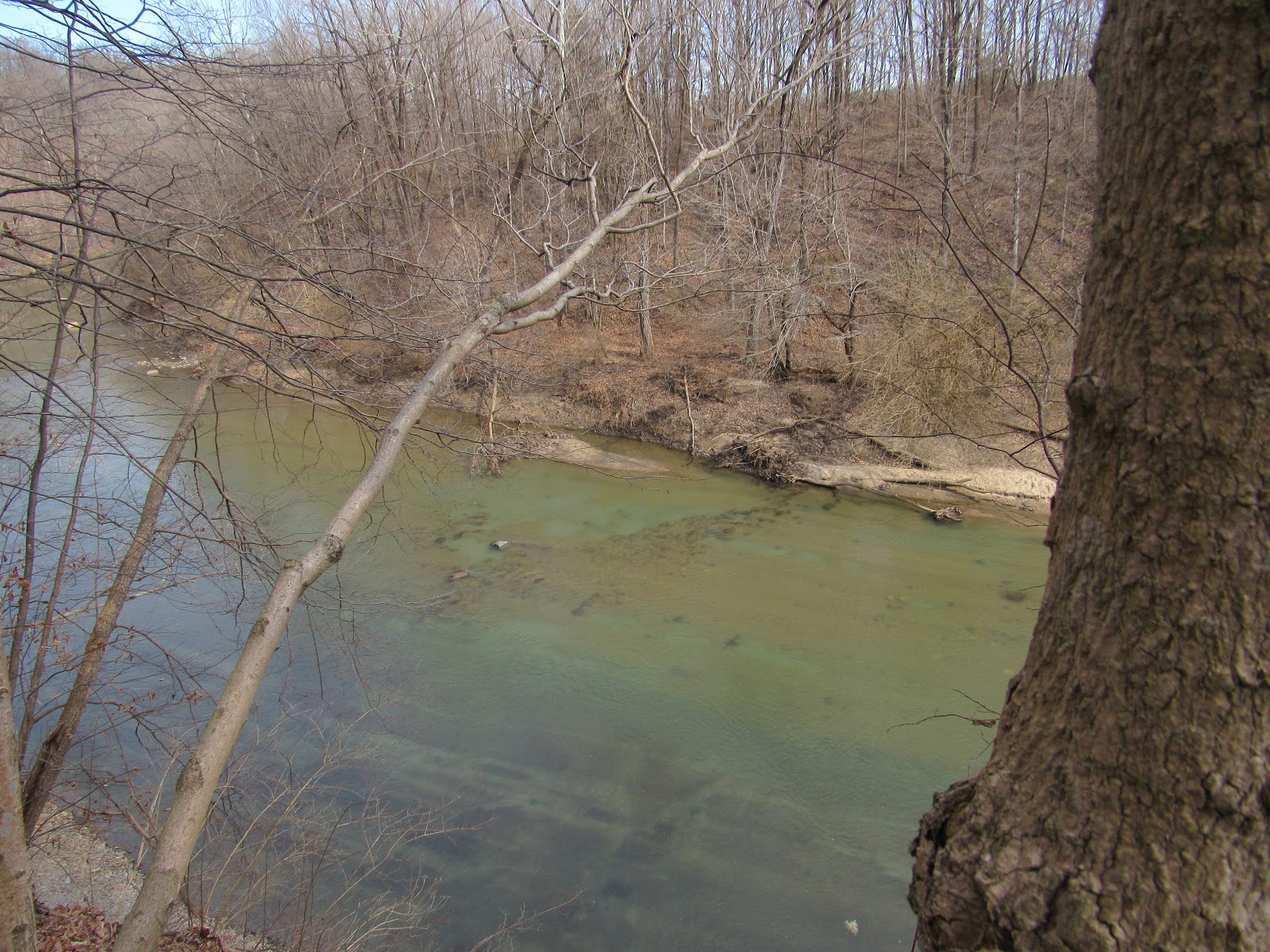
Below was this, the National Wild and Scenic Middle Fork of the Vermilion River (the south-flowing one).  It was quite a large river, though I think not entirely large enough to fit its title.


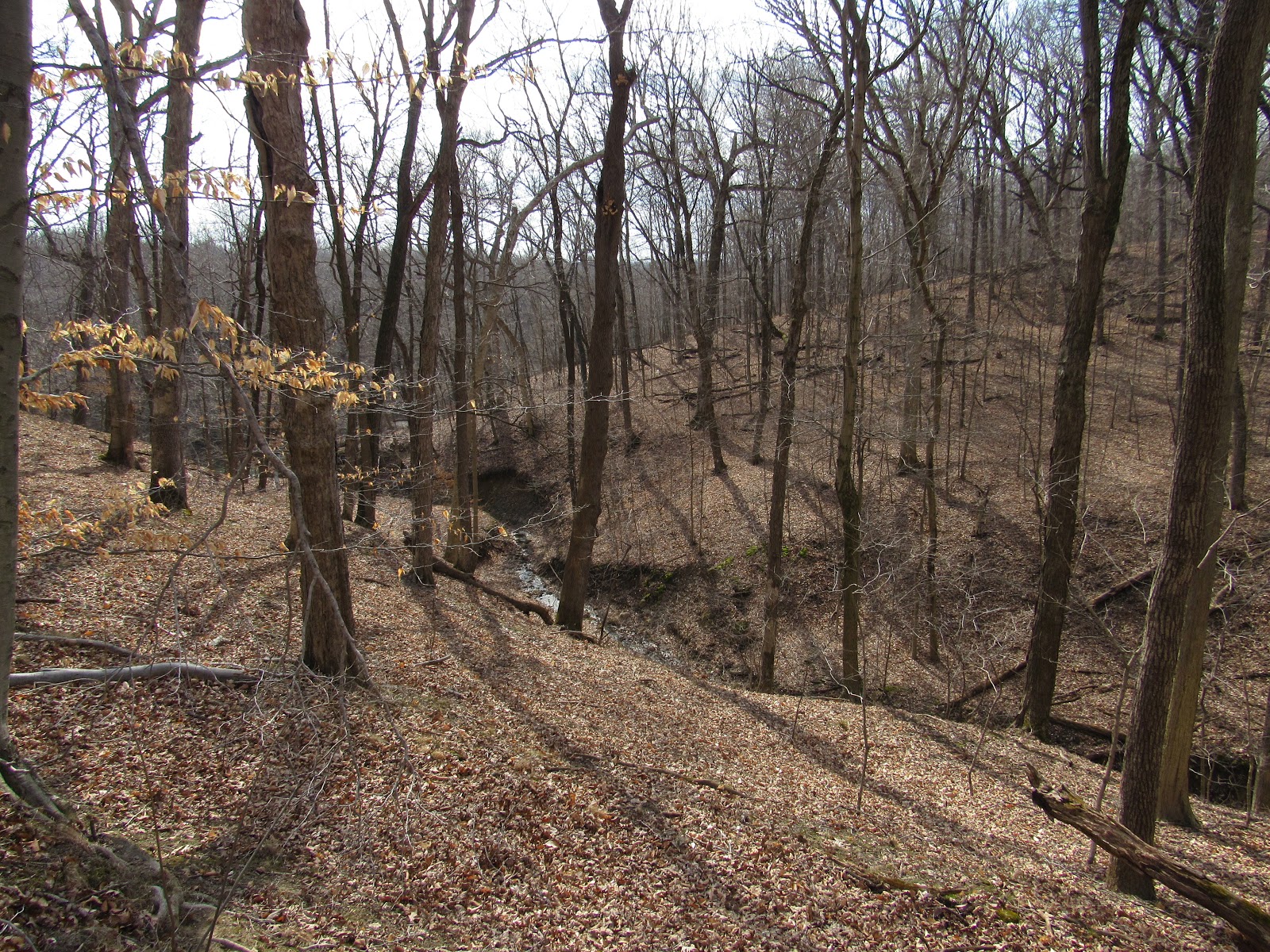
I walked along the edge of the bluff, crossing ravines and creeks like the one above as I came to them.  I do love the openness of these woods, where I found not a single Asian Honeysuckle bush.


On this beach, I had my first butterfly of the year, a Mourning Cloak which startled me and flew off quickly enough that I was unable to get its picture.  Both a new butterfly and a new earliest-time-seeing a butterfly for me!  Spring is certainly on its way!


I found a lifer Southern Two-lined Salamander under a rock in a creek as I worked my way up from the river, though it dived down a hole before I could get its picture or even get more than a quick look at it.  Being unable to get pictures of animals was becoming monotonous, to borrow a phrase from Mark Twain.  Then I found an animal I could look at as long as I wanted. Notably, it was dead.


I found this Eastern Box Turtle shell in the creek.  What fascinates me is the fact that it has a radio tracker on the back of the turtle.  I've never seen one of these in real life before.  I'm currently making inquires into who runs this program that tracks Box Turtles out here, and I will write more information below when I find out what project this turtle was involved in.


(Space left blank for finishing the story)


I found this strange water-filled concrete structure at the top of the stream, containing my first-ever Wood Frog, dead and bloated.  (Photo not taken because I never want to see that again.) I'm going to wait and find a live Wood Frog before considering it a lifer.  At this point, I was hungry, so I had my lunch in my car and drove to a "strip mine" where a Northern Shrike had been seen the day before.  It was time for the second chapter of "The Great Shrike Hunt".  (The first chapter is here.)

As mentioned previously,  I saw no shrike.  I did find something else, however:


Large numbers of Greater White-fronted Geese (Anser albifrons) and Snow Geese (Chen caerulescens) sat just a hundred feet away from the road, in what looked to be more of a quarry pond than a strip mine.  I have no idea what this place is, but the birding was great!


Thousands more Snow Geese littered the hillsides, with Ring-billed Ducks (Yes, that was intentional)  (Aythya collaris) on the ponds.


Redheads  (Aythya americana) and Lesser Scaups (Aythya affinis) were also present in this large group of ducks, which stretched across the foreground.  This area is where the Shrike was reported.


All at once, something I did must have spooked the Snow Geese, as they flew up in a vast cloud.


I've never been so close to a large flock of Snow Geese before.  It was spectacular in a way that that word feels inadequate to describe such a spectacle.


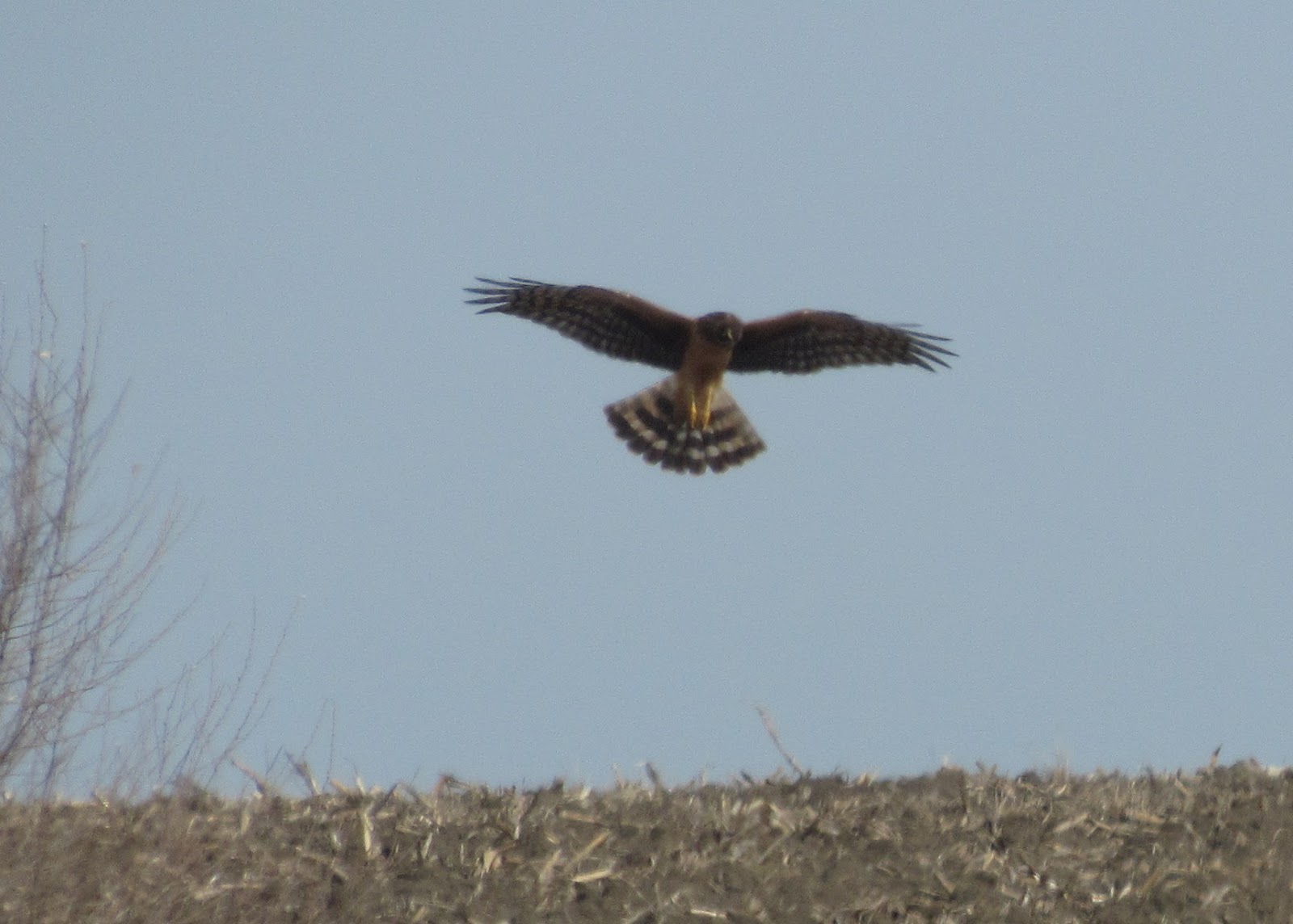
They eventually looked like they were going to depart, so I took photos of a nearby Northern Harrier (Circus cyaneus) flying about on the other side of the road.


Here it is, just before it plunged on some poor mouse:


Then the geese decided to come back, even closer than before, at least while flying.


I found sixteen Ross' Geese in the photo above, essentially miniature Snow Geese.


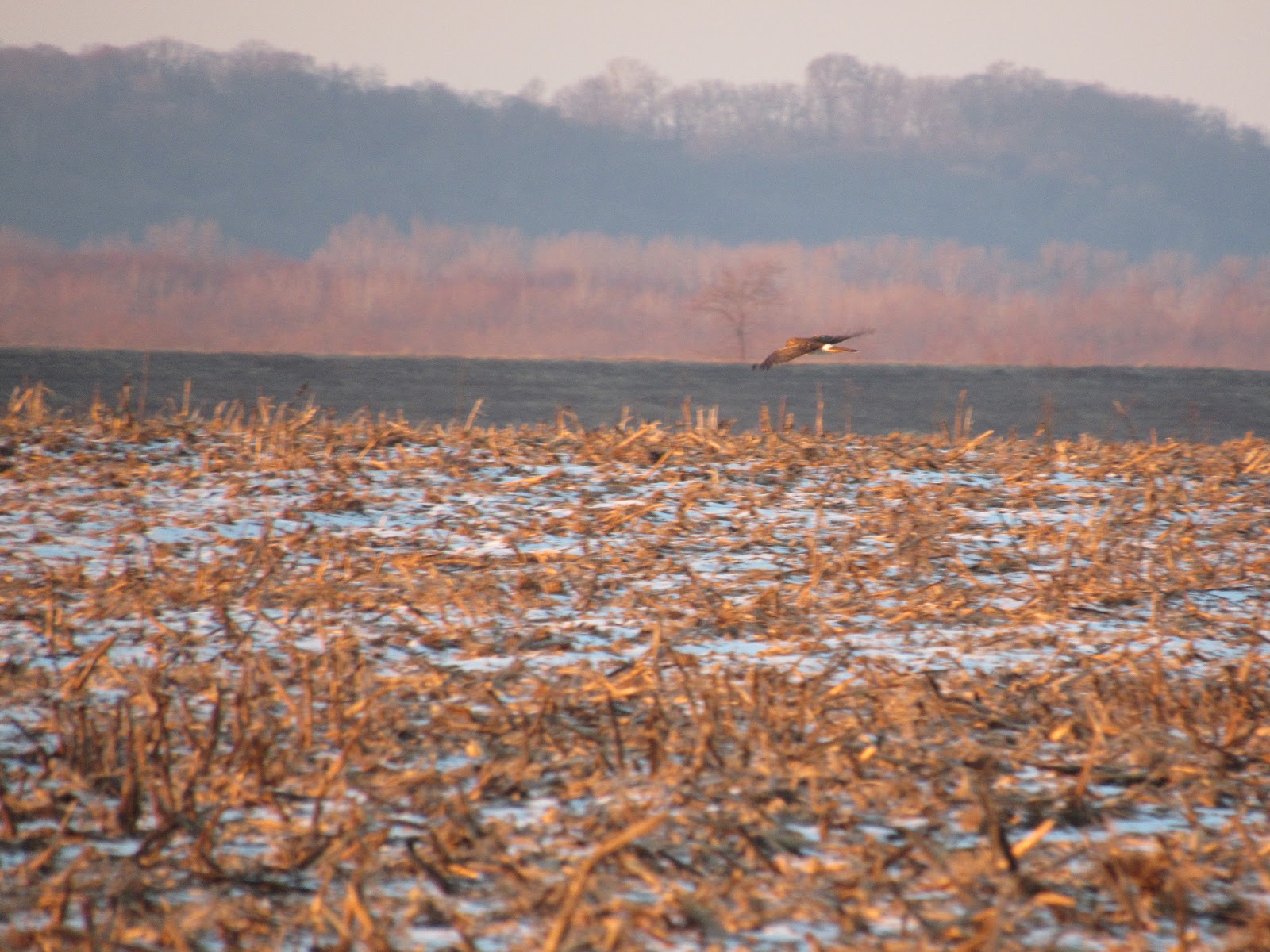
After the geese landed, just a bit further away than before, I decided to go looking for that Northern Harrier again.  I rediscovered it as it flew out of a bunch of grass:


I kept looking for the Shrike, but instead I found some large mounds of gravel or something, looking very much like I'd accidentally ended up in the Badlands:


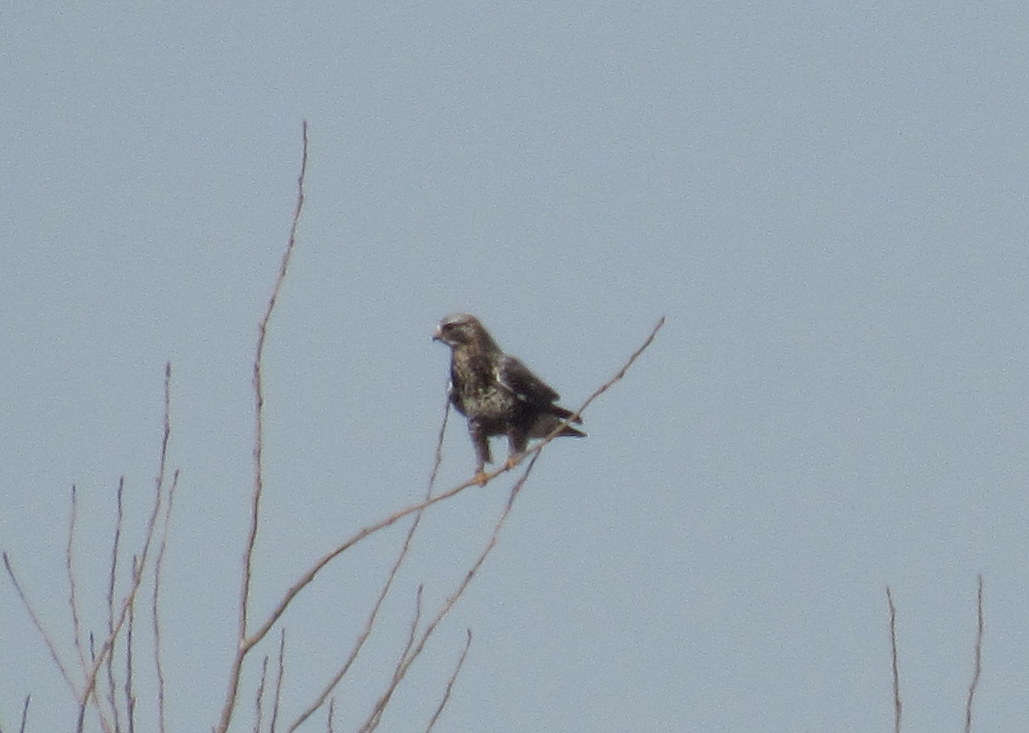
Nearby, I found this. I had formerly been wondering if I was ever to get a photograph of this species:


This is the fairly-common-but-I-only-see-it-when-driving-so-thus-it's-difficult-to-photograph Rough-legged Hawk (Buteo lagopus).  It's named for its feather-covered legs, clearly visible above.  I watched it through my scope until it flew away, back into the "Badlands".   Satisfied that I'd finally photographed something, I then left for Forest Glen Preserve.

Now, for the next part, I want you to realize that I don't usually get lost, and that when I do, it is never my fault, but the fault of the cellular data or the map.  In this case, however, I blame someone else.


Whoever designed the layout of Forest Glen County Preserves deserves some form of cruel and unusual punishment.  It's the most deliberately confusing road network I've ever driven.

Now, looking at this map, it may seem that I am being overly dramatic. However,  it might be observed that some of these roads rapidly turn up and down through woods, so that visibility is not always easy.  Furthermore, these roads go from "One Way" to both lanes rather suddenly (and vice versa).  Additionally, the road signs generally do not mark the Illinois Nature Preserves or trailheads. instead pointing to every closed, special-event only building,  Also, some of these roads are closed to all but the "staff" (none of which I could find on a Saturday afternoon).

I rest my case.


I pulled over to ask a few visitors where the group campgrounds were.  The first thing I was told was "You can't miss it." There's a reason those words are joked about by comedians everywhere.  I never found the group campgrounds.  Instead, I contented myself with Doris Westfall Illinois Nature Preserve and some calling frogs, the first ones I've heard this year.  I never did see the frogs, though.


I then found my way to a trail, which said it was a mile long, enough for an hour's slow examination.  I thus proposed to hike it, stopping by the beautiful stream on the side:


I've never seen a creek in Central Illinois as lovely as this, and only a handful in Southern Illinois to even be worth comparing!  I'd imagine there's a few salamanders in it, but I never found any here.


I did find another Illinois Nature Preserve, Howard's Hollow Seep, the third Illinois Nature Preserve of the day!  Here I found the species I'd been trying to find at Forest Glen Seep, the earliest flower of the year, the lowly Skunk Cabbage (Symplocarpus foetidus):


It soon became evident that this was not a rare plant!  I found at least a hundred flowers of this species, and the smell soon became quite bad, as this plant is aptly called Skunk Cabbage.  It's neither a skunk nor a cabbage, but it smells like a mixture of the two.


Despite having very large leaves in the summertime, the flowers were surprisingly small, as you can see above.  Several flies were out and about, attracted to the smell.


On one of the flowers above, a rather clever little spider waited to pounce on the pollinating flies.  That strange thing in the center of the little "hood" is the actual flower here.  Howard's Hollow Seep looks like a great place for other salamanders, but there weren't many logs to flip, and I didn't want to disturb what looked to be a very healthy marshland.


I eventually left after a bit more hiking, somehow found my way out, and decided to drive to Indiana to end the day.  A minute down the road, I reached Indiana.  Looking out over the Vermilion River, I considered my journey ended, and drove back home.  It was a wonderful day, even if it didn't exactly go according to plan.  Honestly, I need to just stop trying to plan everything and roll with it more.


Ebird Checklists:

Middle Fork Nature Preserve

http://ebird.org/ebird/view/checklist/S34491045

Quarry/ Strip Mine Ponds

http://ebird.org/ebird/view/checklist/S34491414

Tuesday, January 10, 2017

One Strike, No Shrike- But Lots of Owls!


Saturday, January 7, 2017 began like any other day of Christmas break.  I dragged myself out of bed at 9:45 AM (I'm not a morning person), ate breakfast, and began checking my social media around 11 AM.  A local birdwatcher in my area (to be honest, one of the best ones in the state) had spotted a Northern Shrike in Cass County, less than an hour's drive from my house.  This discombobulated my day's plans entirely.

There aren't many birds that I will drive an hour for on their own merits. Shrikes are among that small number.  They are rare in Illinois, and getting rarer. Also known as butcher birds, shrikes, which hunt mice and small birds, have the curious habit of sticking their victims' corpses to thorny bushes, in order to save them for later.  Their specialized habits and general rarity makes them one of the species I most want to see.


I left the house at 1:30 PM, realized I didn't have enough gas, went to buy gas, accidentally left my gloves off when pumping gas, and to top it off, I managed to tear off one of the card pockets of  my wallet while paying for the gas.  Two tailgaters and an obnoxiously slow driver later, I was in a considerably foul mood.  Added to this was the traditional difficulty of finding a shrike.  While they generally try to stay near their larder (the bush they hang all their dead prey in) they can move around a bit while hunting, often in somewhat brushy areas where it's hard to see them, at least according to what I've read.  I had low expectations, particularly after the luck I'd had already.  On the highway, I barely even saw any Red-tailed Hawks, and those are usually quite common there!

Thanks to the vagaries of cell reception, there is a large gap in service in Western Illinois, Anywhere west of the Sangamon-Morgan county line gives me 1X cell phone reception automatically.  As a result, I had no GPS.  Therefore, when I tell you that I missed my exit, I have an excuse.  Once I'd figured out I had missed my exit, I took the next available exit, and ended up, after a bit of map-checking, on Phillips Ferry Road.

In front of me on the road, I spotted three small, pale, sparrow-like birds. These turned out to be lifer Lapland Longspurs, though they flew off before I could get a photo. Several more good birds later, I came down the bluff to the bottom of Phillips Ferry Road.  A few birds flew in front of me, and landed in some brush to my right, near a barn.  Looking over at them, I saw one with a red mark on its head.  I thought, "How is that bird flying with such a big head wound... That's a Common Redpoll!"  I didn't get a photo of it either, though I stopped.  I relocated it, but it flew before I could even raise my camera, and it flew behind the barn, along with a few other similar birds (though I can't say for certain they were Redpolls)  Behind me, meanwhile, I spotted a man walking around in the yard of the house nearby, staring at me.  I wasn't about to trespass in front of him, not even for a Redpoll.  For legal reasons, I'll refrain to say what I would have done had that man not been there...

(Update:  For whatever reason, despite several searches, no other birders have relocated the Redpoll.)


I took photos of the Red-tailed Hawk (Buteo jamaicensis) flying overhead instead.  The man kept staring, so I left.  He probably thought I was a burglar or something.

Two lifers, so far! The Common Redpoll was especially good, since to my knowledge at this point in the winter I'm the only birder to have seen one in central Illinois in all of fall 2016- winter 2017.  Winter finches like the Redpoll haven't had to come south for food this year, so they've remained in the north.  I'd like to remind everyone that I had no intention of driving down this road, at this time.  If I hadn't, I would have missed two lifer bird species, and one especially that's not very common this year.  Thank you, God!

That was a lot of exposition, so I will try to balance that out with pictures now.


Short-eared Owls had been reported in the area near the shrike, so I decided to look for them and Northern Harriers first.  I haven't seen any at Nipper so I decided to give this area a try.  My first animal were four White-tailed Deer (Odocoileus virginianus), including two bucks,


A large flock of Horned Larks (Eremophila alpestris) sat on the road just down from me.  They posted sentries just a little bit out from the group.  Every so often, something would spook them, usually me, and the whole flock would fly up at once, and then slowly return to pecking gravel.  Birds eat gravel in order to use it in digestion. There's a specialized region of a bird's stomach, called the gizzard, which stores this gravel and uses the ingested gravel to help break down tough foods.


Along the edge of a creek, I found a few sparrows, including this Savannah Sparrow (Passerculus sandwichensis), above, and the American Tree Sparrow (Spizella arborea), below.  I'm certain with a little more looking, I could have found a few more species of sparrows, but I was quite happy with those I did see, especially the Savannah Sparrow which I did not expect to see.


Driving down the road, I spotted this white canine in the grass, and at first I thought it was a leucistic coyote.  Of course, when it ran across the road to a house, and I saw the collar, I figured out it was just someone's dog.  Later, however, on the drive back, I saw a coyote eating roadkill in the center ditch of the highway, twenty feet from me as I drove past.


It was truly a beautiful day, and the day got better still as I drove through a prairie and spotted a bird of prey flying low over the grass...


Then, I spotted a second one, just behind the first. I was too late to get a photo of the first Northern Harrier (Circus cyaneus), but I got this photo of the second just before it vanished in the grasses.


In a nearby tree, I spotted a Bald Eagle (Haliaeetus leucocephalus), the first of two for the day. To be honest, I'm actually surprised I didn't see more, considering how close I was to the Illinois River!  I suspect there wasn't enough open water on frozen-over Meredosia Lake to attract more eagles.


Indeed, all my waterfowl of the day were flyovers, including Canada Geese (Branta canadensis):


There's nothing quite like a blue winter sky in Illinois:


At this point, I went looking for the shrike, and I drove down Honey Point Road, from whence it was reported. At the very end of Honey Point Road is a gate, and I could not turn around on that gate.  I had to reverse about sixty feet before the road and the nearby ground were level enough to allow me to turn around!  I contented myself with driving down Indian Point Road, where one patch of woodlands yielded five Red-tailed Hawks at once!  I was so amazed, I didn't take many photos:


I still hadn't seen my Shrike or Short-Eared Owls, the two main bird species reported from this area that I had come to see.  I went back along Morgan-Cass County Line Road, where the majority of prairies grew, and I spotted about six Northern Harriers at once!


Far off, over the fields, I could see one harrier hunting intently over the prairie:


Suddenly, something entirely different flew up from the prairie!  It (top right) and the Northern Harrier (bottom left) proceeded to chase one another:


A second one flew up from the prairie, and I realized I had just gotten my first photos of a Short-eared Owl (Asio flammeus).  I have a hard time really "counting" a bird, especially a rare bird like this, without a photo, so I snapped away.


Even at my great distance, you can see the face of the owl distinctly:


The Harrier and the Owl continued to fight for about five minutes. diving at each other with their talons, but never quite connecting all the way.  Eventually, they got bored and flew away from each other.  I drove off about this time.


In the setting sunlight, I watched the third and final Short-eared Owl fly over the fields.  I started last year by going and looking for Short-eared Owls at Nipper Wildlife Sanctuary, and I feel that this is a tradition that I should continue.  Next year, I'll have to look for them someplace else, to keep up the streak.  Since this time, I've learned where the Northern Shrike is exactly, so I plan to look for it again sometime soon.  This is the first chapter in "The Great Shrike Hunt".


Ebird Checklists:

http://ebird.org/ebird/view/checklist/S33524334
http://ebird.org/ebird/view/checklist/S33524282

http://ebird.org/ebird/view/checklist/S33524682

http://ebird.org/ebird/view/checklist/S33525276