Showing posts with label Rare Herps. Show all posts

Wednesday, May 31, 2017

"Those rocks aren't THAT big..." Visiting the Ozarks, Part 4 (Finale!)


Ozarks Spring 2017 Series
This is Part 4


At this point, people might be tiring of the Ozarks, and I was starting to as well.  That's why I've saved one of the best finds for last, and also because I don't want to reveal its location.  This is an Eastern Collared Lizard (Crotaphytus collaris), and it is one of the more odd residents of the place where I found it.  Most Collared Lizards live in the southern Great Plains and the deserts of the West.  However, Missouri has microclimates in the Ozarks that resemble its habitats out west. so it lives here.  I'm just going to say that this lizard was found in an unexpected location.


Now, you might think that I'm being overly cautious in not saying where this was.  However, the Eastern Collared-Lizard is a state-listed (protected) species in Missouri, because people regularly capture these attractive lizards for the pet trade.  This has led them to vanish from much of their habitat.  I don't want to contribute to that, so I'm not going to say where I found it.


I flipped over a rock in the same place and found a Prairie Racerunner (Cnemidophorus sexlineatus viridis) hiding underneath.  It took off a second later., and as I've mentioned before, they earn the name racerunner!  They do a slithering series of dashes that's quite fun to watch.

If they were easier to catch, I'd be worried about the Prairie Racerunners being caught for captivity in a similar fashion.  It's my opinion that they are the most attractive lizard in the eastern United States.

 Now, to return to our regularly scheduled nonsense, we stopped at Elephant Rocks State Park on the way to home.  The first rocks we saw weren't that large, hence the title of this post.  In front of the bathrooms Nathan found this moth, a Polyphemus Moth (Antheraea polyphemus).  This impressive moth was the last of the many stunning moths we saw on this trip.

I did see several Great Crested Flycatchers (Myiarchus crinitus) here, which I found exciting.  I don't see these much where I live.  Yet we have plenty of flies... we could certainly use them!


Several Prairie Racerunners  may or may not have been seen there, to the point where they may or may not have been one of the most numerous animals in the spot where they may or may not have been found.  I may or may not be concerned about people trying to catch these where they may...

Ok, I give up, this is getting exhausting to write.  Herpers aren't supposed to disclose the locations of reptiles, I've found out.  Also, a herper is somebody who likes reptiles/amphibians (herptiles).  However, I hope it's vague enough if I say these lizards were EVERYWHERE!


Pencil Flower (Stylosanthes biflora) , a new plant for me, bloomed along one of the many side-trails people have made here.  There were dozens of these, all well-worn with use.  We used some of them. because the main path was literally designed so that a visually-impaired person would be able to use it. As a result, it went around the interesting rock formations we wanted to see, not up close to them.  We didn't blaze any new trails, however, and stuck only to areas where people had walked before us.


The rocks slowly got larger, with little bonsai-like oak trees growing in the cracks and dirt patches.


Fence/Prairie Lizards (Sceloporus consobrinus) like this unusually reddish one vied with Prairie Racerunners as the most common lizards.  Either way, there were more lizards here than in the average Floridan garden, and that's saying something, because Florida gardens have lots of lizards!


A few Lichen Grasshoppers (Trimerotropis saxatilis) hid in the lichens here, but there were far fewer fruticose lichens, so their ability to hide was compromised.

Massive pink granite boulders, with fifteen-foot-deep, three-foot-wide cracks between them, became the norm upon the hilltop.  We could also look out and see the Ozark hills in the distance.


Here's Tayo trying to climb up this rock.  It defeated his attempts to go on top, but I use him here for a sense of scale.  These were large, oddly-balanced rocks!


Here you can see the unusual wetlands in small sinkholes atop the rocks. Frogs had laid their eggs here some time back, and dozens of tadpoles lived on the algae in a few of the rocky pools.


The rocks do bear the vaguest resemblance to a pachyderm, and I do mean the vaguest.  Also, a pachyderm is an elephant, rhino, or hippo- some large thick-skinned mammal, of the sort that would be found in the average nature documentary.


We sat under some boulders, where a triangular window let in the sun.


On the other side, the ground sloped down. Two precariously-balanced boulders on the edge threatened to imitate Raiders of the Lost Ark as we ran downslope ahead of them.  However, the analogy to that Indiana Jones escapade was inexact- the boulders remain, as far as I know, fixed in the same position, balanced on the edge of the slope, still threatening to fall down.


On the edge of the woods, we encountered a toad.  I have been told that this is a Dwarf American Toad (Anaxyrus americanus charlesmithii), which would be a new type of toad for me.


A large quarry pond reminded us of Elephant Rocks's history. Before being a state park, Elephant Rocks was a pink granite quarry. In general, the quarry added little to the beauty of the rocks, but this pond is an exception.


I did mention there were lizards here, right?  While photographing this lizard, I spotted a red shape with an unusually light, thin bill fly away- Summer Tanager!  I then heard some odd birdcalls coming from the nearby bushes, so I crept forward, towards the calls.  I'd wait, then I'd hear another one, and I 'd creep closer to my target.  I raised my camera- Brown-headed Cowbird (Molothrus ater).  Boo.  This is one of the most common birds at Elephant Rocks, so I was annoyed.


Jokes about "regular hiking time, and birdwatcher's hiking time" began about this point, and proved popular.  However, this was merely some good-natured ribbing.  I was trying to see it all, and I missed much, including a snake species I'd always wanted to see, that someone else in our group saw.


Now, I could have done without seening this.  I'd seen few invasives prior to this, but this was an unwelcomingly healthy population of Japanese Honeysuckle (Lonicera japonica) (a vine, unlike the bush, Amur/Asian Bush Honeysuckle, that is usually called Japanese Honeysuckle). The sickly-sweet scent reminded us why this plant grows here now- it was brought over for gardens.  Even today, some people still grow it in their gardens.  However, Japanese Honeysuckle takes over and then demolishes native landscapes, its heavy vines blocking out anything else growing in its path.


An equally unwelcome native also grew on the side of the trail- Poison Ivy (Toxicodendron radicans), shown here in flower.  I'd never seen it's flowers, though it has white berries in fall that I have seen.


An incredibly colorful bug landed on Professor Croteau's back as we ate snacks nearby.  This proved to be the last major sighting of anything until we got back to Illinois.  As we unloaded our van in the LLCC parking lot, a Common Nighthawk called and promptly flew overhead, a great Fifth Orchid for a truly amazing trip. It's taken me four blogposts, and I'm sure I haven't written half of it!  However, all good things must come to an end, and for the sake of privacy, time, and lack of further photos, I must bring this series to a close.  I can't wait until my next visit here!


Ebird Checklist:

http://ebird.org/ebird/view/checklist/S37026176

Wednesday, May 24, 2017

"We won't find THAT snake..." Visiting the Ozarks, Part 1

Ozarks Spring 2017 Series
This is Part 1

Behold!  I have returned from the Ozarks!  And I was wrong about everything!

That's a trifle exaggerated, but I did just go to the Ozarks for the first time with the Lincoln Land Environmental Club, and much of what I thought I knew about the area proved to be wrong.  I wasn't sure how it was going to be, but it looked fun, so we put in the work growing tomatoes to help pay for the trip, and we badgered everybody with paperwork so that we could go.

Now, a couple of nights before, I'd asked a friend about finding snakes in the Ozarks, and they mentioned to keep an eye out for Eastern Hognose Snakes.  I said I probably wouldn't find any... 


Not ten minutes out of the first parking lot at the first state park we visited, I nearly step on an Eastern Hognose Snake (Heterodon platirhinos), a lifer for me.  Well, this was going great so far!  

This particular snake species is famous for pretending to be dead when caught, but we let this one go on its way without so much as a brief display.  


Half an hour later, at the same state park, a Speckled Kingsnake (Lampropeltis getula holbrooki) slithered across our path, within an arm's reach of me.  I took a few quick shots and let it go on its way.  This is a lifer snake I didn't expect to find here! Could the day improve any more?


Sure, let's add in some Spring Coral-root Orchids (Corallorhiza wisteriana) less than five minutes later on the same trail.  At this point, I was overly blessed, and extremely happy.


Spring Coral-root Orchids don't have leaves or chlorophyll (the green stuff in plants that they use to make food), they require special mycorrhizal fungi in the dirt in order to live.  These orchids steal their nutrients from fungi that borrow nutrients from forest plants.  It's a complicated lifestyle that signifies a healthy forest when these are found.


The stag beetle crossing our path  a bit later was unnecessary but still amazing.


Furthermore, there were so many new plants to see, like the Four-leaved Milkweed (Asclepias quadrifolia) above.  Certain plants, like this species, are far more present in the Ozarks than anywhere in at least my current part of  Illinois.


One of the most common species was the earlier flowering species of Beebalm (Monarda bradburiana), a plant that lives mostly in the Ozarks and Southern Illinois.  Despite its range extending into Illinois, this was still a new plant for me.


Cancerweed (Salvia lyrata), which does NOT cause cancer, bloomed along the side of the trail.  This is one of those plants I always associate with vacations, because I find it a lot on vacation in the South but never in Illinois.  However, it does live in parts of Illinois- I just haven't found it yet.   This is one of those plants that grows almost entirely south of the Mason-Dixon Line.  And yes, it was named because pioneers once thought it could cure cancer, but it sadly cannot.

(Everything above this section is set apart to protect its secrecy, otherwise the snakes and orchid might be in trouble from collectors.) Sometime later in the day, we went down a trail and discovered the Shut-ins, a series of rock formations at Johnson's Shut Ins State Park:


Essentially, these "shut-ins" are really hard rocks (rhyolite) eroded over time by the flow of the stream.  As a result, they make the river flow in fantastical ways through tight cracks and over rapids.


When the water's lower and warmer, this is a great place to swim, but the river was legally closed to swimming at the time of our visit.  We only understood this as the Shut-ins section being closed, not the entire river.  Still, most of us didn't break this rule.  At least 37% of those on the trip obeyed it.


Here's your lineup of suspects.  After looking at the shut-ins for awhile, three people remained below while four of us went up to a nearby trail.


We could see that the Shut-ins extended downriver, and we also found a Green Tiger Beetle:


Below the Shut-ins, the water became an un-name-able shade of blue, which looked absolutely stunning in real life.  We kept trying to figure out the name of the color- was it cyan, turquoise, cerulean, or something else?  We settled on cyan, I suppose, but I'm still not convinced.


At any rate, the abundant  Lance-leaved Coreopsis (Coreopsis lanceolata) was unambigously yellow:


And the common Fire Pinks (Silene virginica) were RED.  (Not pink, that's just the name of the plants for some reason.)  These are an interesting plant in that they are abundant in the Appalacians and the Cumberland Plateau, as well as in the Ozarks, but they somewhat skip over the connecting tissue of the Shawnee Hills.  They're there, but they don't appear to be as common for some reason.  Basically, they live in the two upland areas outside of Illinois, but not very much in between.  This helps to support the theory that the flora of the Ozarks and the Appalachians/Cumberland Plateau were once connected to each other, before being separated by the Mississippi River Valley.


We ended up going downslope to a trail along the river, where we found a Midland? Water Snake (Nerodia sipedon) swimming along in the water.


This river, the Black River, is one of the best I've ever visited.  The water is clear, full of small rapids and pebble-bottomed, with little fish quite visible in it.

Giant Swallowtail Butterflies (Papilio cresphontes), the largest species of butterfly in the United States, were quite commonly seen here, and I had never seen them before:


Along the trail, we eventually found a spot with a commanding view of the river:


This giant rock demanded to be climbed on, and so we did.  Beforehand, I took a photo downriver:


Tayo and Nathan had already climbed up, so I took a photo of them:

We'll leave Tayo and Nathan stuck on that rock for now, because this post has gone on long enough.  There's so much more to cover, but I'd rather leave it on a cliffhanger... besides, we haven't gotten to the bears yet.  That was exciting!

Ebird Checklist for disclosed area:

http://ebird.org/ebird/view/checklist/S37025430

Wednesday, October 26, 2016

Best Views in Illinois!- Fults Hill Prairie Nature Preserve

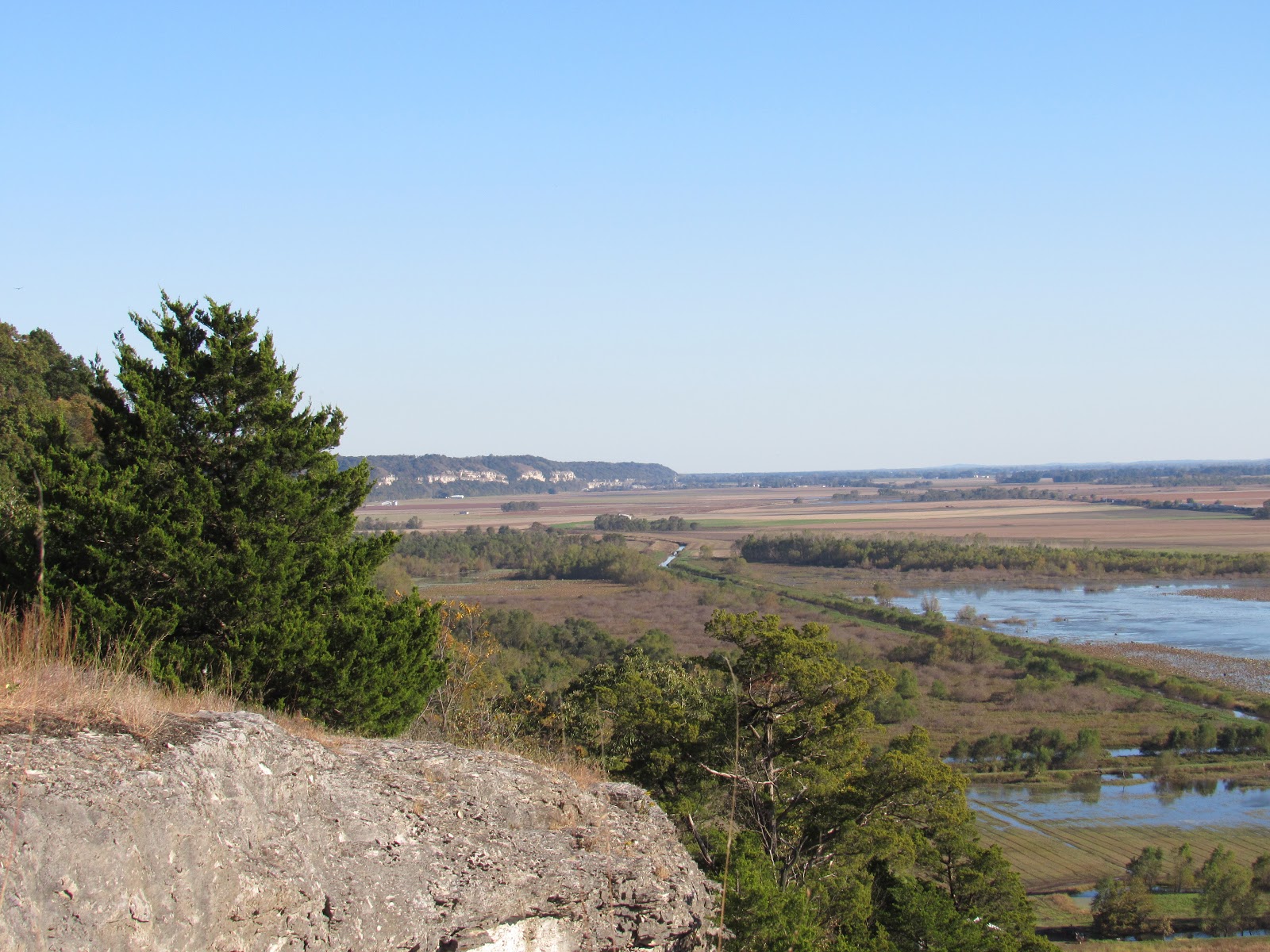
Fults Hill Prairie was the second of the two preserves we visited on the Lincoln Land Environmental Club trip.  Fults Hill Prairie Nature Preserve is a 300-foot tall bluff (and you feel all 300 feet of elevation gained when hiking it, too!) overlooking the Mississippi River Valley and the adjacent Kidd Lake Marsh Nature Preserve (home to Illinois' northernmost population of Cottonmouths).  Speaking of venomous snakes, we found this... interesting?... warning posted on the rail of the stairs:


Both the habitat and the location of Fults Hill Prairie are in line with the habitat and range of the Timber Rattlesnake, essentially Illinois' only rattlesnake.  (There is one other species, the Massasauga, but it's so rare, don't even bother looking for it.)  I'm actually fairly disappointed not to find it, as it's a personal goal to find a venomous snake, especially a Timber Rattlesnake.  In addition to three possible species of venomous snake (Cottonmouths at the base of the bluffs, and Timber Rattlesnakes and Copperheads on the bluffs themselves), Fults Hill Prairie also has one of Illinois' few scorpion populations. All of these are shy and uncommon- we sure didn't see any, and I was looking!  Furthermore, the scorpions  (Common Striped Scorpions, far more common out West) are nonlethal and a state-listed species.  Be careful where you step!


Actually, while I'm listing cautions, there's a few more.  This is a spectacular place for views and nature, but not for little kids or pets, which cannot be trusted near the unguarded bluff edges.  You could quite easily fall to your death here, so don't be stupid.  Additionally, if you're out of shape even just a little bit (like me), you will not like the two hundred or so stairs to the top.  The trail is listed as extreme difficulty for a reason.  On the other hand, if you're from Colorado or something, it'll probably be quite easy, and if you're from Australia, it might even seem quite safe.  All things in perspective, I'm making this sound unnecessarily dangerous.  Fults Hill Prairie Nature Preserve is no walk in the park, (even if it is a walk in a park) but it is certainly worth visiting if you can handle it:


I think the above photograph makes a pretty good argument for why people visit, despite the risks.


Among the many flowers on the edge of the cliffs, I found these wild onion seedpods especially unique, as they likely belong to Cliff Onion (Allium stellatum), a species I've not seen before, but which is more common in the Ozarks and whose name seems quite appropriate!


Three or four overlooks made great places to stop along the ever-climbing trail.  We joked that the trail never seemed to stop going up.  We could see a few ducks in Kidd Lake Marsh:


Just overhead, the Turkey Vultures (Cathartes aura) used the air currents off the bluffs to propel themselves along.  When we appeared, they immediately began circling right over us.  I think they were curious as to what we were doing, up so high with them.


We found a few in nearby trees, where they watched us as we photographed them from across the first prairie we came to.  This short, narrow prairie, adjacent to the trail, led inland away from the bluffs.


I have to say, I like Turkey Vultures, but I don't care for their looks.  Still, that bald head is useful when digging into roadkill.  Thanks in part to roadkill, there are actually far more Turkey Vultures than when the European settlers first arrived. (The increase in the deer population since that era also helps, as carcasses like that of deer form a large part of this bird's diet.)


After watching the vultures for a bit, we continued down the trail into the woods. I decided to flip over a log, and at first there appeared to be nothing.  Then something wiggled, just below the surface:


It was my first-ever Spotted Salamander (Ambystoma maculatum), which is on the edge of its range here, though it's far more common in the Shawnee Hills.


I had just learned about these salamanders in Vertebrate Zoology, so it was a bit of a surprise to me to see one, especially in a place where I had been expecting scorpions.  This salamander was in upland, fairly dry woods on the edge of a hill prairie.  It's not exactly the best spot to find a salamander.


Here, the salamander decides to burrow through my hand.  This particular species belongs to a group known as the mole salamanders for their digging habits.   This group of  salamanders is perhaps the most common species in central Illinois, though in the Shawnee Hills and far eastern Illinois they are outnumbered by lungless salamanders, at least in theory.  In practice, this single week has produced more salamanders for me in my life than any other week.


After a couple minutes, we released the salamander back into its burrow, where it disappeared.


We then moved on, and I found a fern, or two...


This is the Bronze Southern Grape Fern (Botrychium dissectum obliquum) so called because its leaves are bronze in winter, and because its sporangia (not flowers) looked like grapes to someone:


I then found a few more, and then several more, and then realized there were a few hundred:


I'd only just discovered this species for the first time earlier this year, so I was quite surprised!


In addition to the hundreds of normal, "Bronze" Southern Grape Ferns, we also found a couple dozen of the "Cutleaf" Southern Grape Ferns (Botrychium dissectum dissectum), considered a different subspecies, and one I had only discovered at Lincoln Memorial Gardens the previous week!:


We eventually  made our way out of the fern-filled woods, and into a larger hill prairie.  I spotted my first ever Western Ribbon Snake (identified by its small head) on the side of the path, although it made a swift escape before I could even get a photo of it.  This small strip of Illinois is some of the only habitat in the state for a few Ozark snakes, including the Coachwhip and the Prairie Ratsnake, but we didn't find any more snakes.  Still, any new snake species is great!


Speaking of great, the cliffs adjacent to this prairie had some of the finest views I've ever seen.


It may look like I'm flying to get this picture, but actually the cliffs swing outward at this point.   This is one of those areas where I warn you not to be stupid, as you are on top of high cliffs.  It's absolutely beautiful, and you can see for miles, however, so just sit near the edge and enjoy the view.


While near the rocky edge, I discovered a few things:


This is Rose Verbena (Glandularia canadensis), a new plant for me, in a way.  Garden Verbena plants are hybrids involving this species and a few others, so in a way I've actually grown it in my garden.


I found this gall on an Eastern Red-cedar (Juniperus virginiana), a coniferous tree found commonly on the edge of these bluffs, and seen in several previous photos.


Overhead, several more Turkey Vultures went by, but mixed in with them were a few Red-tailed Hawks (Buteo jamaicensis) like this one above.  I suspect this might be a good spot for hawkwatching, especially a few weeks back in September when large numbers of Broad-winged Hawks were migrating southwards along the Mississsippi River.


The most colorful plant, meanwhile, was this goldenrod species (Solidago sp.) on the edge of the cliff.  The bright yellow of this plant popped on the gravelly cliff edge.


We lingered on the precipice for a few minutes, before retracing our steps back to the end of the prairie, where the trail led down a steep, rock-covered slope to the parking lot.  With all the large, flat stones available, we began turning them over, in a hunt for whatever we could find.


Under every other rock seemed to be a millipede of some sort or another.  The one above, with its brown and orange coloration and unusually flat body, seemed to be the most interesting of them all.


Under one rock, I found this old friend.  The cosmetid harvestman (Vonones ornata) is one of the stranger-looking arthropods I've seen.  It is a species of harvestman or daddy longlegs, but with short legs and a penchant for dry, open woodland edges along hill prairies, it would seem.

For no explicable reason, knowing that this is a harvestman and not a spider made me able to hold it without a care.  Perhaps this is the way to break my fear of spiders?  Either way, it was one last unusual sight to see for a great trip that I will be making again.  If you feel up to the challenge, I dare you to visit Fults Hill Prairie as well.