Showing posts with label Costa Rica. Show all posts

Saturday, January 9, 2016

Costa Rica, Part Five of Five, La Paz Waterfall Gardens: Of Ferns, Leaves, Cameras, Humidity, Birds, and Several More Mediocre Things That In Combination and Scale Really Weren't So Mediocre After All

 Welcome to the last part of my Costa Rica adventure.  I hope you've been enjoying what I've written and photographed so far. By the way, this post sets the Guinness World Record for longest title on The Wild Land of Lincoln.  That may or may not have been intentional.

La Paz Waterfall Gardens is located somewhere north of San Jose near the town of Alajuela and up in the clouds someplace.  I suspect it's a piece of heaven that fell down and landed on some mountain.  It was probably a part of the water supply.  In all seriousness, or as much as I ever tend to use, this is a stunningly beautiful area.  Here's what I saw when I first came through the entrance:


That bird is a subtropical cacique (Cacicus uropygnalis uropygalis), likely a male due to the size of the red coloring.  This is one of my favorite pictures of all time.  You just don't get birds like this in Illinois.  Okay, maybe we do have birds like this (Tanagers, orioles, and warblers, I'm looking at you) but it was still a really nice bird.

We then went into a buffet for tourists, full of such blessed nourishments for our bodies as french fries and pizza.  I thought I'd died and gone to heaven.  After eating mostly the Costa Rican staple of rice and beans all week, (which were prepared using different seasonings most of the time and were actually pretty good)  it was great to have norteamericano food.  I continued thinking I'd gone to heaven as I looked at the orchids surrounding the buffet, until I went into the bathroom and found a two inch long cave cricket in my stall.  After lunch, we went around the zoological gardens part of La Paz Waterfall Gardens.


As we were in the cloud forest, this was basically every tree trunk's appearance.  Hummingbirds flocked to nearby feeders.  A sign stated that 26 hummingbird species had been recorded from these feeders.  TWENTY SIX!  In Illinois, we have only one common hummingbird species, the Ruby-throated Hummingbird, or Archilochus colubris.  I had never seen such a diverse display of hummingbirds, or, to be fair, any species that wasn't the Ruby-throated Hummingbird.  These jewels of the avian class were accustomed to visitors and let us get within six feet.  Of course, my camera hated the dim lighting of the clouds and shade, so here are some pictures.  I really don't know what better to expect given the lighting conditions... until my phone camera worked twice as well.  I give up.  How is it that a machine built for the sole purpose of taking pictures takes worse pictures than a machine built to do hundreds of various tasks, not limited to taking pictures?  As you ponder that, look at the following photos.  The first one is mine, and the rest are Dr  R-----'s photos, whom possessed a better camera.


 We spent a few minutes at the hummingbirds, but our group only had two hours to visit (which was a complete shame, if understandable due to our schedule, though I could have spent several days and not taken in everything that we saw.)  So we moved on.  My camera and I had developed open hostilities at this point, so, praying that my phone would have enough battery to last, I used my phone camera instead... and it worked better.

I highly recommend, if you feel frustrated by your photographic equipment, then just stop photographing.  It will make you feel better, and a good deal of the experience becomes more real when you are not behind a lens.  Also, use your phone camera.

Advice over, we hiked down into the waterfall section of the gardens.  The humidity was firmly 100%.  I do not believe the air can be more saturated.  We were in a cloud (hence cloud forest) while it was raining next to the spray of a chain of rapids and waterfalls.  I've had baths that were drier. Now, here are the photos.  I have nothing to say, other than, of all the places I have ever visited, only one has ever made it onto my phone as a wallpaper.  I'll let you guess where that is.


It was this photo.

 The ferns on the right of the picture are the largest tree ferns I have ever seen, either in a greenhouse or the wild, or even in pictures.


My coat was soaked through by the sheer humidity of the area.  I could have jumped in a creek and stayed drier.  I keep trying, but there is no way to communicate how wet it was, or how spectacular.


Plants, of course, were everywhere.  Few were flowering, but of the ones that were, this bromeliad was a stellar example.  It was dwarfed, however, by the sheer size of the following plants.  Photo credit Dr.  R----- for reasons that will soon become apparent.


Sadly, it is a bit blurred, but that is a 5' 8'' blogger next to the leaves of a Gunnera species.  The locals refer to these as the poor man's umbrella.  I was very tempted to rip off a leaf and use it for that purpose, but as most of the water was atmospheric humidity, such an endeavor would have been unsuccessful.


Here, the river cuts through a gorge onto the next set of waterfalls.  All of these waterfalls lay several hundred feet from each other, and the whole trail was only about two miles long.

 I'm in the jungle.  This view just sold that idea to me at the time, and it still does today.

   La Paz Waterfall Gardens is one of the most beautiful places I have ever visited.


This is one of my favorite pictures I have ever taken.


Here you get an idea of how close these waterfalls are to each other.


This was my final view as I left the area with my group, and two days later left Costa Rica itself.  The barren area along the bottom right corner was the edge of the road.   I hope you've enjoyed seeing a bit of Costa Rica with me, and trust me, what I have planned for this year is quite a lot. I just bought a new car, and I think it may need some testing on backcountry roads in the vicinity of a nearby nature preserve where short-eared owls are known to reside in the winter.  Stay tuned.

Tuesday, January 5, 2016

Costa Rica, Part Four of Five- Lankaster Botanical Gardens: OMG ORCHIDS!

I am an orchid nut.  I should probably put that as a disclaimer.


I'll quote the corresponding section written by Billy Russell in CHBC Costa Rica for a sense of perspective.

...while most of us headed back to the hotel in a bus nearly flooding from the tears of our sad, sad youth, a small group set off to an off campus site of the University of Costa Rica to look at plants. Jared has been very good about sharing his knowledge on all things green this week (and most things creepy-crawly). I've never been so intrigued and horrified at the same time than whenever Jared would point out something he found... 

The plan was never to go to Lankaster Botanical Gardens  (the off campus site referred to above) in the first place.  However, everyone had noted how plant-crazy I had been, pointing out this and that.  A local missionary offered to take a few people over to visit Lankaster Botanical Gardens,  I went with them.  Lankaster has an extremely large orchid collection, so I was immediately in heaven.  I have very little knowledge of tropical orchids, so most of these plants are complete unknowns to me.


This is about half of the building where the orchids were housed.  There are also some Bornean Nepenthes pitcher plants and a few bromeliads, but over 90% of the collection was orchids.


The small epiphytic orchids were mounted in moss on wood blocks.  One of the most distinctive features of Costa Rica in general was the epiphytes.  Epiphytes, for the unaware, are plants that grow on trees. While moss and lichens tend to grow on trees, vascular plants generally only grow on trees in the subtropics and tropics.  In central Illinois, there appear to be no true vascular epiphytes.  Costa Rica, by contrast, has thousands of plant species, as diverse as cactus and orchids, all growing on trees.  (The houseplant Christmas cactus, Schlumbergia spp., is a form of epipytic cactus from Brazil.)


Here, some bromeliads are growing on a cactus.


Here is another plant growing on a tree.  This is an unknown member of the Araceae family of plants, related to the native Arisaema triphyllum, or jack in the pulpit.  The leaves were over two feet long.


There were a lot of orchids.  If it hadn't been for the previous day, this would be the highlight of the trip.  Ziplining and what's in Post #5  still beat this out, however.  You'll see why in a few days.


I have no idea what this is.   The flowers reminded me of an antelope for reasons as yet unclear to me.


Anguloa, or Tulip Orchid, looks more like an infant in a stroller than a tulip to me.  These orchids are native to the forest floor in the cloud forest of  South America.


I believe this is a Masdevallia species, as is the one below.  Masdevallia orchids are native from Mexico to Brazil, but are especially common in the cloud forests of Central and South America.  There are over 500 species, with many more unclassified as of yet.


The following is likely a Dendrobium species, but I do not know for certain.  What I do know is that it had a wonderful scent.


 I do know what the next orchid is.  It is an Asian lady's slipper, Paphiopedilium spp.,one of many.  I used to grow one, but I managed to kill it after a few months.  That was the only orchid I have ever tried to grow.  I have set a goal to see at least one native Cypripedium lady's slipper orchid this year.  There's no way on earth I could grow one of those, however, nor would I want to.


There are so many more orchids I have pictures of, but there were many other plants at Lankaster.  I will briefly cover them, after one more unknown orchid receives a picture.  


So many orchids, so little time.  Outside of the orchid building, further up the path, there was a sea of terrestrial bromeliads.


This was extremely impressive,  Even more bromeliads grew on the sides of trees, some quite large, like the one in the back center of the above photo.  There were a few fire ant hills along the path, so we had to be careful where we walked.


There were many insects, but few of them stopped to get their picture taken.  If I had a dime for every one I saw, I'd own the world.  If you look below the leaves of this plant in the above photo, you might see a few green leaves, or rather, parts of leaves.  The leaf-cutter ants are at it again!


I did not have the time to take all the pictures of ferns that I wanted to. Suffice it to say that this is a representative picture of the fern section of the gardens.  Spoiler alert, it was nothing like I had seen the day before, but it was still very impressive.  I believe my family suspects my shade garden is turning into this.


Here's a plant that many of you may not recognize, Musa acuminata.  I can assure you that you know this plant very well, however.  Alright, I'll stop messing with you.  It's the banana tree.  Those green fruits growing along the stalk are unripe bananas.  As a side note, expect the price of bananas to increase sharply in a few years.  About 47% of banana plants are Cavendish bananas, and almost certainly those are the sort you have on your counter right now. They are the kind that most Americans eat.  In Africa and Asia, a devastating fungal wilt which targets Cavendish bananas has decimated farms. When it reaches Central America, as is likely to be the case, banana trees will start dying by the millions.  Thus, go out and have a banana, before they all die.  Now, on to more positive things.  How about ducks?


These are black-bellied whistling ducks, Dendrocygna autumnalis.  This species of duck can be found as far north as Texas, south to Paraguay.  They nest in trees, not unlike the native wood duck. I believe this picture was not taken at the botanical gardens, but I do remember having seen this species in the area. Let's have one last orchid to conclude this post.  I don't recognize this species, either, but I do remember seeing different specimens all over the gardens.  They smell vaguely like coconuts.


 I hope you enjoy the final blog post of my Costa Rica trip.  Next week means I will have a lot more work and a lot less free time, so don't expect me to post as often as I have been.  Here's a tease for next time...


Friday, January 1, 2016

Costa Rica, Part Three of Five: Ziplining/Addendum - Happy New Year!


Welcome to 2016! Continuing last year's series, I went ziplining in Costa Rica. (See CHBC Costa Rica for more details.)  We had to hike up part of a mountain with the maturing Dr. R------ (the person who took the above picture)  and his wife, Mrs. R-----, who the day before had narrowly missed breaking a bone falling down another hill.  Needless to say, it was a difficult hike for them.  We had time on the hike to stop in spots to wait for the others.  I took a picture of this ground-dwelling orchid/monocot with its unusual leaves.  I assume this is an orchid, but I have no idea.  I saw it in several areas, including the dark stream valley below camp.  If anyone has any knowledge of this plant's identity, please, please, please let me know.  It's one of those little things that bothers me every so often.


We had a very fun time ziplining.  I am not a person whom enjoys extreme sports, and thankfully,  sliding down a thin cable over a hundred feet above the ground is not nearly as extreme as it sounds. There were thirteen stages, spread throughout the mountain's slope.  I had to leave my camera in my bag for most of the time, however, so I did not photograph much.  A tiny, unidentified lizard was one of the discoveries I made hiking between  I discovered a new species of nettle whilst reaching to examine a millipede.  The discovery was quite a sudden surprise, and I remembered it the rest of the day whenever I brushed that part of my arm against walls and such.   There is a reason they are called stinging nettles...


(Above photo credit Dr. R------)  I was not fond of one particular section.  I was lowered from what was essentially  a chain metal fence stuck sideways on a tree down a hundred feet into a canyon.  It was just as scary as it sounds. You can see the platform in the above picture, and if you look carefully just below the center of the picture, you can see the rope.  At the bottom of the canyon were a large number of mosquitoes as well as a small creek with a cascade about fifteen feet high.


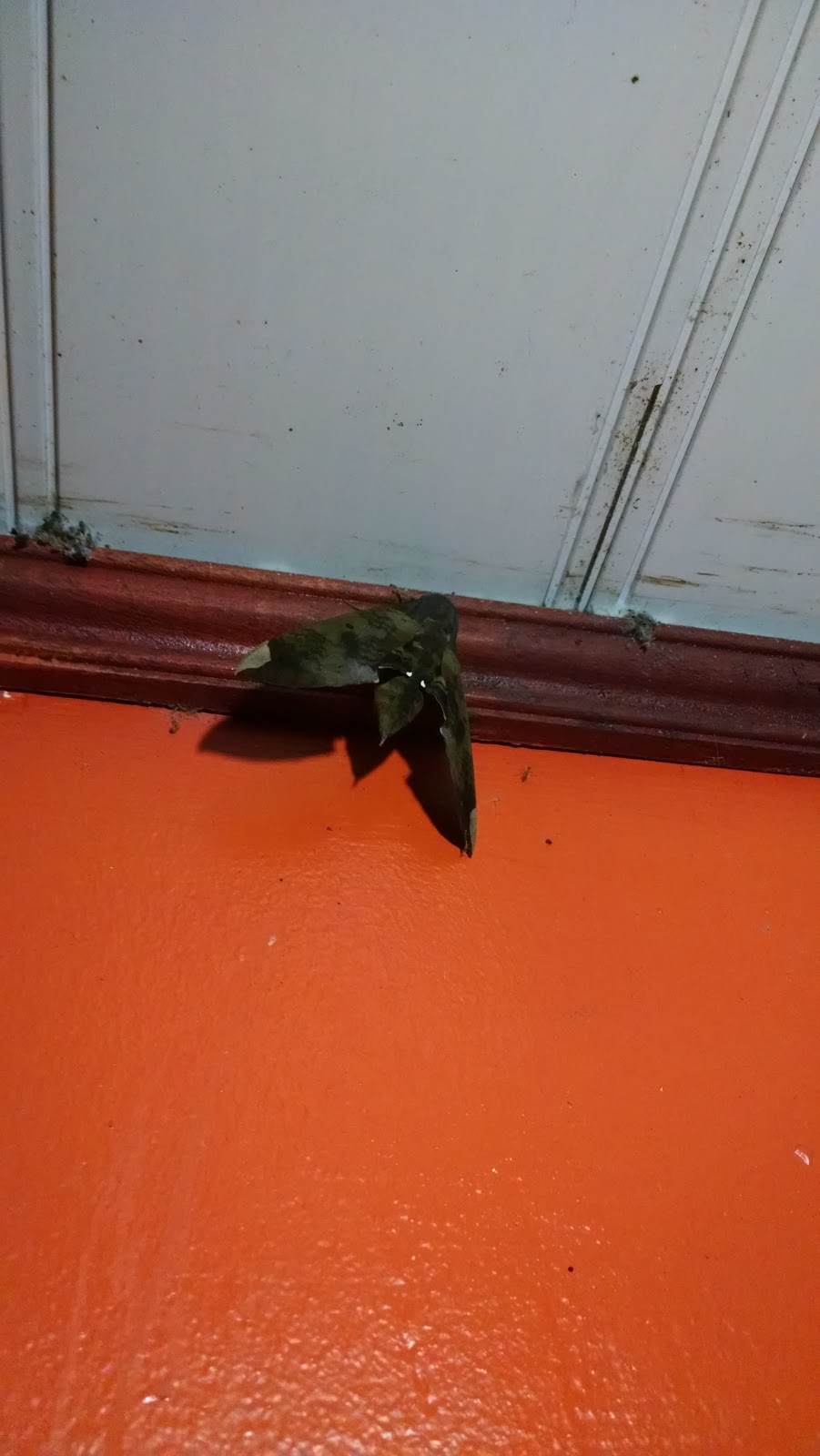
That was roughly the end of ziplining, and we went on to La Paz Waterfall Gardens, which I have decided to write about as the grand finale, because it was so beautiful.  Thus, next post will be about Lankaster Botanical Gardens.   However, before I wrap this up, I have decided to add an addendum, aka explain what Mimosa pudica, Sciurus variegatoides, and Pitangus sulphuratus are, if you haven't looked them up (and I know you haven't, because no one ever does...)  Additionally, I saw a neat moth  the night before we left Costa Rica, and I have no place to put it.  So here it is.


This insect remarkably imitated a bath in both size and wing shape.  It is the second largest moth I have ever seen, and the largest I have ever photographed (I saw a luna moth, Actias luna, in Chattanooga, Tennessee, that was possibly larger, but as I was six at the time, I did not have a camera.)  If anyone has any clue as to what species this moth is, please let me know.  It reminds me of a poplar hawk moth (Laothoe populi), and it could be in the same genus or family.

On to Mimosa pudica, the sensitive plant.  This is a tropical weed, found as far north as Georgia,  Indeed, I have a picture of one, taken in the Line Creek area of Peachtree City, Georgia, discussed in several previous blog posts.


The notable feature of the sensitive plant is that its foliage folds up when touched, hence the name.  In Costa Rica, these are referred to as sleeping plants for the same reason.  The foliage folds up at night and when touched, unfolding in roughly an hour.  I received seeds of this plant for Christmas, and I look forward to growing it.  (UPDATE- They never sprouted.)


Variegated squirrels, Sciurus variegatoides, were also seen in Costa Rica.  These are the most colorful squirrels I have ever seen.  Other than the colors, these are essentially just squirrels.

While there were occasionally parrots and once a toucan, as well as many swallows, the most notable bird was the Great Kiskadee Flycatcher, Pitangus sulphuratus, ranging as far north as central Texas and found everywhere in Costa Rica.  These are large noisy birds the size of a blue jay that flew around and caught insects everywhere.  I had no idea what they were at the time.  These are relatives of our local flycatcher species, albeit far more colorful.

That's all for now.  Happy New Year!  I hope 2016 will be an excellent year for nature, and by corollary, nature bloggers.  As a tease of the next blog post, Lankaster Gardens, this plant is one that you should recognize from your kitchen: 


Tuesday, December 29, 2015

Costa Rica, Part Two of Five? Ujarras/Coffee


Belated Merry Christmas!  While this was a mission trip, we did take about two days' worth of time (two afternoons and one full day) to explore the countryside.  The first afternoon of free time away from the camp was spent seeing the ruins of Ujarras, before driving over to a coffee plantation on the shores of Lago de Cachi.  Some members of the trip recalled a previous visit when a sloth, likely the brown-throated three-toed sloth, Bradypus variegatus. Unfortunately, no sloths were seen on this trip.  While common, sloths have excellent camoflage, partially due to algae that collects in their fur.   We did see an overlook over one of the valleys.


Growing at the overlook was the largest Opuntia cactus I have ever seen.  It was a bit of a surprise to see a cactus growing in a predominately rainy environment.


 We arrived at the Ujarras, a  World Heritage Site notable for the remains of one of the oldest church buildings in the Americas.


The crumbling walls of the old church  are an excellent haven for mosses and, as it turned out, a lizard.


This is the green spiny lizard or emerald swift, scientifically called Sceloporus malachiticus.  This was a fairly bold animal, willing to stay on its rocky ledge just a few feet above eye level as a horde of tourists looked at it.  Although it barely shows in the picture, the tail of this lizard was sky-blue.  These lizards are occasionally found in pet stores, but this was the first time I had ever seen one.  This is easily the most impressive lizard I have seen in the wild.  It is a close relative of the eastern fence lizard, Sceloporus undulatus.  Eastern Fence Lizards barely range into southern central Illinois, but are common further south in glades in the Shawnee Hills in Illinois.  A picture of it is shown below.


The other animal of interest was the leaf-cutter ant,  This ant, which could be one of several species in the genus Atta, are widespread across Costa Rica, and found nearly everywhere.  They cut leaves off of trees and carry the leaves back to the nest. The leaves are used to grow fungus inside the nest, which the ants then eat.  Essentially, leaf cutter ants are farmers.


An ant nest was discovered under this shrub.  A nearby bush, unpictured, had been completely stripped of its leaves by the ants living here.


Next we went to a coffee plantation.  Coffee is the main export of Costa Rica, and along with tourism is one of the main industries.  As it was the afternoon and the rainy season, the rain began to come down.


This particular plantation has permitted tours of its facility.  We saw the plantation, as well as a toucan high over the parking lot, too far out of range for a photograph.  The whole area, despite being a plantation, was quite lovely.  Part of this may have been due to the fact that the plantation rests next to a sizable lake, likely Lago de Cachi.


After drinking coffee provided to us at the end of our tour, we hiked down towards the waters edge.  This was a very wet area, and my group began discussing the possibility of crocodiles. Caimans are native to Costa Rica, and being from Illinois we had no idea where we might find one.  I have a picture of the general area, taken as close to the water's edge as I intended to get.  


Shortly after this, something made a large splash in the water center left of the photo, and we scurried back up the hill in some fright.  The jury's still out on whether it was a caiman or a large fish, but we had no intention of finding out.  After this, we returned back to the camp over the Rio Reventazon gorge. 


It rained all the rest of the day.  I still found one last plant, a maidenhair fern (Adiantum raddianum) This species is extremely popular to grow indoors, and indeed I used to own one.  Maidenhair ferns grew around the lodge at camp on steep slopes where only ferns and mosses seemed to grow.


That's all for now. Happy New Year, as this will likely be the last post until the new year.